
In line with GA!’s aspiration to connect current events with history, you can find this week’s headlines below, provided with additional commentary from a historical perspective.
“From Greenland to Panama and Mexico, leaders are in shock”
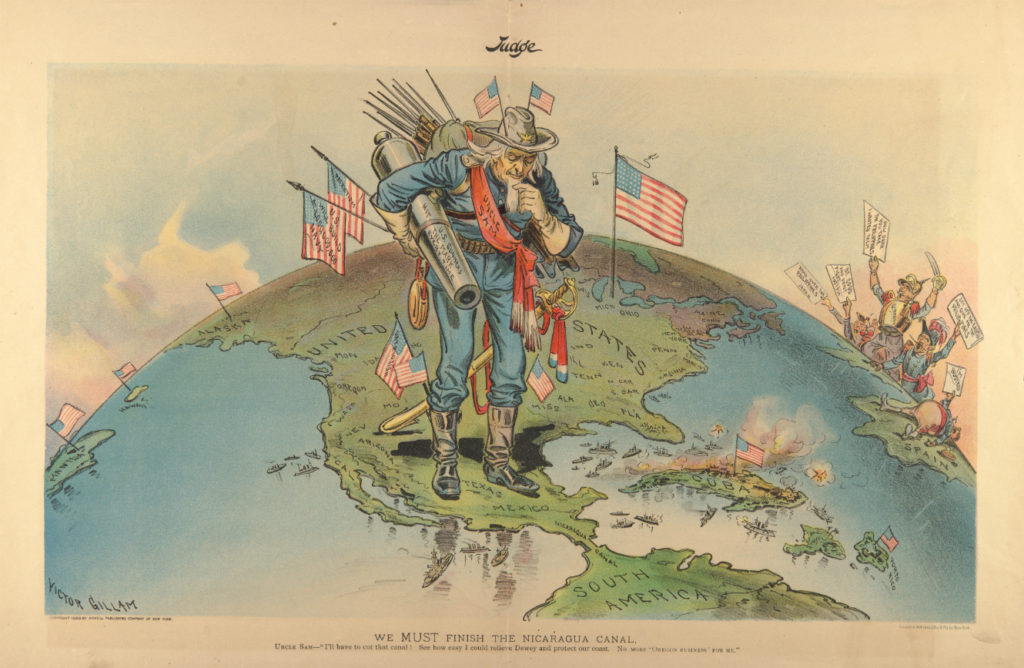
In the past few weeks before he returned to the Oval Office, Donald Trump made headlines with his comments regarding Greenland, Canada, Mexico and Panama. Trump stated Canada should become the 51st state of the US, he reiterated his desire to purchase Greenland of Denmark or annex it, claimed the US should reoccupy the Panama Canal and wants to rename the Gulf of Mexico to ‘Gulf of America.’ While these comments seem and are quite ridiculous, there is actually a strong historic precedent for it in the form of American Imperialism.
Looking at the size of the modern day United States, it is easy to forget the country gained its independence as thirteen relatively small states on what is now the US’ East Coast. Ever since independence was achieved however, there has been a push by its residents to expand westwards. As this process started, the first victims of this ‘Manifest Destiny’ were the native populations of America, many resisted but were ultimately conquered. Three big expansions during the 19th century completed the continental US. The Louisiana Purchase of 1803 vastly expanded the US’ claimed territory. After the Mexican-American War of 1846, the US completed its expansion towards the Pacific Ocean, with California amongst the gained territories. Finally, in 1867, the US purchased Alaska from Russia. What must be kept in mind is that when these territories were acquired, they were not ‘organised’, meaning there was no local system of government, besides the natives of course. In most cases, the natives were chased out of their land as the Americans established local governments. Important to note here is the Monroe Doctrine of 1823, which states the US regards the whole of the Americas as its zone of influence, which it has acted upon since in many ways.
This doctrine is the context of further overseas American expansion, started at the very end of the 19th century. The Spanish-American War of 1898 meant Spanish rule of numerous territories was replaced by American rule. This occurred in Puerto Rico, Guam and most notably the Philippines. Hawaii was annexed the same year. While the US did not formally occupy Cuba, the extent of American ownership of land did mean the country was de facto an American possession. During the first half of the 20th century, the US bought the Virgin Islands and annexed the Panama Canal Zone in 1904 upon completion of the canal. After World War Two, the US also controlled the island of Wake and Midway and the groups of islands of American Samoa and the US Marshall Islands. The Philippines eventually gained independence and the Canal Zone was returned to Panama in 1979, but the US has since hung on to many of the important strategic locations in the Pacific and elsewhere in the world.
Trump then is the first President in a long time who is openly discussing and contemplating the expansion of US territory, something which was quite common through the 19th and early 20th century among Americans leaders and lawmakers. So can Trump actually achieve any of these ideas? The likely answer is no. At least not without military force and likely disrupting alliances. Trump will want to enhance his cooperation with Greenland for strategic purposes. This cooperation does already exist as the US and Denmark have invested in air bases which can house F-35’s. Canada could be hit with harsh tariffs but this applies to virtually every country which has a trade deficit with the US. Trump has claimed Panama is giving China preference for use of the Canal but this is very far from the truth as American ships are by far the largest customer of the Canal, so what Trump actually wants in this case is rather unclear. All of these threats do indicate Trump is eager to extend and enforce the American zone of influence throughout the Americas. Trump’s demands then can be understood as a very open return of the Monroe Doctrine to American foreign policy. How this will actually play out will become clear over the coming four years.
“Negotiators zero in on potential deal to disarm Syria’s last battleground”
Ever since rebel group HTS took over Damascus in early December and ousted dictator Bashar al-Assad, commentators have wondered how the whole of Syria can once again be brought under central rule. The main group for whom this question is highly relevant, are the Syrian Democratic Forces (SDF). This group is the US’ and the West’s main ally in the country but is simultaneously a foe and torn in the sight of Turkey. This is because of the group’s Kurdish elements.
The Kurds are an ethnic minority spread across the Middle-East, mostly living around the area where the borders of Turkey, Syria, Iraq and Iran meet. The group has often been the victim of oppression and many independence movements poised to create a Kurdish state have failed. Most Kurds live in Turkey where there has been a decades old struggle with the central government for more autonomy. The most famous group fighting for this autonomy is the PKK or Kurdish Workers’ Party. This group has been designated by the West and Turkey as a terrorist organisation for its many attacks inside Turkish Kurdistan.
The SDF was formed during the Syrian Civil War to fight the Assad regime but was subsequently armed and supplied by the West, mostly to fight ISIS. The group did so successfully with Western air support and defeated ISIS definitively in 2019. The group has since been the de facto government of the triangle of land in Syria east of the Euphrates river.
Now Assad is gone, the question has risen on what to do with this group. Potentially, any debate about or with this group would rather easily reignite Syria. The West would like to see the relatively well organised group have some role in the new Syria because of their experience in fighting ISIS as well as their relatively positive stance on human rights. But a formal role for this group, or autonomy for them in their region is an absolute no-go for Turkey. The Kurds and the PKK are a continuous source of upheaval in Turkey, according to the Turks themselves. The Turks fear any autonomy for the SDF would mean a safe haven for PKK fighters and a step towards a potential Kurdish state if the SDF somehow allies itself with the already existing autonomous Kurdish regions of Iraq.
In the days after the HTS takeover in Syria, there were skirmishes between HTS and the SDF, mostly around the city of Deir ez-Zor, which sits on the banks of the Euphrates. What further complicates matters is the fact that HTS is sponsored by Turkey. However, after those initial skirmishes, negotiations have since started to determine what the role of the SDF should be in the new Syria. Early signs now indicate these negotiations may be successful in satisfying all parties involved and thus preventing the Syrian Civil War from restarting between HTS and the SDF with likely strong Turkish involvement. It’s still early days, but Syria may take another important step towards guaranteeing a new stable future.
“A hidden refuge in Sudan that the internet, banks—and war—can’t reach”
While slightly hopeful signs can be seen in the multiple conflicts in the Middle East, the brutal civil war in Sudan continues to rage on. The conflict seems to have entered a new phase which could see the complete fracturing of the countries into multiple de facto states, all ruled by the various fighting entities. We wrote about Sudan in this previous report. The Economist reports about the visit of one of their correspondents to the Nuba Mountains in this article. This mountainous region near the border with South Sudan has become somewhat of a safe haven in the civil war. 1 Million of the country’s 11 million displaced people have come to Nuba. The area is governed by neither the SAF (Sudan Armed Forces) or the RSF (Rapid Support Forces), the two main fighting parties. The Nuba Mountains are being run by a rebel group known as the Sudan People’s Liberation Movement–North (SPLM-N), the region has no mobile-phone network, no paved roads and no electricity infrastructure. This is a result of the strategy the government army, the SAF has adopted towards the different rebel groups. Its strategy is to besiege the regions where the rebel groups are in power, cutting those regions off from the rest of the world completely. Similar to the Nuba region, this strategy has also been applied to the Darfur region where the main rebel group RSF is active. Because the strategy is siege, the rebel groups are now actively rebuilding government systems and other types of infrastructure in the territory they hold, effectively creating new states which are not ruled and cannot be controlled from Khartoum. With these dynamics now taking place, we may see a situation as in Syria before the fall of Assad or potentially, we may see the rupture of Africa’s third largest country.
“The start of a fragile truce in Gaza offers relief and joy”
Last Sunday, the guns finally fell silent in Gaza after 15 months of war. A fragile ceasefire, definitively negotiated on January 15, went into effect with a three hour delay on Sunday morning. This deal is supposed to be in effect for the coming six weeks, during which Israel and Hamas will exchange Palestinian prisoners for Hamas’ hostages which it took on October 7 and the IDF will leave its positions within the Gaza Strip. Besides the exchange of hostages and prisoners, aid for Gaza is supposed to be delivered, by a quantity of at least 600 trucks per day. During these six weeks, negotiators are meant to work out the final details which could lead to longer, more stable truce. However, there are many obstacles to overcome if this is to come about. The first of these obstacles is the lack of agreement on who should govern Gaza. For Israel, any government including Hamas is unacceptable while simultaneously the only alternative, the Palestinian Authority, has been gone from Gaza since 2007 and has not exactly won popularity with the Palestinian population on the West Bank. Another obstacle is the domestic political situation in Israel. The now infamous extremists Ben Gvir and Smotrich in Netanyahu’s coalition have been against any ceasefire deal throughout the war and continue to oppose any negotiations. They could thus sabotage the deal internally or the coalition would fall. If that is the case, it is possible Netayahu could find support among moderate Israeli politicians, but nothing is certain. For the coming six weeks then, the population of Gaza can likely catch their breath after 15 months of destruction. What is in store for them over the long term however, is in the dark.
“Taliban deputy foreign minister calls for girls’ high schools to open”
In Afghanistan, a member of the government has publicly criticised the regime and said girls should once again be allowed to attend high school. Sher Mohammad Abbas Stanekzai, the deputy foreign minister, went on local broadcaster Tolo and asked “the leaders of the Islamic Emirate to open the doors of education.” Women and girls were banned from education in Afghanistan during the 1990’s when the Mujahideen and Taliban were in power. Before this period, during the Afghan Kingdom and communist rule from 1933 until the late 1980’s women enjoyed a very good position in Afghan society. When the Americans invaded Afghanistan after 9/11 and started their programmes of nation building, one of the priorities was the reinstatement of the rights of women. This was successful in the cities and area’s which were in the hands of the central government, but in areas controlled by the Taliban this was of course not the case. A similar situation existed during the aforementioned period in Afghanistan when the position of women was relatively good, rural areas were often not fully controlled by the central government and thus took a more conservative approach to women’s rights. When the Taliban took over again in Afghanistan in the autumn of 2021, they initially promised to uphold many of the progress made during the twenty years of American presence. However, schools soon closed their doors for girls once again. Stanekzai now said: “In the time of the Prophet Muhammad, the doors of knowledge were open to both men and women. Today, out of a population of forty million, we are committing injustice against twenty million people.” Whether these comments from a high ranking member of the government may be the first signs of a turn in Afghanistan will have to be seen, but is certainly an interesting development to keep an eye on.
“TikTok restores US service after Trump says “we have to save it”
As Donald Trump reenters the White House, one of his first acts will likely be to make sure TikTok remains available for the American market. This is remarkable because it represents a complete turn by Trump himself and with this stance, he goes against Congress and many of his fellow Republicans. In 2020, Trump was still strongly opposed to TikTok since it is a Chinese owned company and was thus feared to be used to influence America domestically. Many lawmakers in the US agreed since the competition between the US and China has increased. In April of 2020, Congress passed the Protecting Americans from Foreign Adversary Controlled Applications Act (PAFACA). Under this act TikTok could be banned, especially after the Supreme Court ruled in favour of the US government in a case TikTok had brought before the court. This weekend, TikTok was briefly unavailable in the US. However, in a complete reversal of his previous position, Trump now was to ‘save’ TikTok. He intends to achieve this by making sure the company becomes an American company, meaning it would no longer fall under the PAFACA. If this is not achieved however, and at the moment it seems unlikely TikTok can easily and quickly be acquired by an American party, TikTok will likely become unavailable again in the US. Trump has said he will sign an executive order to prevent this from happening again for the coming 90 days, during which time the app will then have to be acquired by an American party. Trump has praised the app because it helped him win the elections and many other right-wing politicians also need the app to spread their message, particularly among young voters. The reasons for maintaining the app are thus clear and rational for these politicians. Whether they succeed in keeping TikTok will have to be seen.



Leave a Reply