
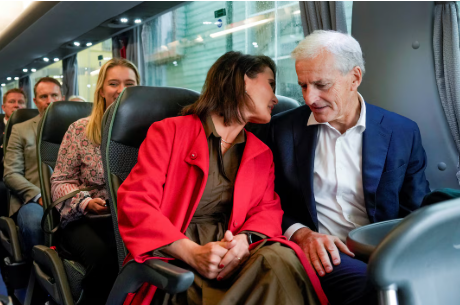
Norwegians to pick new parliament in tightly fought election clouded by geopolitical angst
Today, Norway is holding its parliamentary elections, as Norwegians head to the polls. Election polls mainly show it is a race between the Arbeiderpartiet (AP) of incumbent Prime Minister, Jonas Gahr Støre, and the right-populist, Progress Party (FrP).
The current government is a single party minority government consisting of the AP with parliamentary support of the populist agrarian Senterpartiet (SP) and the left wing, Sosialistisk Venstreparti (SV).
Should AP remain the largest party as the polls project, then come 2027, it will have been the largest party in the Norwegian parliament for 100 consecutive years. AP has also governed Norway for more than half of the last 100 years. The party was down in the polls for much of 2022 and 2023, but scandals facing its opposition coupled with decisions such as bringing back former Prime Minister turned NATO chief, Jens Stoltenberg, helped AP take the lead this year.
In second place, is the FrP, which is riding the anti-establishment wave many countries are going through at the moment. The party has also taken a libertarian position on government spending and economic policies, favouring less spending and lower taxation. Aside from its economic libertarianism, Progress has taken traditional populist-right positions such as maintaining a eurosceptic line, opposing further integration with the European Union (which Norway is not part of but has many agreements with), and maintaining a hardline against increased immigration.
The election poses for Norwegians, a very stark choice between a pro-EU, welfarist, social democratic establishment in the form of AP, and a populist, libertarian, eurosceptic FrP.
On one hand, the centre-left establishment party, which has ruled over the country the past 4 years and many times before. AP represents established figures like Støre and Stoltenberg, generally favours increased cooperation with the European Union along with maintaining Norway’s traditional high tax, high welfare spending policies.
Since Støre came to power the Russian invasion of Ukraine has made war in Europe a reality, shifting security priorities for the EU and NATO. Norway is not a member of the EU, but is a member of the European Economic Area (EEA), being obligated to follow many (but not all) agreements and rules that EU members must follow. Additionally it is a vital part of NATO, and its presence in the arctic and border with Russia have made the new security situation in Europe even more tense for Norwegians.
The recent re-election of Donald Trump as President of the United States only worsened the situation, as Trump’s tariff policy coupled with his mixed messaging on NATO has worsened anxiety in Europe over its relationship with the U.S. regarding security and economic cooperation.
Additionally the War in Gaza and the humanitarian disaster it has caused is another major issue. Norway’s government has been among the most critical of the Israeli state. In May 2024, Norway, along with Ireland and Spain officially recognised the State of Palestine. This was a step many nations in Europe have not yet done, including Germany, the United Kingdom, Denmark, and the Netherlands. Additionally, last month, Norway’s sovereign wealth fund, cut off relationships with several Israeli firms.
Some experts argue this instability has helped cause a rally around the government effect, giving the incumbent AP an advantage as voters seek a steady hand to remain in charge in the coming years. However there is still a large contingent unhappy and seeking a massive change in direction for the country.
FrP poses a strong contrast to the AP in most issues. It remains committed to Norway staying out of the EU and opposes integration, though it has softened its position of EEA. The party maintains a good relationship with Trump, with former politicians of the party nominating Trump for a Nobel Peace Prize back in 2019. The party also traditionally was very supportive of Israel, though as public opinion in Norway has turned against Israel, the FrP, has softened its stance saying they believe Israel has gone too far. However the party still puts the majority of the blame of the war on Hamas who they say can end the war.
However the most stark issues of the election have been economic. Norway’s wealth tax has been a major issue with many on the political right, including FrP calling for it to be scrapped saying it discourages investment and unfairly targets businesses.
In the past several years, stories of Norwegians relocating, mainly to countries like Switzerland to evade Norway’s high taxes have made the news. Norway’s government even tightened rules regarding relocation and its exit tax to discourage businesses and wealthy individuals from leaving.
Additionally, the publication of the book “The Country That Became Too Rich”, this year, by Norwegian economist Martin Bech Holte has further fueled this debate. Holte has argued Norway’s oil wealth and subsequent strong welfare state and sovereign wealth fund has made the country unproductive, the state bloated, and claims the country is now lagging behind.
This viewpoint has been embraced by the FrP. The message is also being repeated by the Høyre (H) led by former Prime Minister Erna Solberg. Earlier in Støre’s premiership, the Conservatives benefitted from public sentiment against him, but in 2023 a major scandal broke regarding Solberg’s husband’s stock trading during Solberg’s premiership. This coupled with increased polarisation ultimately led to them falling to a solid third.
Other parties in the election include SP, which was in a minority government with AP until the beginning of this year. The government collapse this year was due to disagreement over adopting EU directives regarding energy. While AP favours more EU cooperation, SP remains quite Eurosceptic and populist. They opposed the EU energy directives which aimed to increase renewable energy and encourage more energy-efficient infrastructure construction. Despite leaving they still provide parliamentary support to the current government.
The Green Party known as Miljøpartiet De Grønne (MDG) also have benefitted thanks to increased attention on Gaza and Climate Change, two issues where the Greens benefit from public anger at a lack of stronger action taken by the government.
Norway has a bloc system with the Left bloc consisting of AP, SP, SV, MDG, and the far left party Rødt (R) and the Right bloc consisting of FrP, H, as well as the liberal party Venstre (V), and the Christian Democratic party Kristelig Folkeparti (KrF).
It is worth acknowledging that Norway has a 4% threshold with both KrF and V barely surpassing it and at major risk of losing representation. Due to the bloc system, smaller parties have a larger influence in election outcomes as whether they cross the threshold can completely change the balance of power.
MDG was also in this position previously but a recent surge has put them somewhat comfortably above that. Meanwhile other left parties like SV and R remain stagnant at around 6-7% each.
Whatever Norway’s election results are, it could have significant consequences, for the EU, for NATO, and for the Norwegian welfare state itself.


Leave a Reply