
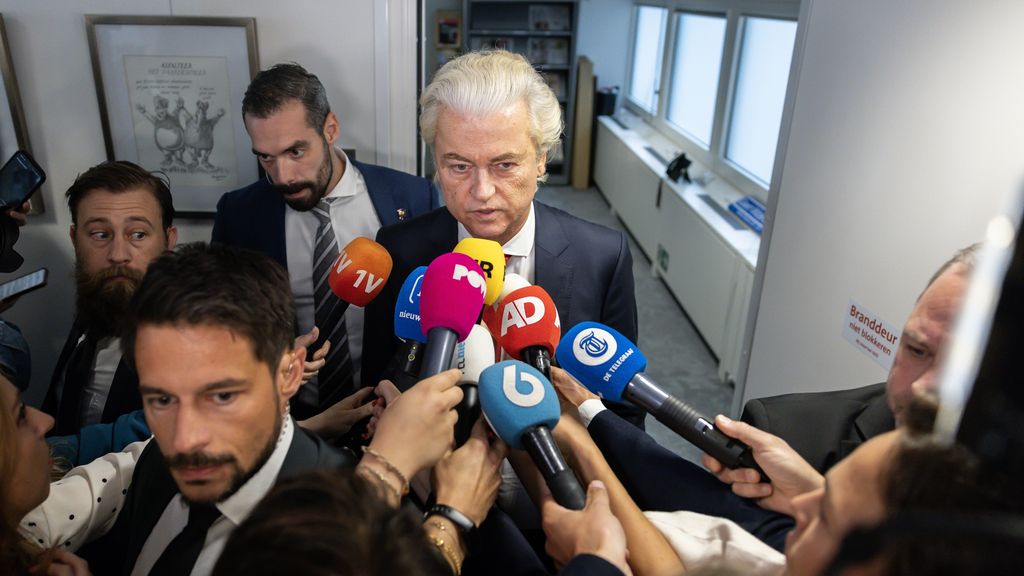
Wilders breaks with coalition, withdraws PVV members from Schoof cabinet
Leader of the far-right Party for Freedom (PVV), Geert Wilders, has announced that PVV is leaving the government coalition.
The Netherlands has been led for the last 11 months by a right-wing cabinet consisting of the centre-right New Social Contract (NSC), the centre-right to right-wing People’s Party for Freedom and Democracy (VVD), the right-wing Farmer–Citizen Movement (BBB), along with Wilders’ Party.
The Prime Minister (PM), rather than being one of the party leaders, is a former civil servant, Dick Schoof, who was not a member of any party.
Schoof was a member of the Labour Party (PvdA) until 2021. However, he was not actively involved in politics beyond his party membership. His premiership was chaotic, with many viewing him as not the real Prime Minister but a puppet of the party leaders. He was picked after months of negotiations between the parties.
Wilders’ party came in first in the 2023 Dutch elections. This would usually mean he becomes Prime Minister, something he wanted, however he was seen as too controversial, with the other parties vetoing him.
Despite not being the Prime Minister, Wilders had a tremendous influence on the cabinet. At times, he acted as a peacemaker, notably when the cabinet almost collapsed, early in its tenure, in August 2024. Other times, his party’s ministers would cause tension within the cabinet due to xenophobic remarks.
Not long after the cabinet was formed, PM Schoof was forced to answer for racist comments made by PVV ministers about hijabi women, and his condemnation of said remarks led to Wilders chastising him.
The cabinet had many close calls, with many speculating that it would collapse over the recent spring budget.
Ultimately, however, the cabinet’s fall was mainly due to migration. Migration is Wilder’s signature issue, on which he has built his popularity. He was elected, in part, to implement a more restrictive migration policy. However, due to pushback from the NSC (and occasionally the VVD), the cabinet has not implemented significant reforms to migration.
The prominent opposition leader, Frans Timmermans, has refused to support a minority government. He leads the joint list of PvdA and another left-wing party, GroenLinks (GL/PvdA). GL/Pvda is the only force in parliament that has enough seats to sustain a government. This means the Netherlands is heading for new elections, announced for October 29.
So, what are the main stories going into this election? Wilders will have to make the case to disappointed voters that he is not responsible for the lack of action regarding migration. Whether he can pin the blame successfully on his coalition partners, the NSC and VVD, remains to be seen. Wilders began his career in the VVD before leaving in 2004, over the VVD’s support for Turkish ascension into the EU.
He then founded the PVV in 2006. In 2010, the VVD became the largest party for the first time, governing with the Christian Democratic Appeal (CDA). Wilder’s former colleague and friend Mark Rutte became Prime Minister in the Rutte I cabinet. The PVV provided a confidence and supply agreement to this government. However, it collapsed in 2012, following Rutte I’s imposition of a series of austerity measures during the Eurozone crisis.
His party was ruled out from then until 2023. That year Rutte announced he was leaving politics and was replaced as leader of the VVD by Dilan Yeşilgöz. When asked if she would coalition with the PVV, Yeşilgöz, said she would not exclude Wilders and opened the door to governing for him. This, among other factors, helped Wilders win over pragmatic right voters.
Wilders built his career as a firebrand against immigration, Islam, and the European Union. His style of politics made him one of the most effective opposition politicians, moving discourse to the right. However, when faced with the responsibility of governing, Wilders has failed to adapt his party the way other far right politicians, like Giorgia Meloni, have.
On the left, GL/Pvda is holding a convention in the coming weeks to decide to merge once and for all. The two parties have been integrating for years, following the PvdA’s loss of 75% of its seats in 2017, which forced it to redefine itself.
The CDA, after years of decline, has managed to resurrect itself despite the splinter parties, the BBB and NSC, which mainly took its voters, both having collapsed in polling.
And, of course, the VVD faces the choice: does it rule out Wilders, killing his credibility as a governing party again, but leaving it open to attacks from the right who say they are handing the country over to the left? Or does it refuse, leading to attacks from the left and centre accusing them of being irresponsible and propping up the far right?
The election is months away, but the main parties have already entered campaign mode, as you can expect attacks to heat up in the coming months.
Conservative historian wins Polish presidential vote
Poland held a close and consequential Presidential election on Sunday, with a second-round runoff between Rafał Trzaskowski, from the ruling Civic Coalition, and Karol Nawrocki, supported by the Law and Justice Party (PiS), the party of the current Polish President, Andrzej Duda.
The election was crucial as centre-right and pro-EU Prime Minister Donald Tusk is dependent on the president to get much of his agenda passed. Despite winning power from PiS at the end of 2023, Tusk has had much of his agenda blocked by Duda, whose term did not end until this year. The hope for Tusk and his supporters is that Trzaskowski would allow the government to implement its agenda.
Poland’s adherence to the rule of law has been a significant source of contention between Poland and the European Union (EU).
The PiS tenure of 2015-23 was notable for seeing the EU openly condemn the Polish government’s anti-democratic moves. It put a key judge-appointing body under its political control, resulting in condemnation by the EU and international watchdogs. The EU even froze funds due to accusations of Poland politicising the courts and justice system. The Commission has since unblocked the frozen cash.
Tusk had been Prime Minister from 2007 to 2014 before becoming President of the European Council from 2014 to 2019. His return to Polish national politics was primarily driven by his desire to restore the rule of law and improve relations with the European Union.
However, his second premiership since 2023 has seen slow progress with little change. Tusk has blamed this on Duda. Tusk’s government has attempted to undo several reforms that PiS implemented during its time in power, which significantly damaged the rule of law. However, Duda has successfully blocked many of these reforms.
While the Presidency should be largely symbolic as in other parliamentary systems, the President has veto powers and can block the Prime Minister’s agenda if he deems fit. Duda has blocked many key reforms. In addition, Tusk aimed to liberalise the country’s abortion law but has also failed here thanks to stonewalling by Duda. Tusk and liberal Poles may have had hopes that in Trzaskowski, they would finally have a President supportive of their agenda and one who would not block every reform they made.
However, these dreams have been dashed as Nawrocki won with just 50.89% of the vote. Nawrocki, despite continuing support for Ukraine, opposes Ukrainian membership in NATO and the EU.
He is also a sovereigntist, opposing Poland’s extensive integration into the EU.
While Trzaskowski and Tusk want Poland to be a leader in the European project, utilising alliances with France and Germany, Nawrocki sees Poland’s path as more independent. While he does not necessarily want to leave the EU or NATO, he does not wish to cede further power to them.
Nawrocki also opposes EU plans for migration and climate.
However, Tusk has also taken a more right-wing position on those issues, opposing the EU Green Deal and migration relocation schemes. So, even if Trzaskowski won, Poland would likely still push against pro-migrant policies and the Green Deal.
Arguably, the most significant blow comes to abortion rights activists. Poland has among the strictest abortion laws in Europe. The PiS government implemented a near-total ban in 2020. Now, the hope for reform is dashed for another five years as Nawrocki can veto any reform made by Tusk and his government.
Poland’s election results represent a significant loss for the EU, as it faces increasing uncertainty from the U.S., a renewed Russian threat, and the growing influence of China looming in the background, leaving Europe’s divisions open and its ideas about its future in conflict.
Nawrocki’s win was, however, razor-thin, indicating that the divide between those who envision their future in Europe and those who see it in their country remains alive and ever-present.



Leave a Reply