
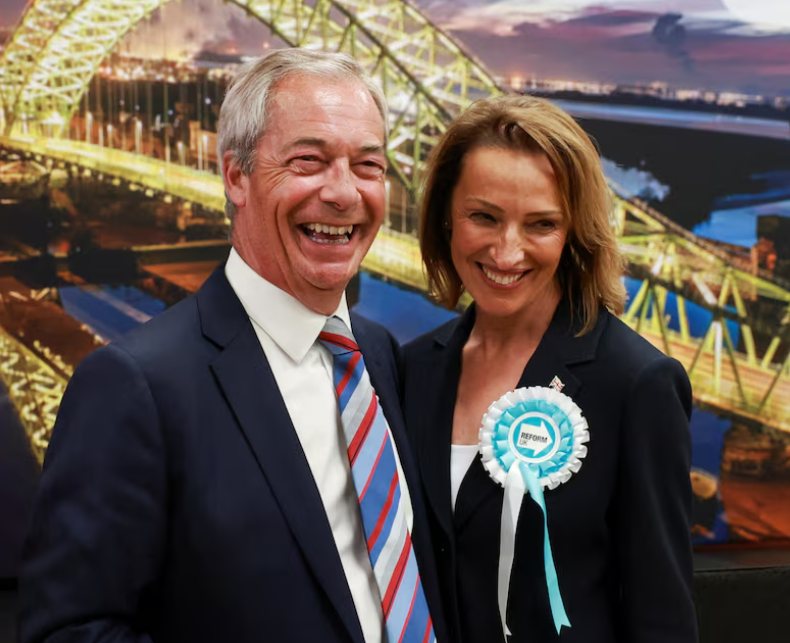
Farage’s Reform UK Party wins mayoral and parliamentary post in surge of support
Britain held its local elections on May 2, and the country is still reeling from the shockwave of its results. Labour, the incumbent party, lost 187 seats in Council elections. Meanwhile, it won three mayoral races, all by razor-thin margins. Two of them had the new Populist Right Reform UK around 1% behind Labour. For clarity, the council and mayoral elections are separate elections.
The main opposition, the Conservative Party (Tories), has been noted for being absent from the political conversation. The party suffered a massive loss last year and has ceded ground to Reform UK, which is expected to overtake them and potentially win the next General Election.
The Tories lost 674 seats. The Conservatives ruled Britain from 2010 to 2024. The party won outright majorities from 2015-17 and 2019-24. The 2010 victory came after 13 years in opposition to Tony Blair and Gordan Brown’s Labour Party.
In 2010, Tory leader David Cameron was elected, and a coalition government was formed with the Liberal Democrats. Coming off the 2008 financial crisis, the government imposed a series of austerity measures that many said in later years, put a stranglehold on the British economy, made the country poorer, and slowed down growth. However, the consequences of these policies were not truly felt until much after Cameron left.
Cameron’s most significant action in his term was greenlighting a referendum on British membership to the EU. Reform UK, which is currently gaining ground, is led by Nigel Farage. Before Reform UK, Farage led the United Kingdom Independence Party (UKIP), which slowly was gaining ground in the run-up to the 2015 UK election. In order to steal voters back from UKIP, Cameron promised a referendum on British membership in the EU, UKIP’s signature issue. On June 23, 2016, British voters chose to leave the European Union in what is called the Brexit referendum.
Cameron, who personally supported membership and campaigned against leaving, resigned and was replaced by his Home Secretary, Theresa May. May was put in charge of negotiating a deal, but she failed to do so and resigned in 2019.
She was replaced by former London Mayor Boris Johnson, who called for a snap election, won a substantial majority, and pushed Brexit through. However, Johnson would be brought down later as the Tories began collapsing in polls in 2021 following revelations of senior ministers violating COVID lockdown rules they had imposed. Johnson resigned in July 2022.
He was replaced by Foreign Secretary Liz Truss, who broke the record for the shortest tenure. In her mini-budget, she announced a series of tax cuts, which collapsed financial markets and ultimately brought down her government in just a month and a half.
Finally, Rishi Sunak, the Chancellor of the Exchequer under Johnson, took over. Sunak’s tenure was marked by the Tories remaining behind Labour in the polls for over a year and a half. He attempted to deal with the various crises Britain faced, but he never won public trust back for the Tories.
Following a catastrophic defeat in last year’s elections, the Tories have gradually ceded more and more ground to Farage and Reform, which many treat as the real opposition. Reform won 677 seats on Friday, easily being the night’s biggest winners.
They were followed by the Liberal Democrats, who won 163 seats.
While the Tories gradually lost trust over 14 years, Labour’s loss is far more rapid. In 2010, Labour suffered massive losses under Gordan Brown, the incumbent Prime Minister during the 2008 financial crisis. Labour lost a further 26 seats in 2015.
Later that year, it elected Jeremy Corbyn, someone firmly on the party’s left and the first open socialist party leader in decades. Corbyn’s tenure saw some success, such as making substantial gains in 2017 and denying Theresa May her majority, arguably killing her chance to negotiate Brexit. However, it was also marked by infighting, with many in the party establishment and centre opposing Corbyn. Additionally, allegations of anti-schematism further weakened the party. In 2019, all these factors and a muddled message on Brexit meant Labour saw its worst result since the 1930s, and Corbyn resigned.
In 2020, Keir Starmer was elected. While initially running to the left, he scrapped almost all his leadership pledges and moved the party to the centre and, in some cases, to the right on issues such as the economy, immigration, and transgender rights.
Starmer’s leadership tenure faced criticism, especially from the left, for inauthenticity, but the Tory’s unpopularity allowed him to remain on top as the only realistic alternative. However, now that he is in power and made unpopular decisions such as cuts to the Winter Fuel Allowance and disability benefits, refusing to scrap the two-child benefits cap imposed by the Tories, among other things, he has faced a collapse in popularity.
Additionally, many left-wing and young voters are defecting to the Liberal Democrats, now more socially progressive to Labour, and the Greens, who are socially and economically to the left of Labour. This is because many young progressives no longer feel represented by Starmer’s cautious moderation and rightward shift on key cultural issues. Labour has promised among other things to increase deportations of irregular migrants and Starmer has reiterated throughout his leadership that he believes a woman is a “adult human female,” a definition that excludes trans-women and is seen by many as bigoted and discriminatory.
Meanwhile, other working-class and populist voters defected to reform out of genuine anger at the two-party duopoly of Labour and the Tories, which have dominated British politics for over a century. Many working class voters argue that Labour has not done enough to stop the flow of migrants into the country. Others again oppose Labour’s cuts to various social services and benefits in their quest to reduce the country’s debt. These cuts come after 15 years of austerity politics that have left the country poorer and with slower growth than before.
What is the future of British politics? We will have to see, but it seems clear that the two party duopoly is collapsing. Both the Tories and Labour have had a century to shape British politics. Now it seems clear the British voter wants something new. In the early 20th century, this propelled Labour to replace the Liberal Party which previously competed with the Tories. Now both Labour and the Tories are facing the consequences of more than a decade of policy failures leaving the country poorer than it was just two decades ago.
Australia PM Albanese makes stunning comeback with landslide win
Two weeks ago, we covered the impact United States President Donald Trump was having on the Canadian and Australian elections. Now, with both elections finished, the trends we were seeing have materialised with the victory of Carney’s Liberals in Canada and in Australia the landslide comeback by incumbent Labor Prime Minister Anthony Albanese. As a note, when referring to Labor, I am speaking of the party in Australia and when referring to Labour, I am referring to the one in Britain.
As of now, Labor has a strong majority. It needed 76 seats for one; it secured just under 90. The Liberal-National Coalition, meanwhile, has around 40. Several seats are still close to call, but Labor’s victory is clear.
The Coalition was led by Peter Dutton, who is from the right wing of the Liberal Party. He has often been compared to Trump for his populist style and right-wing policies, especially toward migration. Dutton praised Trump in the past, including on his plan for the U.S. to annex Gaza. He has frequently been compared to Trump, something that has become a stark negative in recent months amid Trump’s threats of annexation of allies, attacks on Ukraine, and talk of a trade war.
Dutton, for his part, tried to make the case that he would be best suited to deal with Trump. He cited his experience as a cabinet minister during Trump’s first term in the Turnball and Morrison governments. Perhaps his right-wing views, which he shares with Trump, could allow him to act as a bridge between Trump and other Western allies. This was the approach of Giorgia Meloni, the Prime Minister of Italy. Could Dutton replicate this?
Unfortunately, this pitch did not satisfy Australian voters, who punished the Coalition and Dutton himself. He lost his own seat on election night, much like Canadian Conservative Party leader Pierre Pollievre. This was a stark rejection of Dutton’s politics which often aligned with Trump on issues such as Gaza and immigration. To add further insult to injury, when asked about Dutton, Trump told the press he had no idea who that [Dutton] was.
He then praised PM Albanese, whom he said he was very friendly with. Albanese had struck a more conciliatory tone with Trump in the past, something that brought him much criticism. However, he can point to Australia being among the nations that received the lowest tariffs when Trump unveiled his “Liberation Day” tariffs.
Albanese’s victory was undoubtedly a surprise for multiple reasons. He broke the incumbency curse as incumbents worldwide have struggled to win elections in the past several years due to a growing cost of living crisis, significant housing shortages, and increased instability following the COVID-19 pandemic and the Russian invasion of Ukraine. Unlike other incumbents, Albanese was able to both win and strengthen his own mandate, winning an outright majority as incumbents across the world lose election after election.
In the U.S., Trump failed to win his second term when he was an incumbent in 2020 but won in 2024 when he faced the incumbent Vice President, Kamala Harris. The incumbent Conservatives were wiped out last year in the British general election. Now, Labour, which won last year, just suffered massive losses in the local elections. The CDU in Germany lost in 2021 after 16 years in power, and the SPD, which replaced them, just lost in February after only 4 years in power.
Secondly, within Australia, he is the first Prime Minister to win back-to-back elections in 20 years. The last one was John Howard, who won four times, the last one being in 2004. Labour won twice in 2007 and 2010 but with different leaders. The Coalition won three in 2013, 2016, and 2019 with three different leaders.
The biggest losers of the night, arguably, are the Greens, who lost all their seats in the lower house, as left-wing voters strategically rallied around Labor. Many voters who would have voted Green chose to vote Labor tactically in order to prevent a right wing government. Earlier projections had them winning one or two seats, but those seats were flipped in the days after election day. On Wednesday, Green leader Adam Bandt lost his seat in Melbourne, leaving the Greens at 0 seats.
Other parties, such as One Nation, remain stable at one seat. The One Nation Party is a far right party that denies climate change, globalism, and is anti-migration.
The Teal Independents, a group of independents often lumped together, have also remained stable. They are known for pushing for increased action to mitigate climate change by reducing greenhouse gas emissions along with improved political integrity and accountability. They typically represent local areas and have grassroot campaigns.
However, unlike in Albanese’s first term, when they, along with the Greens, held the balance of power and could push Labor left on certain policies, Albanese’s landslide victory means Labor has far more freedom to pursue its own agenda for the next term.



Leave a Reply