
Judge demands to know if White House is helping return wrongly deported Maryland man
The administration of United States President Donald Trump has faced condemnation recently after it was revealed that it deported Kilmar Armando Ábrego García, a Maryland man accused of being a member of the notorious gang MS-13. Despite the accusation, García has never been convicted of any crime, nor has any connection to the gang been proven.
His case ended up going to the courts, all the way to the United States Supreme Court. During court proceedings, administration officials conceded that García’s deportation was due to an administrative error.
García came to the U.S. from El Salvador illegally around 2011 in the hopes of escaping the local gangs in his home country. He was granted protection from deportation in 2019 due to concerns that the local gangs in El Salvador would target him.
Until recently, El Salvador was notorious for some of the worst gang violence in the world. That has gone down in recent years, which some credit to the hardline approach of Salvadoran President Nayib Bukele.
Bukele has faced praise and condemnation for his approach. His proponents say he has restored order to the country and brought the gangs in line. In 2019, when he was sworn into office, El Salvador had a homicide rate of 36 per 100,000; in 2024, it was just 1.9 per 100,000 people.
Critics say he is an aspiring autocrat whose government is notorious for various human rights abuses and attacks on the press. Salvadoran prisoners face brutal conditions, including being locked with rival gang members, being forced to stay awake for 23 hours, and several other measures condemned by human rights activists. The most notorious of these prisons is CECOT, where the Trump administration has now begun sending alleged criminals (without trial).
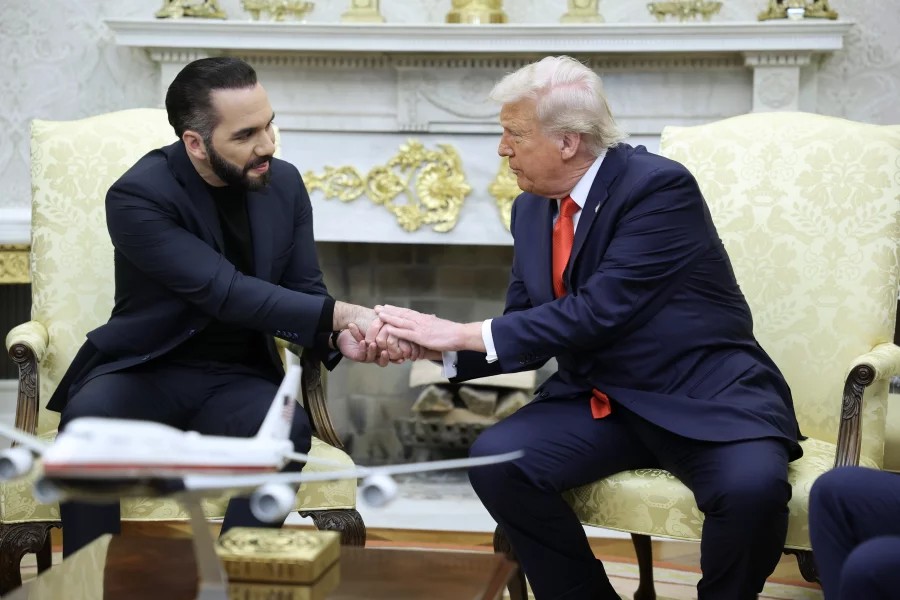
Bukele has offered to host deported U.S. illegal migrants and criminals in Salvadoran prisons. Bukele and Trump hosted a press conference in the White House on Monday. When asked, Bukele said, of course, he was not going to return García to the U.S., calling him a terrorist, following the line of the Trump administration. Despite him not being convicted of any crime and courts ordering the administration to try and facilitate his return, the administration says it will not do so.
A Maryland judge is now ordering a two-week “expedited discovery” process to determine whether administration officials are acting in bad faith. Evidence for this includes the press conference with Trump and Bukele. During the press conference, Trump administration officials said that the courts sided with them despite this being demonstrably untrue.
However, it is worth remembering that Trump will hardly be the first president to take on the courts.
Andrew Jackson, the 7th President of the U.S. and one of Trump’s idols, famously said, “The Supreme Court has made its decision, now let them enforce it”, in reference to the court ruling against his plans to forcibly relocate Native Americans. His Indian Removal Policy would go through despite opposition from the courts.
But it wasn’t just Jackson who got away with it. U.S. Presidents Jefferson, Lincoln, and Roosevelt (Franklin) all had spats with the courts. Jefferson ignored the court’s rulings on his Embargo Act. Lincoln ignored the court when he suspended Habeas Corpus during the American Civil War. Roosevelt, meanwhile, did not outright ignore the courts but put pressure on them and even suggested packing the court by increasing the number of justices to 15. He ultimately got most of his agenda through as more Justices retired and he picked their replacements, who agreed with his agenda.
Not all Presidents who took on the courts were successful, however. Jefferson, Lincoln, and Roosevelt all had Congress on their side. Richard Nixon, on the other hand, had neither Congress nor the courts. He ended up resigning in disgrace right before he was likely convicted of obstructing justice.
So, where does Trump fit in? Well, regardless of whether one supports the decisions these previous Presidents made, they all undoubtedly increased the presidency’s power. Trump has Congress on his side, and even though he is disagreeing with many of them at the moment, the courts are largely Republican as well.
Trump ignoring the courts, while not the first time in U.S. history, still furthers a dangerous precedent. Trump’s second term has been known for consolidating power in the hands of the presidency. His Department of Government Efficiency was established and made various cuts to the country’s bureaucracy without Congressional approval, as is traditionally required.
Trump has also been a proponent of the Unitary Executive Theory. This means that unlike other presidencies, where the heads of various government agencies are relatively independent of the president’s influence, his administration has administered more direct control of various government agencies.
Him outright ignoring the judiciary means Trump will likely seek to consolidate even more power into the hands of the presidency even further, creating an even thinner separation of powers. He is hardly the first president to consolidate power but he is taking it further than any of his predecessors could ever imagine.
‘The West as we knew it no longer exists,’ von der Leyen says amid Trump tensions
European Commission President Ursula von der Leyen shocked many by saying that the West as we know it no longer exists. She did not say this to repudiate the U.S. but to emphasise that Europe’s alliances are worldwide. While not a direct attack on the U.S., she did signal that Europe was moving toward strategic autonomy.
“The world has become a globe also geopolitically, and today, our networks of friendship span the globe, as you can see in the tariff debate.” Von der Leyen said. Here, she is alluding to the trade war launched by United States President Donald Trump after he imposed sweeping tariffs on most countries, including close allies like the European Union.
In the aftermath of Trump’s sweeping tariffs, Von der Leyen has been making calls with representatives from Norway, Iceland, Canada, New Zealand, Singapore and the United Arab Emirates as part of a multilateral strategy to cope with the damage done thanks to the tariffs and how to move forward.
She has also spoken with Chinese Premier Li Qiang, fuelling speculation of improved European-Chinese ties after previous tensions. This is especially relevant as the U.S. takes a more combative stance against China, even suspending the tariffs on all countries except China, whose tariffs they kept raising.
Von der Leyen declared “the West as we knew it no longer exists,” a jarring statement coming from one of Europe’s most committed Atlanticists. “The West” is a concept meant to define a set of countries, namely democratic countries, countries that are primarily European or of European descent, and Capitalist. In this context, Von der Leyen refers to the West as the traditional relationship between the U.S. and Europe. Now, she says the world is changing, and Europe must establish friendships with other countries independent of the U.S.’ desires. Europe typically worked closely with the U.S. diplomatically in the past.
The U.S. and the EU previously were aligned on key enemies like Russia and China. However, that gap has broken. Europe’s primary concern today comes from Russia, with whom the U.S. has openly made overtures and promoted warm relations. Trump notoriously has a close relationship with Russian President Vladimir Putin.
The U.S.’s main concern is China’s growing influence. This has been the case for over a decade and a half since former U.S. President Barack Obama announced the U.S.’ “pivot to Asia.” Europe, meanwhile, maintains less belligerent relations with China, which has begun investing in Europe and partially owning key infrastructure like the Hamburg Port.
Von der Leyen’s comments were not a complete repudiation of the U.S., as she stressed that she herself is a friend of the U.S. and a committed Atlanticist. However, even committed Atlanticists like her realise that the world where the alliance was built is changing. While not attacking Trump directly, she did take a more subtle attack on what he is turning the U.S. into.
She said, “Europe is still a peace project. We don’t have bros or oligarchs making the rules. We don’t invade our neighbours, and we don’t punish them. On the contrary, there are twelve countries on the waiting list to become members of the European Union. That’s about 150 million people…In Europe, children can go to good schools, however wealthy their parents are. We have lower CO2 emissions, we have higher life expectancy. Controversial debates are allowed at our universities. This and more are all values that must be defended and which show that Europe is more than a union. Europe is our home. And people know that.”
Comments like that, which showcase a strong contrast between Europe and the U.S., show that there is now a fundamental disconnect in values between them.
Having a committed Atlanticist and such a prominent figure in the EU make this point should signal to everyone that the old order is over and that the diplomatic tectonic plates are shifting.



Leave a Reply