
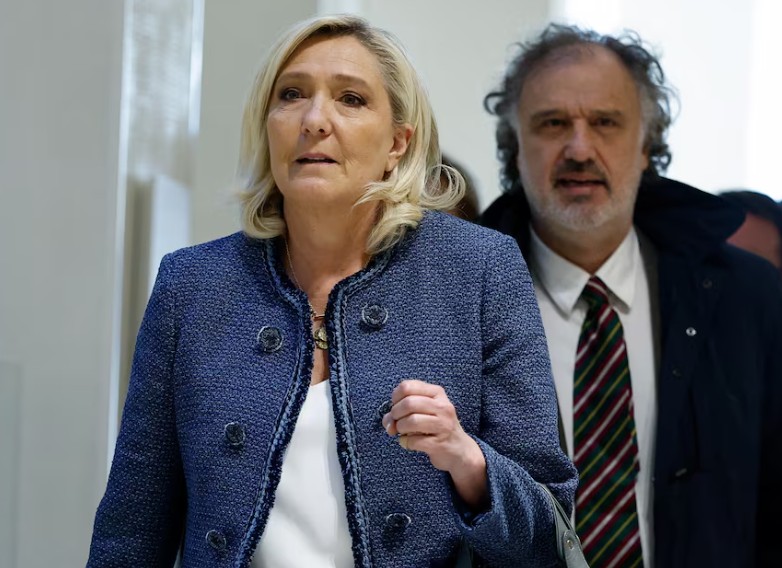
France’s Le Pen convicted of graft, barred from running for president in 2027
France’s Marine Le Pen, leader of the far-right National Rally (RN), has been convicted of embezzling more than 4 million euros from the European Parliament. This conviction has earned her a sentence of four years, with two years suspended and the other two on house arrest. She was also fined 100,000 euros personally, while her party was fined 2 million euros. One million of her party’s fines have been suspended, and if they do not reoffend, they only have to pay back 1 million euros.
Most devastating for her and her party, arguably, is the five-year ban on holding political office. This means that in France’s next Presidential election, which would have been Le Pen’s fourth and, according to her, final run, she will be ineligible to participate’. Le Pen gradually increased her support in each election, reaching the second round in the 2017 and 2022 elections. In the latter, she got 41.45% of the vote in the second round. Many pundits speculated that she had a strong chance of winning in 2027, especially given that incumbent President Emmanuel Macron was ineligible to run for a third term, meaning Le Pen would not face an incumbent.
The verdict was met with condemnation across Europe’s far right. Hungarian President Viktor Orban tweeted, “Je suis Marine.” Matteo Salvini of Italy’s Lega Nord and PVV leader Geert Wilders from the Netherlands also condemned the conviction. Le Pen also got the sympathy of Elon Musk, the billionaire head of X, Tesla, and SpaceX and, most recently, the head of the Department of Government Efficiency in the United States. American President, Donald Trump also condemned the ruling and compared it to the various charges brought against him prior to his re-election last year.
Le Pen also professed her innocence, claiming the ruling was politically motivated. The verdict is set to be appealed to a higher court.
RN, Le Pen, the European far-right, Trump, and Musk, among others, have used the verdict to push a narrative of their views being silenced. They point to the verdict against Le Pen being a plot by the European establishment to suppress her movement and eliminate a threat. Some point to the ruling in Romania against Călin Georgescu as further proof of this “conspiracy.”
France’s Justice Minister, Gerald Darmanin, said that he hopes the case is appealed in an appropriate amount of time. In a tweet back in November, Darmanin said he thought it would be quite shocking if Le Pen lost the right to stand for office.
Le Pen’s most likely successor is 29-year-old Jordan Bardella, the President of RN and the head of RN’s group in the European Parliament, Patriots for Europe (PfE). Notably, Orban, Wilders, and Salvini all lead parties belonging to PfE. Most recent polls have Bardella leading in the first round.
Whether Bardella can capture the momentum Le Pen has built for the party and use it to catapult himself to the Presidency of France remains to be seen. Le Pen inherited the party from her father in 2011 and distanced itself from the fringe reputation that Le Pen’s father had developed.
Le Pen’s case is still up for appeal, which means she could be found not guilty and return to politics. In that event, this ruling could serve as anti-establishment fuel for her and her supporters. A poll regarding the decision showed 29% of respondents to be unhappy and 42% believing the decision was an “influenced court decision.” However, if Le Pen loses the case, it could end her political career. That said, while she might pass a party she brought mainstream credibility to, over to a new generation, the legacy of Marine Le Pen will be felt in France for years to come. The far-right in France remains a potent electoral and political force that the country’s liberal establishment will have to continue to face.
Fierce protests in Turkey after Erdogan rival jailed
Tens of thousands of Turkish citizens have taken to the streets in recent weeks with the arrest of Ekrem İmamoğlu, the Mayor of Istanbul and the most prominent politician from Turkey’s main opposition party, the Republican People’s Party (CHP).
İmamoğlu was set to announce his candidacy in Turkey’s next Presidential Election but was arrested for “bribery, extortion, corruption, aggravated fraud, and illegally obtaining personal data for profit as part of a criminal organisation.” He was also accused of aiding the Kurdistan Workers Party, a militant Kurdish separatist organisation, that is recognised by Turkey (and the U.S., EU, among others) as a terrorist organisation. This is because he formed an alliance with the pro-Kurdish DEM Party during the 2024 municipal elections.
Thanks to government pressure, he also had his college degree revoked. In Turkey, you cannot be president if you do not have a university degree. GA covered his arrest in a previous analysis.
Now, thousands have taken to the streets to protest the arrest with Turkish security forces cracking down harshly on protests. This is the most significant wave of unrest the country has seen in a decade, and protesters have been met with tear gas and rubber bullets. Officers have used water cannons and pepper spray as well. The protests were condemned by Turkish President Recep Taiyapp Erdogan, who accused the CHP of disturbing the peace and seeking to polarise the Turkish people. The protests are the largest since the Gezi protests of 2013. However, notably, unrest is nothing new for the Turkish state.
In 1955, a series of pogroms were initiated against the Greek minority in Istanbul, helped partially by rallying by then-Turkish Prime Minister Adnan Menderes.
Menderes shared many traits with Erdogan, having a Conservative-Liberal economic policy, pushing deregulation, loosening restrictions on religion, and playing to Turkey’s Islamic identity. Like Erdogan, he took on the country’s secularist military and political establishment. However, unlike Erdogan, Menderes failed and was ousted and executed in the country’s first coup d’etat in 1960. The new Turkish constitution was unique for granting a degree of freedom never before seen in the country when it came to political organising and, in the eyes of many critics, empowered the most extreme forces in society.
The 1960s and 1970s were met with further political violence, including Communist terrorist movements, the rise of Turkish ultranationalist terrorist groups like the Grey Wolves, and a revival in Kurdish identity and militant Kurdish separatism. The country had another coup in 1973 to restore order. However, the instability continued with incidents such as the Çorum massacre, where Turkish ultranationalists targeted and murdered the country’s Alevi community. Between 1976 and 1980, the Turkish far-right, occasionally allied with the state, is estimated to have killed 5,000 people.
Ultimately, in 1980, there was another coup and three years of martial law to restore order, with thousands of political activists disappearing and all parties being temporarily banned.
Fast forward to the 1990s, when Turkey elected its first openly Islamist Prime Minister, Erdogan’s mentor, Necmettin Erbakan. Erbakan’s election and conflict with the country’s political establishment resulted in a coup in 1997, which was met with further resistance, including by the then Istanbul mayor, Erdogan, drawing parallels to today. Erdogan was arrested but would later be released and become Prime Minister in 2003 and President in 2014. After facing several of his own protests, including the aforementioned Gezi protests of 2013 and a failed coup in 2016, his tenure has been marked by a consolidation of power, strengthening of the Turkish presidency, and disempowerment of the military.
Erdogan has used the scars of Turkey’s past and the deep resentment of the military to justify his power. He was the first person to challenge the country’s political and military establishment and win. Now that he is the new establishment, he is working to suppress the new generation of secularist pro-Western leaders that replaced the old Kemalist establishment in the CHP.
Erdogan’s tenure has also been known for a collapse in media freedom and high inflation, with many young people furious at his administration. As the country sees another crackdown, what will the long-term consequences be?
In a country with deep political divides, youth frustration, and bubbling anger, the arrest of İmamoğlu has caused many underlying tensions to boil over as the Turkish youth revolt against Erdogan as they did in 2013 and as they did against the Kemalist establishment in the 1990s.


Leave a Reply