
In line with GA!’s aspiration to connect current events with history, you can find this week’s headlines below, provided with additional commentary from a historical perspective.
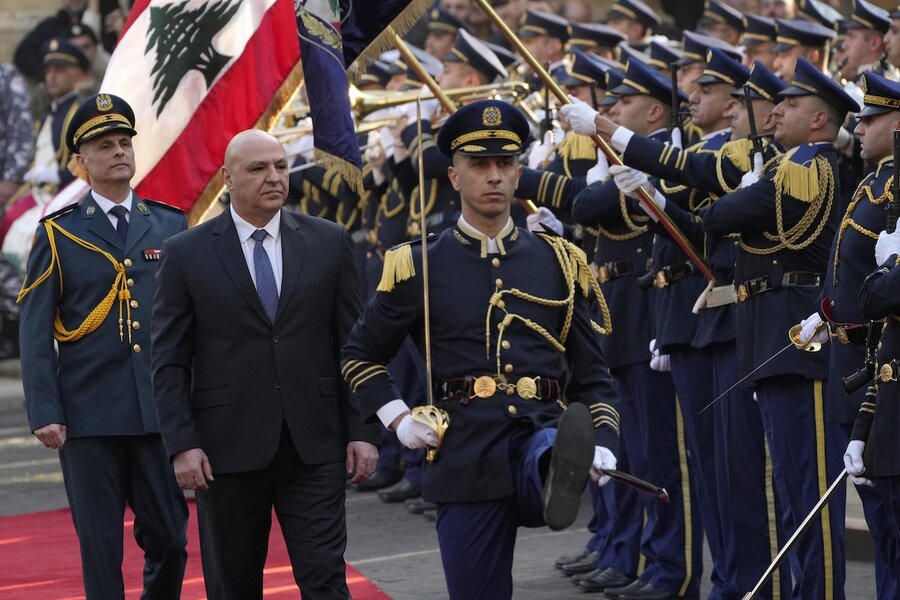
“Who is Joseph Aoun, the new president of Lebanon?”
The Lebanese parliament has finally elected a new president: Joseph Aoun. The country in the Middle East had been in a political deadlock for two years, during which parliament was unable to elect a new president. Lebanon has been in a terrible political and economic situation ever since the enormous explosion in the port of Beirut in august 2020. Many commentators and experts have expressed hope that now this political deadlock has been resolved, the new president is able to steer Lebanon back onto a path of development and prosperity.
Lebanon is one of the most diverse countries in the world and the Middle East. It has relatively equally large groups of both Sunni and Shia Muslims, as well as Christians also called Maronites, and Druze and Alawite minorites. This description does not even scratch the surface of Lebanon’s diversity but it does give an indication of its diversity. A description of these groups is important to understand the country’s peculiar political system.
As Lebanon was preparing for independence from France, which had ruled the country ever since it obtained it as a ‘mandate’ after the Ottoman Empire collapsed and after the Sykes Picot Treaty put Lebanon in France’s zone of influence, a system was needed to govern the country while respecting all groups. What came about is known as the National Pact. This is a set of unwritten rules to make sure all groups are represented in Lebanese politics and meant to keep some stability. According to these rules, the President and Commander of the Lebanese Armed Forces must be a Maronite Catholic, the Prime Minister must be a Sunni Muslim and the Speaker of Parliament a Shia Muslim. More rules exist for other positions and smaller minorities. Another aspect of the pact is that the Christians should not strive to make Lebanon a Western state but accept that the country has Arab and Islamic elements.
Joseph Aoun is indeed a Maronite Catholic and he was Commander of the Lebanese Armed Forces (LAF) before he became President. During his time as leader of the army, he successfully led counterinsurgency campaigns against ISIS cells in Lebanon, which got him praise from the US, the UAE, Qatar and Saudi Arabia and gave him powerful connections in these states. He has also managed to guide the LAF through the war between Israel and Hezbollah relatively unscathed.
The above description of Aoun has thus given hope that he might be able to get Lebanon pointing in the right direction again. Crucially, his appointment has also been received positively by the Israeli government. The National Pact however is not without its controversies and has proven fragile in the past and often the cause of instability rather than the cure. The Christians in Lebanon were more closely aligned with the French authorities during the Mandate period and thus, when a census was organised to determine which group should get what slice of the pie, the census favoured the Christians. This first census was held in 1932. An agreement was made in 1989 at the end of the Lebanese Civil War to slightly change the National Pact, but the basic idea remained the same. While the Christians were a majority when the pact was first introduced, the country is now largely Muslim, although no official census has been held in decades to determine the exact balance of the various groups. The underlying thought of the National Pact thus no longer applies and the Christians have a disproportionate amount of power. Despite this fragile balance, one hopes Aoun is able to get Lebanon thriving again.
“Alawites formed Syria’s elite. Now they are terrified”
The aftermath of the fall of Syrian dictator Bashar al-Assad continues to shape new structures in Syria. One group which is likely to be negatively impacted by the new rulers are the Alawites. The group, which are religiously a Muslim minority, forms some 10% of the Syrian population but held most positions of power in the Assad regime. As a tradeoff for their disproportionate influence in the country, Assad protected them from other groups. Now that the regime has fallen, they fear for their lives.
The Alawites, as said, are a Muslim group. They live in the coastal area of the Eastern Mediterranean in Turkey and Lebanon, but mostly along the coastal strip in Syria between those two countries, centering on the port cities of Latakia and Tartus. In 1970, an Alawite by the name of Hafez al-Assad became Syria’s leader. This was remarkable since the Alawites at that moment were the poorest minority in Syria. Robert Kaplan likened the coup by Hafez to “an untouchable becoming maharajah in India or a Jew becoming tsar in Russia—an unprecedented development shocking to the Sunni majority population which had monopolized power for so many centuries.”
During the 54 years in which father Hafez and son Bashar ruled Syria, the Alawites gained wealth and power. But now the regime has fallen, it has become clear the group has not benefited in a way the opposition groups believed they did. Any promise of protection has of course been proved hollow as Assad’s security forces completely disintegrated and he himself fled the country. Economically, Assad has also appeared to have neglected the region in which his supporters live. Once upon a time the region’s fertile coastal soil provided the country with an abundance of wheat, tomatoes and olives. But energy has been unaffordable for years and consequently, farms have stopped production. In the area, Assad’s supporters only had electricity for two hours every twelve hours.
Assad’s propaganda led his supporters to believe that groups such as HTS, which has now taken over Syria, would violently oppress them and so they should keep supporting Assad. Now some of the new dynamics in the new Syria are becoming clearer however, HTS might be the one group able to protect the Alawites. The question is whether they can and want to divide their attention. The group may have taken over the capital Damascus, but as it is focused on the centre of power, other groups are now in charge of the Alawite territory. These groups may not prove as kindly. “Assad severely damaged the social cohesion between these communities. Restoring the social fabric will take a very long time,” Murhaf Abu Qasra, the new minister of defence said.
Another dimension in this story are the Russian airbase and naval port around Tartus. Their locations were purposefully situated within the territory where Assad knew he could count on support. Now he is gone, the bases may prove a liability for the Russians and there have been signs of them having started the evacuations of these bases. As with the rest of Syria then, the future of the Alawites hangs in the balance.
“Tougher U.S. sanctions to curb Russian oil supply to China and India”
The United States has taken action to counter the sanction busting by the Russians. In 2022, when Putin launched his invasion of Ukraine, the US and EU were adamant on preventing Russia from exporting its oil and gas, its main sources of income and thus its main sources of funding for the war. As soon as sanctions were imposed however, Russia began undermining these. This has been done mostly through the so-called “shadowfleet”. We wrote about these ships being used for sabotage last week, but most of these ships are large tankers which export Russia’s oil and gas to countries which have not levied sanctions against Russia. The US has now expanded the sanctions to include 183 ships which have transported Russian natural resources. India and China, the main benefactors from buying the relatively cheaper oil, have now said this will make importing Russian natural resources more difficult and thus they will likely seek their oil from Middle Eastern countries. However, the shadow fleet of tankers has recently been estimated to consist of at least some 450 ships. The 183 which will now be sanctioned will thus severely decrease the size of the shadow fleet but not make it obsolete. It will remain to be seen then whether or not Russia can continue to keep exporting its natural resources to finance the war in Ukraine, or whether these sanctions will finally be a severe enough dent in Russia’s finances which will lead to further economic decline.
“Zelenskiy says he’s ready to exchange North Korean soldiers for Ukrainians held in Russia”
Ukraine has captured two North Korean soldiers alive for the first time since the North Korean soldiers were sent to fight part of Putin’s war. Now, Ukrainian President Zelensky is looking to use these soldiers to trade them for captured Ukrainian soldiers. The capture of these North Korean soldiers has revealed some bizarre facts on what the North Koreans were told they would be doing and what orders they had been given. 10.000 North Korean troops were initially deployed to Ukraine last autumn. Experts believe the reasoning behind this is for North Korea to give its forces battlefield experience while at the same time the deployment is part of a quid pro quo between Putin and Kim Jong Un whereby North Korea provides artillery shells and troops in exchange for Russian help with the development of its nuclear programme. However, the supposed battlefield experience for the North Korean troops has been hard evidence of the North Korean forces’ incompetence. Of the initial 10.000 soldiers which were sent to Ukraine, 3000 are now estimated to have been wounded or killed. One of the captured soldiers claimed he was told he was being sent on a training exercise. North Korean troops have been reported to not be able to communicate with the Russian forces and their equipment being very outdated. The South Korean intelligence community has also claimed North Korean soldiers were order to commit suicide if there was a threat of them being captured. It remains to be seen what dynamic these captured soldiers will bring to the relation between Kim and Putin and if Zelensky will be able to use these North Korean troops to exchange them for his own forces captured by the Russians.
“Qatar hands Israel, Hamas ‘final’ draft of Gaza ceasefire deal, official tells Reuters”
Qatar announced this week it handed the representatives of Hamas and the Israeli government a ‘final’ draft of a deal which would lead to a ceasefire in the Gaza strip. This deal now seems to have come about. Qatar has been acting as a mediator between Hamas and Israel since the war in Gaza started after the attacks by Hamas and other groups on October 7 2023. The Qatari have led multiple rounds of negotiations to end to violence in Gaza during the past sixteen months of war. On many occasions it was reported Israel and Hamas were close to striking a deal, but that never came to fruition. Experts were sceptical about these latest reports because of the timing of it all. With Donald Trump entering the White House, it has been expected that this would embolden Benjamin Netanyahu, who could rely on relatively unconditional American support during Trump’s first term in office. The seemingly sudden rush which brought negotiations to a success in these final days of the Biden administration thus seems to be strange timing for a successful deal to all of a sudden come about. The ceasefire is supposed to take effect on Sunday. Time will tell whether this comes about. Several right-wing members of Netanyahu’s cabinet have already tried to obstruct the deal and it will have to be seen whether the deal is upheld and whether a longer period of peace can be established during the negotiations which are supposed to take place during this ceasefire.
“Japan, Philippines, US vow to deepen cooperation in face of China’s behaviour”
As tensions in the South China Sea continue to rise, Japan, the Philippines and the United States have vowed to continue to cooperate and to increase their cooperation. Tensions in the South China Sea have been high for nearly a decade. China has claimed the strategically vital seas as its own for longer, but began actively claiming it by bullying other countries’ coast guard and building artificial islands over the last decade. 20% of the world’s trade by ships passes through this region. Most of the confrontations in the South China Sea have been with the Philippine coast guard. Chinese naval and commercial ships have purposefully rammed Philippine ships over the past years in an effort to chase the Philippines out of the area. This has led to stronger ties between the Philippines and the US, as the South East Asian island state looks to increase its security by allying itself with the Americans. To achieve this, amongst other matters, the Philippines have granted the Americans access to four sites where the US will house new military bases in order to deter the Chinese. Alongside the Japanese, these three countries have increased their cooperation by joined exercises of their armed forces and of their coast guards. President Trump will likely continue this cooperation considering his more hostile stance towards China. On the other hand, Trump has promised to decrease the US’ global military presence. As with most other news stories these weeks then, all remains to be seen after January 20.



Leave a Reply