
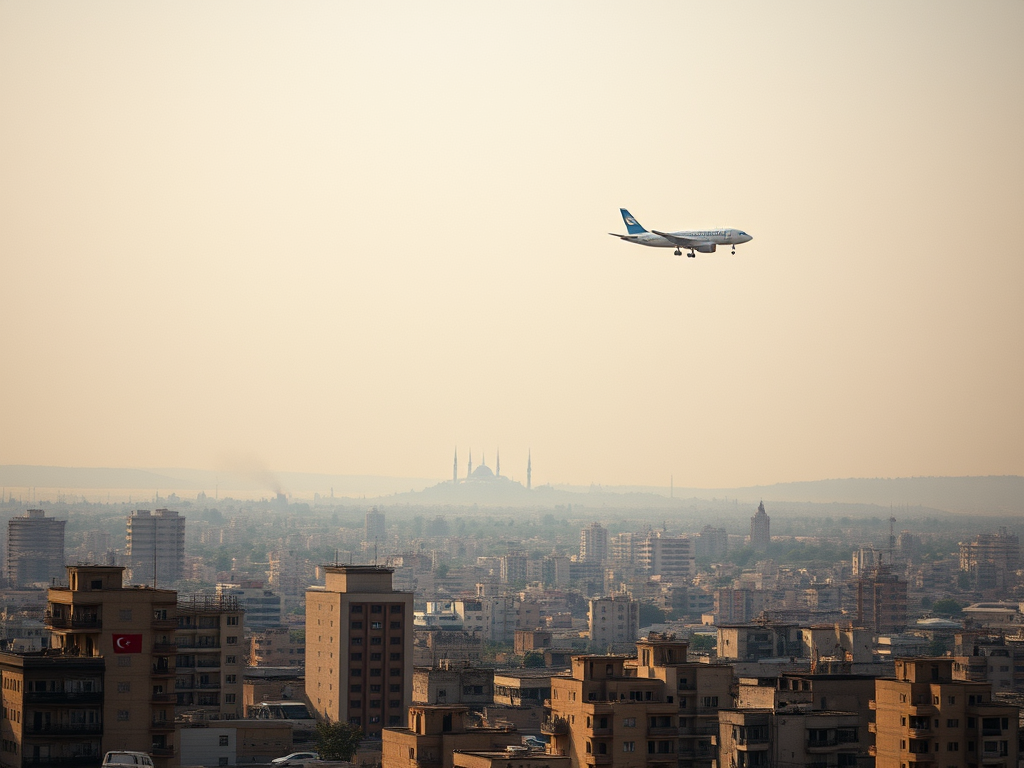
The Fall of Assad
With the fall of Bashar Al-Assad’s government, an enormous change has come over the Middle East. The end of the last of the Arab Spring dictators has left the balance of power totally upended in the war-torn state, and the international community scratching their heads at the recent events. A five-year deadlock has been broken, and a dynastically appointed president infamous for his use of chemical weaponry has fled the country he has ruled with an iron fist for over twenty years.
What happened?
In less than two weeks, from November 26th to December 8th, a sudden flare-up in the Syrian Civil War took the international community by surprise. Long dismissed as a static front, a democratic revolution hopelessly deadlocked and fizzled out, grand conflict reignited in Syria. Over the course of twelve days, the Islamist rebel organization Hayat Tahrir al-Sham – previously affiliated with ISIL and Al-Qaeda, and internationally marked a terrorist organization – broke out of the pocket in the north-west of the country they had long been confined to. Taking one major city after the other, the rebels’ comeback culminated in a dramatic storming of Damascus as Bashar Al-Assad fled the country in the presidential jet.[1]
How could this happen? It appears that other violent conflicts elsewhere in the world drew away or otherwise compromised crucial military support for the regime. As the war in Ukraine nears its third anniversary, Russian airstrikes in support of the Syrian Armed Forces became a thing of the past. The Iranian-backed Hezbollah militias were also known to be an important ally on the ground for Syrian regime. As the Russo-Ukrainian war dragged on and the IDF dealt Hezbollah a crippling blow in September-October 2024, these pillars supporting the Assad regime began to crumble. International relations scholars and other conflict academics took notice – the mainstream news media did not.

What now?
The Syrian army has disintegrated in the face of the HTS advance and president Assad has fled the country, apparently offered asylum in Moscow according to Russian state media.[2] In the country’s north-east, the Syrian Democratic Forces, the Kurdish-led autonomous military force that has operated in support of but separate from the Syrian Army in the past, has advanced across the Euphrates river to occupy positions abandoned by the regime’s military; there is little love lost between these ethnic militias and Islamist factions such as ISIL and HTS. The Syrian Free Army has also capitalized on the central government’s weakness, but it has been Hayat Tahrir al-Sham that has reaped the greatest gains.
Following Bashar Al-Assad’s flight from Damascus, the Syrian Armed Forces no longer appear to control territory. For all intents and purposes, the last Ba’athist state has fallen.
What next?
The fall of Assad’s regime will have far-reaching repercussions for local and regional security. Both Russia and Iran have lost a valuable regional ally, and the rebel factions that overthrew regime are either too fundamentally Islamist to make a palatable partner, or have received a US military aid in the past and are at least nominally aligned with the Western powers. HTS itself has attempted to clean up its act recently, but it remains to be seen to what extent this offshoot of Al-Qaeda has truly turned over a new leaf, and both the organization and its leader remain on the international terrorist wanted list.[3]
Assad’s sudden fall has meant an enormous swing in the intranational balance of power, and the consequences for individual factions will not all be immediately obvious. It is uncertain if the HTS, the SDF and the SFA will be able to form a national government together; they have fought amongst themselves sporadically throughout the civil war, and their guiding ideologies differ. HTS would see a Syrian state founded on Islamist principles, while the SFA came into existence as a response to Assad’s brutal crackdown of pro-democracy protestors in the Arab Spring. The SDF, meanwhile, is a conglomeration of ethnic militias led by the Kurds whom are unlikely to willingly disarm after the abuse suffered at the hands of both the Assad government and the Islamic State. Further large-scale hostilities are not unlikely.

There are international interests as well. Türkiye will vehemently oppose what it sees as any attempt to raise Kurdish ethnic fervour; the Turkish government has long maintained that the SDF has ties to the PKK. Ever since the 2019 withdrawal of US troops, Turkiye has maintained a military presence in northern Syria, and clashed with the SDF. The Turkish government has also been the main supporter of the SFA, to the point that some see them as a Turkish proxy.[4]
Meanwhile, Israel has moved troops into Syria beyond the long-contested Golan Heights, and it seems likely that other regional powers such as Saudi Arabia – a long-time rival of Iran – will attempt to take advantage of the situation. Right now, that situation is still highly fluid. There are now more opportunities in Syria for an enterprising player of regional politics than there have been in some time. It’s a party in Damascus, and everyone’s invited.
-Julius Birch
[1] https://apnews.com/article/syria-assad-ousted-rebel-offensive-timeline-8c54a8b97803d4b10cde53b97227128e
[2] https://apnews.com/article/syria-assad-sweida-daraa-homs-hts-qatar-816e538565d1ae47e016b5765b044d31
[3] https://news.un.org/en/story/2024/12/1158126
[4] https://www.clingendael.org/pub/2019/strategies-of-turkish-proxy-warfare-in-northern-syria/1-turkey-and-the-armed-syrian-opposition-from-free-syrian-army-to-syrian-national-army/



Leave a Reply