
In line with GA!’s aspiration to connect current events with history, you can find this week’s headlines below, provided with additional commentary from a historical perspective.
“Dutch police detain 50 protesters at pro-Palestinian rally after soccer unrest”
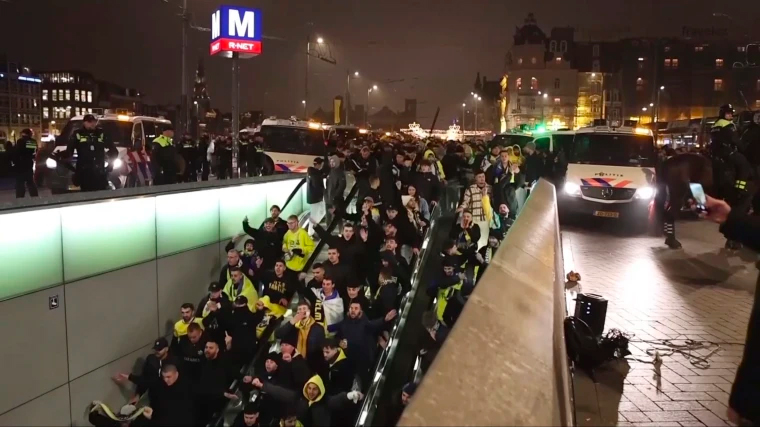
A bizarre few nights of political violence have enthralled the Netherlands and sparked global headlines. On Thursday night a UEFA Europa League match was scheduled in Amsterdam’s Johan Cruyff Arena between Ajax and Maccabi Tel Aviv. On Wednesday, Tel Aviv supporters caused some unrest in the city centre, the night before the match. Pro-Palestine protests had been announced at the Johan Cruyff Arena the night of the match, but were moved to a location nearby by authorities to prevent confrontation. This initially seemed to have succeeded. However, as Israeli fans left the stadium and made their way back to the city centre, they were mobbed by groups of masked people and beaten.
Israeli politicians were quick to label the riots as a pogrom. The word pogrom originates from the Russian Empire where in the late 19th century authorities would allow people to riot in order to vent their anger about government policy and distract them from the failings of the government. More often than not these attacks were aimed at Jews. After the assassination of Tsar Alexander II in 1881 for example, large pogroms broke out in Kiev, Odessa and Warsaw, then all part of the Russian Empire. However, the word pogrom can encompass any attack focussed on a minority although it is most often used to describe violence against Jews.
As more facts came out about the violence, it became clear the Maccabi supporters were not entirely innocent either. They had been chanting extremely provocative texts about Arabs and the war in Gaza. Instead of a pogrom, a more apt description of the events then would be some form of extremely politically motivated football hooliganism.
Politically motivated football hooliganism is not a new phenomenon. During the late 80’s and early 90’s, as Yugoslavia was disintegrating, fans of the two big Croatian clubs (Hajduk Split and Dinamo Zagreb) would often clash with the fans of the two big Serbian clubs (Red Star Belgrade and Partizan Belgrade). In the following violence during the 90’s, many of those in the organised hooligan groups would serve in their respective armies, and some would be part of units which committed war crimes. There have been reports that some of the Tel Aviv fans in Amsterdam were IDF soldiers who had fought in Gaza, but this is difficult to verify.
While people were injured in Amsterdam, no fatalities occurred. While the violence was certainly shocking, it is in no way a very severe example of hooliganism. In 1985, at the final of the European Cup between Liverpool FC and Juventus, 39 people were killed after violence between the groups of fans in the outdated Heysel stadium in Brussels. The events in Amsterdam did of course have an antisemitic element, but it wasn’t an all out pogrom and more an example of politically and ethnically motivated football hooliganism which has occurred before in Europe on multiple occasions.
“Qatar suspends role as mediator between Israel and Hamas”
Qatar has said it will no longer facilitate and mediate talks between Israel and Hamas to bring about a ceasefire in Gaza. The emirate has announced both parties have not been cooperating and would only continue again with negotiations if both parties show they actually want some sort of deal to end hostilities: “Qatar will resume those efforts… when the parties show their willingness and seriousness to end the brutal war.” Qatar plays an interesting role in the Middle East. Alongside the UAE, the small but extremely wealthy Gulf state has increasingly tried to establish itself as a mediator in many different conflicts in the region.
Qatar has been ruled by many of the empires which have come through the Middle East throughout history. Until the First World War, it was part of the Ottoman Empire, after which the British made it their protectorate. Qatar gained full independence in 1971. Qatar often has amicable relations with both Western powers as well as with some of their traditional adversaries in the region. Qatar has been a crucial partner of the US since the Gulf War in 1991. Since then, the US has established a critical airbase in Qatar which has been vital in the wars in Afghanistan and Iraq and where the US regional military headquarters and central command is actually stationed.
On the other hand, Qatar also keeps cordial relations with Iran and is very influential through its own regional but state owned media outlet Al-Jazeera. Those cordial relations with Iran have in turn led to tense relations with Saudi Arabia, which along with a few other regional players, broke off diplomatic relations twice in the past few years. Qatar’s diplomatic efforts to increase its standing on the world stage have come along with other PR moves to promote its tourism industry of which the most famous one of course was the 2022 FIFA world cup.
On the diplomatic stage, Qatar hosts an office for Hamas through which negotiations have taken place over the past years. Qatar has previously been successful in negotiating a deal between a state and a non-state actor in the form of the agreement between the US and the Taliban. Despite this deal not bringing about its intended consequences, it was apparently enough of a success to now have Qatar act as mediator once again.
The fact that Qatar has now broken off these negotiations shows the limits of soft power. Qatar has enjoyed a significant amount of soft power (that is the implementation of foreign policy by peaceful means) of the past years, as shown for example through the aforementioned deal brokered between the US and the Taliban. However even Qatar, with its formidable network of foreign relations has now thus said the negotiations between Israel and Hamas are in a complete deadlock. The fact a country which has successfully brokered peace deals of a similar nature in the past is now so openly portraying the current struggles, points to the high complexity of the current situation.
“Moscow targeted as Ukraine and Russia trade huge drone attacks”
In Ukraine, large scale drone attacks have taken place over the past weekend. The level of violence has increased in the war which has now been going on for nearly three years. Ukraine’s largest drone attack on Russian territory saw 84 drones attack six different regions and temporarily stop air traffic at all three of Moscow’s main commercial airports. Russia’s attack consisted of 145 drones which attacked every corner of Ukraine. These were the largest drone attacks from either side since the start of the war. On the ground, violence has also increased. While Ukraine continues to lose territory slowly, Russian losses have risen to their highest level since the start of the war, with some 1500 casualties (deceased and wounded soldiers) per day during October. Some argue Trump’s reelection has now forced both parties to increase their efforts since the position of the new administration can only be guessed at. Trump has said he will end the war quickly but has also threatened to give the Ukraines even more weapons and support if the Russians do not cooperate.
“Germany may hold election sooner than planned, Scholz says”
The German governing coalition collapsed last week. This has pushed Europe’s largest economy into political turmoil at a time when its own industry is suffering major setbacks and Europe is facing the gravest threat to its security since World War II. Scholz was leading Germany through a progressive coalition with the Liberal FDP and the Greens. He was only the forth Social Democrat to take charge of Germany after Willy Brandt, Helmut Schmidt and Gerhard Schröder and the first SPD leader in sixteen years when he won the elections in 2021. His coalition has now fallen apart due to a dispute over the budget with the Finance minister and leader of the FDP Christian Lindner. Scholz and the SDP currently trail the Christian Democratic party CDU of Friedrich Merz by 17 points in the polls. A reelection is thus highly unlikely at this point. When new elections will be held though is not clear yet. Scholz wants to hold a vote of confidence in his coalition in January and the likely elections in March, but the opposition would like to see this happen sooner. With these new elections Germany will also be tested to see if it can withstand the rise of far right populist parties which has occurred elsewhere in Europe. The Alternative für Deutschland will be looking to gain ground.
“Democrats’ bet on a generation of liberal voters has backfired badly”
Now that it is clear that Donald Trump has won a resounding victory, not only winning the presidency but also a majority in the Senate and most likely in the House of Representatives too, the Democrats have started licking their wounds and trying to figure out what went wrong. In 2008, when Barack Obama won the presidency on his progressive message of hope and change, Democrats claimed demography would work in their favour from that moment onwards. The thought was that minority groups in the US would always side with the Democrats. And because those groups were increasing in size and white conservatives were decreasing in size, the Democrats believed elections would easily go their way in the future. The opposite has now happened. While African Americans did overwhelmingly vote for Harris, her majorities amongst latino and Asian voters were very small. If one compares Trump’s support with that of Republican candidate John McCain in 2008, some interesting dynamics can be observed: Trump won “13% of the black vote in 2024 compared to Republican John McCain’s 4% against Obama; [Trump won] 46% of the Latino vote this time, while McCain got 31% in 2008; [Trump won] 43% of voters under 30 against the 32% for McCain; [Trump won] 56% of those without a college degree – back in 2008, it was Obama who won a majority.” If the democrats want to prevail in 2028 then, they will have to rely on a new and strong strategy to win these voters back. More importantly, they will need to deliver on their promises. The hope Obama and Biden gave voters not being realised was a big factor in Trump winning again.
“Trump and trade worries cloud COP29 climate summit in Baku”
On Monday, the COP29 conference on slowing global warming started in Baku, Azerbaijan. After the UN reported the world was anything but on track to reach its climate goals, as we wrote about, the fight against global warming has now suffered another blow after the reelection of Donald Trump. Trump has denied the existence of global warming on many occasions and pulled the United States out of the Paris Agreement in 2017, saying he represents the citizens of ‘Pittsburgh not Paris.’ While most expect Trump to pull out of the agreement again, many also fear his campaign promises to increase fracking and start drilling for oil in polar areas. While the Paris Agreement in itself is now stronger than it was in 2017, the world’s second largest polluter ignoring it again cannot be good for the global effort to keep global warming reduced to 1,5 degrees. Trump’s adversity to climate policy will also enhance China’s position even further as the leading producer of solar panels and electric cars.



Leave a Reply