
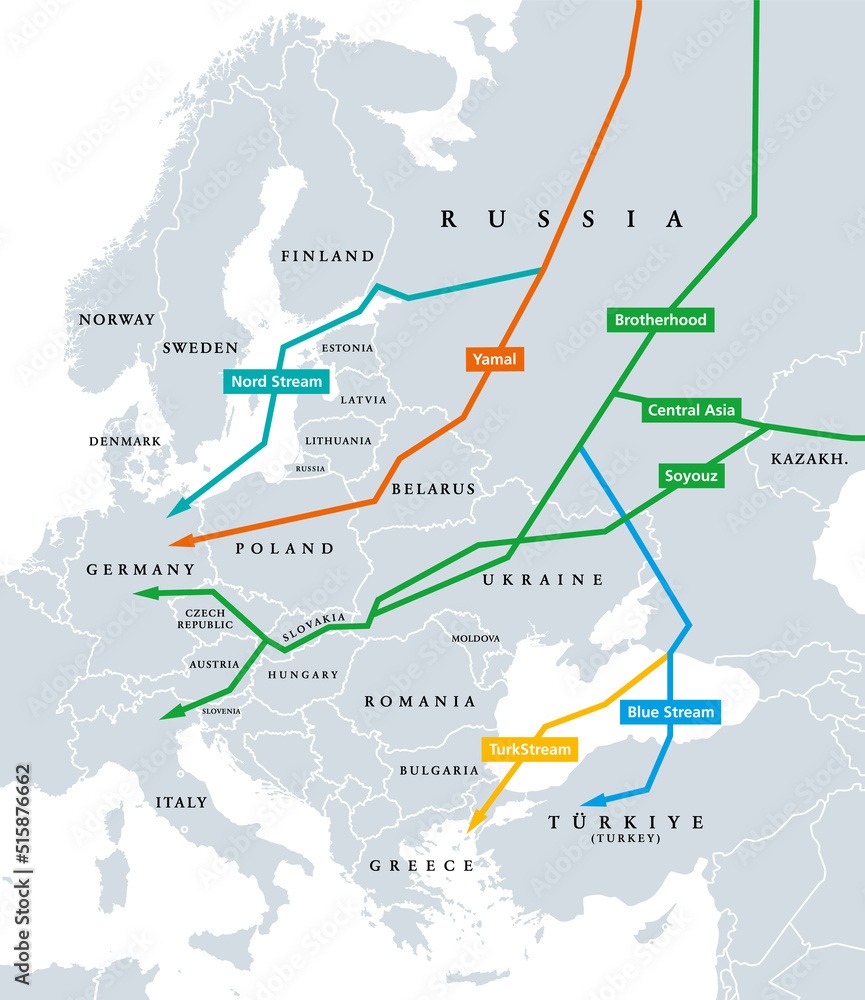
January’s meeting was all about German’s Ostpolitik as Chancellor Scholz announced their break from the policy following the Ukraine War. Thinker Tom Draaijer gave an insightful presentation how Germany became increasingly depended on energy wise on Russia’s gas. Nowadays, everyone’s rational constellation would be transition to other energy sources to no longer be contingent on Russia, but this was not as clear cut for West Germany during the Cold War.
The central themes surrounding Ostpolitik started floating within German politics since the 1960s but were only implemented in the 1970s under Willy Brandt. It initially aimed to normalise German-Soviet relations through economic cooperation. After all, if your economies were interrelated, the costs to harm each other became even steeper as you would indirectly hurt yourself. The Ostpolitik was a break from the Hallstein doctrine as the Federal Republic of Germany (West Germany) wanted to establish diplomatic ties with the German Democratic Republic (East Germany), especially during the Détente period. Their main motto was to acquire change through rapprochement.
The FRG was in an increasing need of a steady energy source. With their new Ostpolitik in mind, they approach the Soviet Union extend their pipelines, which were running through all their satellite states, to the FRG. The Soviets were desperately in need of hard currency, so they were willing to trade gas with the West-Germans.

The Ostpolitik was consolidated through several critical junctures in the form of pipelines: Urengoy-Pomary-Uzhhorod (1973), Nordstream 1 (2004) and Nordstream 2 (2015). The high costs of these policies made policy reversal near unthinkable as the sunken costs of a pipeline, a static energy source which cannot be easily moved like others like oil, are immense. The FRG did not have many alternatives to Soviet gas. The Arab states boycotted Europe and Iran was in upheaval after the Iranian Revolution. American coal and African oil were an option, but the West-German officials thought Reagan wanted to heat-up the Cold War, whilst they favoured a European détente. Besides, Russian gas was cheap and made sense considering the pipeline structures was already in place. Moreover, Dutch gas reserves served as a safeguard if the cooperation with the Soviet went south.
Reagan was determined to prevent this cooperation as he saw it as a threat to the international balance of powers; too much dependence, especially in a sector as crucial as energy, would give the Soviets too much influence. He demanded that the West-Germans would use American coal as an alternative though there was no transport system in place to export it the FRG nor could one be easily developed. Eventually, Reagan had to back down but negotiated a maximum of 30% of energy dependence on the Soviet Union.
As the pipeline was built, policymakers would continue to rely on Russian gas as it was cheap. Though top military executives objected due to security reasons, West-German policymakers waved away these concerns stating that the Soviet has been reliable as the gas had been flowing without any hiccups. This locked these policies even further into a self-enforcing feedback loop.
The dissolution of the Soviet Union made it so that the pipeline structure now cut through multiple sovereign states. During the 1990s, most experts like Fukuyama believed that liberalisation would eventually lead to democracy becoming the only ideology in town. But they forgot that the new Russia was politically fractured with many different powerful actors like the oligarchs. Also, during the Soviet-era, these satellite states got Soviet gas dirt cheap, but had to full market price after the breakup. This gave Russia a lot of leverage within these former Soviet states.
Whenever these states acted up against Russia, like Belarus, they simply closed off the gas, indirectly hitting the Poles and Germans as well. This was resolved through extensive bargaining, but the Germans didn’t want to have to deal with such issues ever again, cooperating with Russia to create Nordstream 1. This pipeline would go directly to West-Europe through the Eastern Sea. This of course had major implications for East Europa as Russia could now close their pipes without it affecting Europe, thus leaving them high and dry. Again, the Americans, especially Bush and somewhat Obama, saw this threat to the international balance of power with Putin gain even more leverage of the entirety of Europe. But the Germans saw this economic cooperation as a chance to enhance connections with Russia, believing that further liberalisation would lead to a democratic Russia.
Over the decades, Russian gas export to Germany increased immensely, doubling from 30% to 60% in 2020. Even when the EU took a stance against the Russian government after its invasion of the Kremlin, with Merkel as a frontrunner for sanctions, the Germans still supported Nordstream 2 and saw it as a chance to further incorporate Russia into Europe. Russian gas also allowed them to transition to green energy sources more smoothly. Of course, this increased their dependency on Russian gas even further which became even more problematic as the Dutch gas reserves were longer serve a safeguard. Polish deputy foreign minister Szymon Szynkowski vel Sęk even compared the Nordstream 2 cooperation with the infamous Molotov-Ribbentrop Pact. The Americans were again against the construction but could only get the Germans to agree that they would stop cooperation if Russia invaded Ukraine. This brings us to present day with Scholz declaring their policy break with Ostpolitik, leaving the EU with a gas crisis costing them more than €1000 billion.
Only an enormous exogenous shock made the Germans reconsider their Ostpolitik. Even though it made a lot of sense to cooperate with the Soviets in the 1970s, security issues became increasingly more important when Russia didn’t democratise as thought. We concluded two key lessons from this situation:
1. Security issues cannot be underestimated and must take prevalence above economic drivers in certain situation.
2. When a policy strategy works in a specific socio-political context, it doesn’t necessarily have to work in the future; context always changes and policies must be periodically be reassessed to see if it’s still optimal for the current state of affairs and near future.




Leave a Reply