

Kazakhstan At A Crossroads
The return of the great game to Central Asia

Despite a vague notion of shared commitment against a Western-dominated world, the BRICS countries at times have varying, if not contradicting interests. Generally, the five countries do not operate in elaborate coordination either. The most marked shift in internal BRICS-relations of the past few years has occurred between China and Russia.
The ‘Second Great Game’
We can be sure of the fact that China has increasingly sought to pursue its own agenda, though. This is observed in Central Asia. By combining the BRICS and the Belt and Road Initiative (BRI), China has expanded its economic dealings in Central-Asia significantly since the 1990s.230 Kazakhstan in particular has signed for 55 projects with Chinese involvement amounting to 27,6 billion dollars. An example is the construction of the Kazakh-China oil pipeline.231
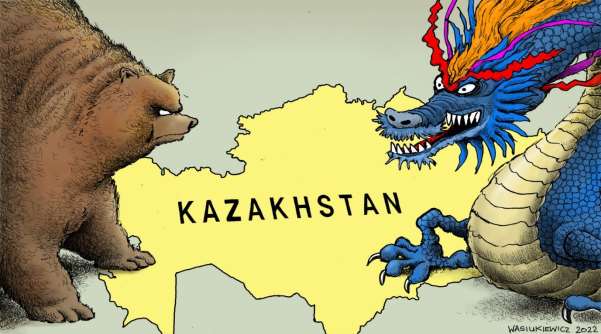
This to the dismay of Russia. These two BRICS countries engage in what academics call a ‘Second Great Game’. Paolo Pizzolo & Andrea Carteny speak of the transition from an ‘axis of convenience’ to ‘intense regional competition’.232 The Sino-Russian common as well as conflicting interests are both observed in the Shanghai Cooperation Organization (SCO), which counts among its members the aforementioned countries, Kazakhstan, Uzbekistan, Kyrgyzstan, Tajikistan, India and Pakistan. The SCO has mainly been concerned with security issues, although China has consistently tried to expand its economic role. These maneuvers have been somewhat tempered by Russia. Moreover, the accession of India (2017), a third BRICS-country, can be interpreted as Russia counterbalancing China.233
Trends seemed to be going China’s way. It has the best papers economically. 234 At the same time, Russia lost some small battles: The Kazakh language now has a non-Cyrillic alphabet.235 Still, Russian influence in Central-Asia cannot be understated. Language and media, labor migration, trade and security arrangements guaranteed a large degree of leverage. How would a Sino-Russian coexistence in Central Asia look in the near future? Pizzolo and Carteny predict a division of roles: China does trade and infrastructure, Russia security. 236 Since their paper was published, however, Russia invaded Ukraine. The consequences for its role as security-provider are beginning to show. First, operations in Ukraine have often not met expectations. Also, the Collective Security Treaty Organization (CSTO) has not remained unscathed. Although the intervention in Kazakhstan (2022) at a time of domestic unrest has somewhat kept up appearances, Armenian pleas for help as Nagorno-Karabakh was cleansed by the Azerbaijani army were ignored by Russia. What perspective does Russia offer Central Asian countries, if it fails to protects a CSTO member, and one of its most enthusiastic geopolitical allies? The effect has been fully realized on the 23rd of February, a mere two days before the finishing of this piece: Armenia has frozen relations with the CSTO.237 To make matters worse, China even mentioned Central Asia’s security capabilities in its Global Security Initiative.238
Diversification of Partners
Does all the aforementioned mean that all obstacles are removed for Chinese hegemony over the region? Not really. Russia’s full scale invasion of Ukraine has pressed some buttons in Central Asia (or accelerated existing trends), although the attitudes of Central-Asian countries can be hard to interpret because of the tricky geopolitical situation they find themselves in. Balancing is of the utmost importance, but diversification of partnerships is also part of Central Asian countries’ answer to the shifting global order.239
Who to diversify towards? Some rapprochement has been made to western countries. The US has shown its ambivalence in recent years. Its departure from Afghanistan in 2021 left Central Asia in a precarious position, but the US has returned to the scene with its involvement in the Russo-Ukrainian war.240 Still, the coming election may significantly once again introduce a period of American hibernation.
More involved is Turkey. 241 Its involvement in Central Asia is hardly surprising considering cultural similarities. In light of China’s persecution of the Uyghur people, Turkey seems the more Turkic- and Islam-friendly partner of the two. Economically, the so-called ‘Middle Corridor’ has great economic potential. 242 Kazakhstan, incidentally, is actively involved in this project.
Regional Cooperation
Why not let the external partners play second fiddle for once? Yes, Central-Asian leaders have more options than even before: China, Russia, the EU, the US, Turkey, and Iran. Still, there are as many pitfalls as opportunities.
There is, alternatively, a feeling of ‘regional belonging’ in Central Asia. Timur Dabaev speaks the agency of Central Asian countries. 243 There might just be opportunities for regional cooperation without the involvement of external parties like never before. Previous projects, like the Central Asian Cooperation Organization (CACO, dissolved in 2005) failed. It is not all that surprising, however, considering the pull-factor exerted by Russia on Kazakhstan (by means of the EAEU), which has received economic benefits that outweighed the gains of Central-Asian cooperation. Additionally, economic interdependence between the Central Asian countries was and is low – extra-regional markets dominate.244
The ‘Second Great Game’ has greatly disturbed the development of Central Asian regionalism. Now, it seems to be too unequal to continue under the same terms. At the time that CACO’s predecessor, the Central Asian Union (CAU) was established in 1994, integration was driven by Kazakhstan and Uzbekistan. It is still these two countries that would have to take the initiative. The president of Kazakhstan, Tokayev, seems to be open to the friendship offensive that Uzbekistan has launched since its change of leadership in 2016. Under the initiative of Uzbekistan’s new leader, Mirziyoyev, the two states signed a Declaration on Alliance Relations (a treaty since 2022).245
In the past, Kazakhstan essentially prevented far-reaching regional cooperation from happening due to its close relationship with Russia. Since 2014, it has been increasingly influenced by China. What it decides now is of the greatest importance. More is possible than ever. From a Kazakh point of view, the EU and US feel far away and close cooperation seems challenging. Surely Russia’s shakiness is not meant to result solely in exponentially growing Chinese influence, though. To me, although everything remains a balancing act, two options seem most realistic, especially in combination: (1) allowing for closer ties with Turkey, in the act cancelling out Chinese hegemony while still holding on to a degree of economic and cultural ties with Russia, and (2) increasing regional cooperation in a new Central-Asian spirit, taking some agency back from the external powers.
Conclusion
In conclusion, the world order that countries like Kazakhstan and Uzbekistan maneuver through is elusive and dynamic. Power-blocs appear coherent only from a distance. Alliances are vulnerable and equilibriums easily shifted. Russia seems to lag behind the other BRICS countries, while Turkey and Iran are knocking at the door. Multipolar does not seem to cover it. Central Asian countries have a tradition of geopolitical juggling, a currently useful skill. Can Chinese hegemony be avoided? Is there a political will for regionalism, or does the lack of regional economic interdependence lead only to a careful diversification of alliances (to Turkey, for example)? Its current window for regaining regional initiative is a potential carefully tested.



Leave a Reply