

Reinventing Trade Diplomacy
How a Less Eurocentric Approach Would Benefit the EU’s Pursuit of Critical Raw Materials in Latin America
Given the intricate link between trade and geopolitics, economic diplomacy must adapt to global shifts. Western policymakers, particularly in the EU, need a distinct approach, emphasizing equitable relationships with trade partners. Analyzing EU trade policies on Critical Raw Materials (CRM) in Latin America highlights the limitations of conventional methods. Recognizing these shortcomings is crucial for reevaluating EU trade diplomacy to enhance competitiveness in the modern international landscape.
THE CHANGING TRADE LANDSCAPE AND THE PROMINENCE OF CRM
As industrial policies resurge and export bans increase, the global trade landscape is undergoing a profound transformation. The unrestrained economic globalization of the liberalization era since the late 1980s is now at a standstill, facing threats from geoeconomic fragmentation challenging global economic integration and free trade.185 Countries are increasingly regionalizing supply chains, opting for re-shoring and friendshoring of strategic goods.186 Simultaneously, the energy landscape is shifting significantly. While fossil fuels drove the 20th-century global economy, we stand at the threshold of an energy transition, moving from ‘Big Oil to Big Shovels.’187 In this context, CRMs have emerged at the forefront due to their crucial role in clean energy technologies. Their significance extends even beyond the energy transition as they are vital to applications in the defense, healthcare, and digital sector. The geopolitical weaponization of CRMs became evident during the escalating US-China trade conflict. Responding to the US and its allies’ chip technology ban, China imposed CRM export bans on gallium, germanium, and graphite. As the EU aims for open strategic autonomy, it must navigate the complexities of great power rivalries while striving to ensure resilience in global politics and trade.188
THE EU’S CRM DEPENDENCE
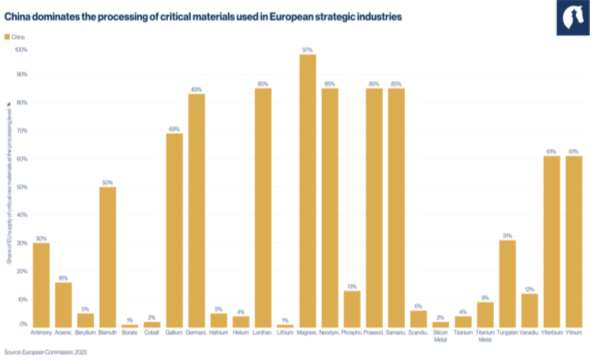
In this regard, the EU faces significant risks to its green transition and industries due to its dependence on CRM imports from China, as highlighted in figure 8. Addressing this challenge requires proactive EU policies, especially given the surging demand for CRMs — illustrated by the projected 40-fold increase in lithium demand by 2040 — and the corresponding rises in prices.189 The EU aims to strengthen its position in global CRM supply chains through the Critical Raw Materials Act (CRMA), employing a dual-pillar approach. The first pillar focuses on bolstering domestic capabilities by promoting mining, refining, and recycling within the EU. However, the domestic pillar encounters challenges due to the substantial time and capital investments required for mining — often exceeding 10 years to establish a production-ready mine — and refining. Additionally, the European feedstock for recycling is a viable source of materials only in the long term. Therefore, the significance of the second pillar, diversification of CRM supply through strategic partnerships, becomes crucial in securing CRM for the EU in the short and medium term.190
However, the CRMA lacks clarity on this aspect, a notable observation given the limitations of traditional trade instruments. While commendable efforts have been made through Free Trade Agreements (FTAs) with countries like Chile and Australia, incorporating provisions for market access and safeguards against export restrictions, the inadequacy of trade policy incentives for import diversification becomes evident due to the EU’s already low tariffs on CRMs. Therefore, a fundamental shift in focus within this domain is imperative. The attention should now be directed towards investments facilitated by the Global Gateway and export credits, strategically aimed at encouraging private investments abroad. The EU must leverage these tools to drive investments in infrastructure and projects that diversify both mining and refining of CRMs beyond its borders. This requires substantial contributions from both public and private partners, urging international collaboration with like-minded partners.191
LATIN AMERICA’s CRM POTENTIAL
Latin America holds a crucial position in global CRM supply chains, contributing 40% to global copper production. Despite facing challenges in ore 25 Figure 8: The ratio of EU CRM supplied by China between 2016-2020. Source: HCSS, 2023. quality, the region boasts significant reserves, including untapped potential in Mexico and Colombia, creating opportunities for growth. In lithium production, Latin America globally supplies 35%, led by Chile (26%) and Argentina (6%), with Chile providing 78% of the EU’s refined lithium. 192 Nevertheless, the untapped potential becomes evident as Australia has double the lithium production of Chile with half the reserves, while Bolivia’s reserves even remain undeveloped. 193 This pattern extends to other CRMs, such as graphite, nickel, manganese, and rare earth elements. Brazil, boasting one-fifth of global reserves for each, currently produces modest amounts, contributing 0.2% to global rare earth elements and 7% to graphite.194 Given the EU’s increasing reliance on CRMs, Latin America’s significance in the global supply chain cannot be overstated. To unlock the vast potential latent in the region, comprehensive imperative.195 strategic investments exploration efforts and are Nonetheless, the current shortcomings in the EU’s engagement with these like-minded partners, exemplified by EU-Latin America cooperation, underscore how the alignment of interests can be hindered by a Eurocentric approach.
EU-LATIN AMERICA RELATIONS: A GULF BETWEEN RHETORIC AND ACTION
Recognizing Latin America’s significant CRM potential, the EU aspires to be the “partner of choice” as it tries to differentiate itself from China’s approach. This is being done by the European Commission’s objective of jointly establishing a competitive and sustainable CRM industry with Latin American countries. In their endeavors to strengthen EU-Latin American relations, European policymakers highlight historical and cultural ties, along with shared democratic values and interests.196 In a notable move, at a July 2023 meeting in Brussels, the EU pledged a substantial €45 billion investment for technology projects in Latin America and the Caribbean. Moreover, EU-Latin America trade relations witnessed a 59% increase in imports and 37% in exports from 2013 to 2022, amounting to a trade volume of around 300 billion euros per year. The potential FTA between the EU and Mercosur could further boost these developments, creating free trade agreements with 94% of Latin America’s and the Caribbean’s GDP.197 Up to this point, the situation appears promising. However, the planned FTA between the EU and Mercosur faces obstacles, showcasing the EU’s challenging partner stance with stringent demands. France’s protectionist stance, aiming to safeguard its agricultural production, exemplifies how national interests can impede a deal that serves Europe’s larger interests.198
Consider Brazil, Latin America’s largest economy, where despite absolute growth in trade numbers with the EU, the EU’s share in Brazil’s overall 26 trading portfolio has diminished. In 2000, the EU accounted for 28 percent of Brazilian exports, decreasing to 16 percent in 2019. In contrast, China, once a negligible trade partner for Brazil, now receives about 30 percent of Brazil’s exports— surpassing both the EU and the United States combined. China’s influence in South America has expanded through initiatives like Brazil joining the BRIC grouping in 2009 and Argentina participating in China’s Belt and Road Initiative in 2022. Efforts to correct this trend involved Mercosur and EU countries attempting to finalize a long-awaited trade deal in late 2023. Unfortunately, negotiations failed, potentially leading to a prolonged drift between Europe and South America. Such an outcome would signify a significant geopolitical setback, propelling Latin American economies deeper into China’s influence, given China’s substantial ongoing investments in the region.199
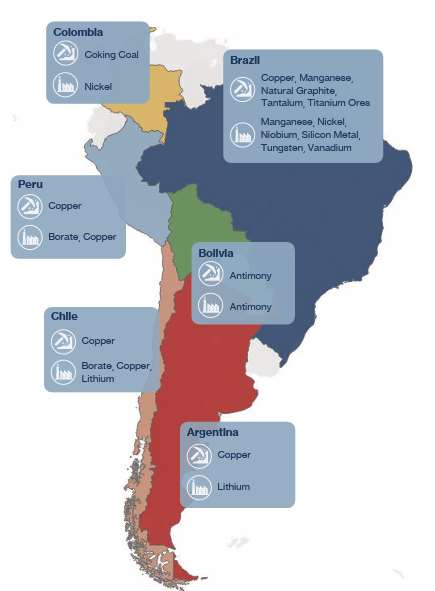
The EU’s approach, marked by maximalist demands, raises eyebrows globally, with developing economies finding it patronizing. This stance risks diminishing the EU’s global approval ratings, as seen in the frustrations expressed by Indian officials during negotiations for a free trade Figure 9: CRM extraction and refining divided over different South American countries. Source: HCSS, 2023. agreement. Implying that Mercosur countries may lose the EU deal if they don’t meet Brussels’s demands is counterproductive. Negotiation involves compromise, and pushing too hard may lead partners to perceive inequality. Mercosur countries, nearing a tipping point, recognize that any fallout with the EU would make China an eager alternative. Engaging in a cooperative manner would not only enhance the EU’s influence but also provide a foundation for addressing environmental concerns and establishing a sustainable basis for future cooperation. Only in this way can the EU become Latin America’s partner of choice.200
SHIFTING FROM EUROCENTRISM TO EQUAL COOPERATION
The EU must reconsider its economic diplomacy strategy as criticism surrounds the proposed Critical Raw Materials Act. This legislation is accused of perpetuating a neocolonial economic framework, potentially forcing resource-rich countries into the historical role of suppliers to Global North nations, thus continuing patterns of exploitation. 201 This aligns with the rising protectionist policies in Latin America, driven by concerns about resource over-exploitation rooted in the historical concept of ‘extractivismo,’ where natural resources were extensively extracted by foreign nations, primarily European, since the late 1900s. This historical context understandably raises apprehensions in the region regarding potential exploitation of its valuable minerals.202 The EU’s current approach is viewed as a mere rebranding of outdated policies rather than a genuine update. Critics argue that the EU’s use of the China argument lacks substantial changes in trade practices, presenting a colonial perspective. They contend that the EU, under the guise of competition with China, may continue to exploit Latin American countries rather than fostering equitable and mutually beneficial trade relationships.203
In light of evolving dynamics in Latin American countries, EU trade diplomacy must pivot to a new approach, especially as it lags in regional CRM investments compared to counterparts like the US and China. This revised approach should involve a shift in focus from mere extraction to refining materials within these countries, aligning with their aspiration to add value to products and move up on the supply chain.204 In this way, the EU adequately responds to Latin American wishes. Their ambitions extend further than the refining of these materials: Peru seeks lithium industrialization, Argentina aims for a lithium battery plant, and Chile eyes developing its battery materials sector, with future plans for electric vehicle production.205
Despite challenges like political conflicts and inadequate infrastructure, Latin American leaders are assertively strengthening their control over CRMs and its benefits. 206 Policy-makers are implementing measures to enhance economic gains through downstream processing of critical minerals. Mexico is deliberating the nationalization of lithium, aiming to add value to raw materials and anticipate higher export revenues, increased taxes, and positive economic outcomes.207 This ties into their changed resource management as they adopt a more assertive stance in negotiation. The “Lithium Triangle” countries – Bolivia, Chile, and Argentina – representing 60% of the world’s lithium reserves, are in discussions about forming a strategic regional alliance, often referred to as a “lithium OPEC.” This vision aligns with Bolivian President Luis Arce’s aspiration to increase state participation and limit exports, fostering the growth of the domestic downstream industry. Such an alliance holds significant potential, enabling these countries to move beyond lithium mining to processing and technology development. With Brazil’s substantial experience in the automotive sector, this move could be disruptive, creating a significant integration of Latin America’s two largest economies. This assertive stance underscores the region’s commitment to leveraging the geopolitical value of critical raw materials in negotiations and global markets.208
As global dynamics evolve, the dissatisfaction in the Global South intensifies, challenging the representation in the international system and questioning the perceived double standards of the West. To address this, EU leaders must move beyond Eurocentrism, as advocated by Dutch Foreign Minister Hoekstra, by adopting a more assertive diplomatic stance that listens, engages in dialogue, and adapts to the changing power balance. Trade agreements, specifically, can serve as a geopolitical tool to deepen relationships with emerging countries and counterbalance China’s economic influence. This could be done with a short-term, transactional approach or a deeper and more substantive, long-term strategy on the basis of equality and share values.209
Latin America, with its rich natural resources, desires a shift from the traditional “dig and ship” model towards more value-added processes. As the EU seeks to secure its CRM needs in competition with the US, China, and Japan, it should position itself as a value-add partner. While offering competitive prices is persuasive, the EU can stand out by helping Latin America develop its processing capabilities and other value-added capabilities like battery plants and car factories. Technical, regulatory, environmental, and educational assistance from the EU could advance the collective economy of Latin America, fostering a move towards more sustainable and advanced processes.210
In addition to facilitating value addition, the EU can play a crucial role in addressing social, political, and regulatory tensions that often hinder investments in Latin America. With the region experiencing shifts toward populism and resistance from local communities, the EU can contribute by providing environmental education and collaborating with local regulators and mining companies to build credibility. This proactive involvement can expedite mine development and boost the production of critical minerals.211
Furthermore, the EU has the potential to alleviate the burden of high tax rates imposed on Latin American mining companies by providing low-cost financing to local governments. This financial assistance can bolster regulatory and environmental oversight and facilitate the development of vital infrastructure like hospitals, schools, and roads. Such initiatives not only benefit local communities but also create an environment conducive to increased production of critical minerals.212 Additionally, Latin America stands to gain from increased engagement with the EU, offering a diversified array of CRM buyers compared to the dominance of China in the market.
CONCLUSION
In conclusion, the EU must transcend rhetoric and take concrete actions to support Latin America in its pursuit of vertical supply chain integration. By aiding in value addition, addressing socio-political challenges, and fostering economic development, the EU can establish equitable and mutually beneficial trading relationships. The Free Trade Agreement with Mercosur assumes paramount importance in this context, but its success hinges on the understanding and cooperation of national governments within the EU, including France. This necessitates a paradigm shift towards reciprocity rather than one-sided extraction, aligning with the demands of the current era. Such an approach not only secures the EU’s CRM needs but also contributes to the sustainable development of Latin America, fostering a more equitable global trade landscape.



Leave a Reply