
The Emergence of a Geopolitical Giant?
How the expansion of BRICS+ could reshape finance, energy markets, and global sea lanes.

grown, indicating interest not only in enhanced bonds between the initial members, but also in expansion, with the official invitations to Saudi Arabia, United Arab Emirates (UAE), Iran, Egypt and Ethiopia constituting the pinnacle of this process. These countries can really strengthen the organisation in multifarious sectors, some of which, namely economy, energy and geopolitics, will be pondered here, in order to accentuate some crucial advantages it gains and how the international status quo could be affected.
The economy of the BRICS
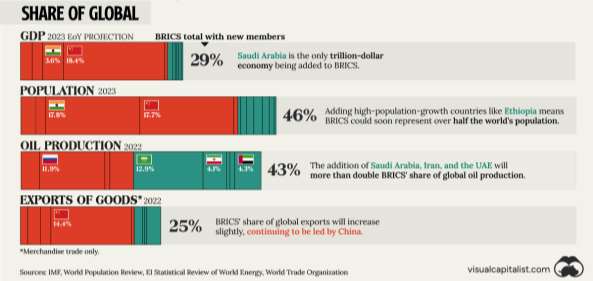
The financial potential of the BRICS+ in 2024 is quite remarkable, with 45% of world population and 29% of GDP, at about 30 trillion dollars, though still being considerably lower than the one of the G7, at 45 trillion, thus 49% of global GDP.44 Furthermore, they are quite important exporters, especially China, signifying their global financial influence potential, which can render them increasingly able over the next years to set the agenda on a vast number of issues.
Furthermore, BRICS+ ambitions for a new currency, backed by gold or other commodities, such as rare earth metals, are of great interest and significance, though its materialisation is not yet guaranteed. Unlike the fiat currencies, which are currently mostly used, this will not be backed by the governments and linked to supply and demand, or to the stability of (and the trust towards) a government, which would irrefutably be a major shift regarding the way the global financial system functions. At this point, it is not known how exactly this currency or basket of currencies, given that there are no intentions for a replacement of national currencies, will operate.
Potential implications for the US dollar are also paramount. Even though prophecies for the end of the US dollar and its collapse are rather exaggerated, it should be expected that the creation of a BRICS+ currency would have a negative effect on the dollar. In particular, it would considerably decrease the use of the dollar in the international trade, given that BRICS+ represent about 25% of world exports45, besides they already encourage the increased use of local currencies as also mentioned in the Johannesburg Declaration, after the BRICS summit in South Africa in August 2023. A deevaluation of the dollar might require considerable changes in the US economy and even affect its robustness.
Nonetheless, to foster such an initiative, strong connection between the countries’ economies is required and that is not very easy, among others due to the great distances, for instance, Brazil is rather isolated at this point from the other BRICS+ countries, political differences and the asymmetry of their economies. A common monetary policy seems, thus, unlikely. Collectively backing one currency could also be a choice. Regardless of its final form, it is certain that this initiative will face serious challenges.
Overall, BRICS+ is a robust financial organisation, with considerable investment capabilities, China is probably the most active with the Belt and Road Initiative, a huge international infrastructure project, and many important states in world trade. An important reason for that is also the crucial role of many BRICS+ countries in the energy sector.
THE BRICS AND ENERGY
Energy is the basis for almost everything in modern societies. Fossil fuels like oil and gas and critical raw materials such as rare earth metals are vital for a vast number of functions, electricity, cars, ships and aeroplanes, wind turbines, heating and batteries. Therefore, countries that possess considerable quantities of such materials have a leverage compared to countries that lack them. Increased inflation in Europe after the outbreak of the war in Ukraine, mainly due to imposing sanctions on Russia in the energy domain, is a prime example.
Saudi Arabia, Iran, UAE and Russia are prominent members of OPEC+, a cartel of significant petroleum producers, which plays a crucial role in determining the price of oil globally. Closer cooperation within BRICS+ will enable them to form a robust, united front that can influence the global price of crucial resources, according to their will and to the detriment of countries they view as rivals and do not possess abundant resources, as they represent over 40% of global oil production in 2023.46
Of course, an excessive weaponisation of oil and gas might not be a preferable choice for the states, which should set prices facilitating trade, in order to increase their revenues. Furthermore, political exploitation of resources can enhance the already dynamically rising trend of gradually changing the energy mix, with a marked augmentation of renewable sources of energy, hence the BRICS+ leverage ought to be taken into consideration, given that fossil fuels are still very important and are likely to remain so in the mid-term, but should not be exaggerated.
Nevertheless, these developments can grant to the organisation another major advantage. In particular, increased use of renewables, like wind or solar power, require a considerable amount of rare earth metals, which constitute a sector dominated by China, as it produces 60% of them and, even more significantly, processes 90% of them, giving China almost a monopoly 47 . This enables the country to threaten the financial, the energy and even the national security of the US and the West collectively48. In this sense, the ‘green transition’, which among others was also viewed in Europe as the way to energy independence from Russia, might lead to new dependencies, equally problematic.
THE GEOGRAPHY OF THE BRICS
An often overlooked facet of the BRICS expansion lies in its profound geographical and geopolitical ramifications. Despite their dispersion across different regions, these nations are intricately linked through a network of Sea Lines of Communications (SLOC), underscoring their strategic command over pivotal junctures crucial for global commerce.
Commencing from the northern region with Russia, a significant force envelops a substantial portion of the Arctic. As the ice gradually recedes, the Northern Sea Route emerges as a compelling alternative for shipping, presenting potential advantages, although the capacity to offset the costs of climate change remains uncertain. With a robust military presence and an extensive fleet of icebreakers, Russia holds considerable sway in this promising domain. In recent years, not only has Russia augmented its investments in various projects, but it has also witnessed a notable enhancement in cooperation with China in the region. China’s self-proclamation as a ‘Near-Arctic State’ and its substantial investments, including the construction of stations, have raised apprehensions in several Western nations, particularly regarding potential espionage capabilities.49
Progressing clockwise, we encounter the Pacific, featuring not only Russia’s harbor in Vladivostok but also China, a dominant player in the vast East and South China Sea. China’s assertive efforts to establish control over the sea and extend its influence to neighboring states have not escaped the notice of the United States, turning the Pacific into a significant arena of competition between these two global powers.
Continuing westward, the SLOC leads to another BRICS+ member, India, and the Indian Ocean. India’s harbors emerge as crucial points for the organization, particularly considering India’s status as a pivotal, burgeoning market with a population of 1.4 billion people. Prime Minister Modi’s ambition to position India as a major global power aligns with its role in key trade routes, marking an essential stride.
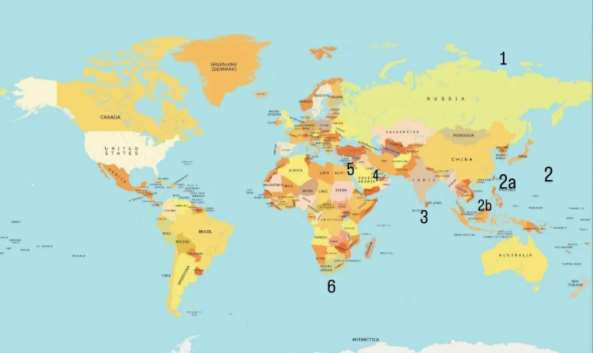
1. The Arctic and the Northern Sea Route · 2. The Pacific Ocean
2a. East China Sea (Korea Strait and Taiwan Strait) · 2b. South China Sea (Makassar Strait)
3. The Indian Ocean (Strait of Malacca) · 4. Persian Gulf (Strait of Hormuz)
5. The Red Sea (Bab-el-Mandeb and the Suez Canal) · 6. South Africa (Cape of Good Hope)
Next stop is the Persian Gulf and the Hormuz Straits, where new members of the BRICS+ are indubitably dominant. Saudi Arabia is considered the leading country of Sunni Muslims and the UAE, while small, are also quite influential. As for Iran, it is not just the strongest Shia country, but, as it has demonstrated multiple times, can close or render very perilous to pass, the Hormuz Straits, from which about 20% of world’s oil consumption passes daily50, thus can have dire repercussions on many states. As long as oil remains a significant resource, these three countries will remain pivotal in world economics and politics.
Another paramount commercial point is the Red Sea and the Suez Canal. Ethiopia has strived to gain access to sea, as also the agreement with Somaliland indicates that can augment its power and prestige in Africa, whereas Egypt’s Suez Canal constitutes one of the most important passages for international trade and the Egyptian Suez Canal Authority is also a paramount organisation setting the tolls for ships seeking to cross the Canal. From its nationalisation by Gamal Abdel Nasser in 1956, to the contemporary Houthi attacks on ships crossing the Red Sea, any kind of developments in the region have a global impact.
In order to avoid this occasionally turbulent area, ships need to travel around Africa, which can benefit another BRICS+ country, South Africa and its ports. Though there have been some difficulties in managing the augmented amount of ships, this development can help in increasing their significance and revenues that can be invested for the improvement of these harbours.
Brazil does not exhibit control over a major SLOC, yet it still offers BRICS+ a ‘window’ to Latin America, the historic backyard of the US, and it would have been even more important, had Argentinian president Javier Milei opted to join the organisation as well. In any case, from the North Pole and the Pacific, BRICS+ can reach the margins of Europe, controlling some assets of insurmountable significance in terms of trade, but also of geostrategic value.
CONCLUSION
Taking everything into consideration, it is not under question whether the BRICS+ are already a geopolitical and financial behemoth, the numbers speak for themselves. What is under question is how stable and robust this giant is and how solid its foundations are, provided that so far, decisions are taken unanimously and are based on the convergence of national interests, which however, as the European experience has also demonstrated, circumscribes the depth of their bonds and as articles below will show, the BRICS+ are also quite rich in tensions.



Leave a Reply