
Date: June 5, 2025
Event Summary
This is a report of the event: GAxSIB Presents: Independent Europe. The report will include different parts of the speaker’s presentation and include both his as well as the broader group’s analysis from those in the room on each section. It will end with discussing what ideas were presented in our workshop following the presentation.

The GAxSIB event, “Independent Europe,” gathered Students and young professionals with experienced professionals who are interested in exploring the shifting realities of European security and defence autonomy. The event focused not on reiterating institutional narratives but on confronting uncomfortable strategic truths: Europe is entering a multipolar world, American guarantees are no longer guaranteed, there is increased instability in Europe and on NATO’s Eastern flank, and internal fragmentation will weaken Europe’s response to these challenges. The key question raised was not whether Europe should become strategically autonomous but whether it can do so in time?
The keynote presentation was delivered by Markus Iven, who currently serves as a Reserve Officer at the German Military Delegation to NATO. He previously spent more than a decade as an officer in the German military, including five years as an exchange officer in the Netherlands, where he obtained an M.A. in Military Strategic Studies from the Netherlands Defence Academy.
In his presentation, he explained global political developments by linking them to academic International Relations theory, thereby offering a personal, science-based assessment of the question of European strategic autonomy. His analysis was particularly grounded in the academic school of Realism, drawing on the works of John Mearsheimer, Henry Kissinger, and Graham Allison.
Afterwards, the presentation, a workshop was held, where audience members had the opportunity to think about and present their ideas and engage directly with the topic.
There were three sub-questions in the presentation that the audience had a chance to think about. They were:
Sub‑question 1
What does U.S.–China great power competition mean for European security and NATO?
Sub‑question 2
What are future scenarios for NATO?
Sub‑question 3
How feasible are EU armed forces?
Core Themes and Takeaways of the Presentation
The presentation was grounded in the following books, which served as a basis for challenging conventional thinking and encouraging critical engagement with controversial perspectives:
The Tragedy of Great Power Politics by John Mearsheimer: This book establishes a theory of how the world works, making several key assumptions: states are the primary actors, they are rational, and they compete for power. His framework argues that, because there is no overarching authority, states fear each other and cannot know the intentions of others.
This perspective is used to analyse how the U.S. views China. The U.S. fears China because of its growing industrial, military, and economic power. In the chaos of an anarchic world system, countries feel the need to maximize their power. Within this framework, the competition that China poses to the U.S. is seen as an existential threat.
On China by Henry Kissinger: Kissinger’s main contribution is establishing a scenario for détente. Rather than assuming the U.S. and China must inevitably go to war, Kissinger, who was a practitioner of international relations, presents détente as a possible alternative to conflict, especially as China rises as a major global power.
This framework is used to analyze how major powers can avoid confrontation and instead manage their relations through careful diplomacy and balance. By applying Kissinger’s approach, states can exert enough strength to defend their interests while also pursuing a policy of détente, aiming for peaceful coexistence rather than escalation.
Destined for War by Graham Allison: This book discusses the Thucydides Trap, using the historical example of Athens and Sparta, where Sparta’s fear of Athens’ rise led to war. Based on the theory , when a rising power challenges an established power, war occurred in 12 out of 16 historical cases. This framework is used to analyze the probability of the U.S. and China going to war.
While the historical pattern suggests that war is a frequent outcome, the presence of nuclear weapons introduces a wildcard, as two nuclear powers have never engaged in a full-scale war.
1. Strategic Context: Decline of Unipolarity and NATO’s Fragility
The analysis is set against the backdrop of an ongoing shift from a unipolar, U.S.-dominated order to a multipolar system shaped by the rise of China. Referring to Realist theory, it was argued that Europe risks becoming collateral in an emerging struggle between great powers. From a Realist perspective, NATO’s original purpose was to serve as an instrument of U.S. power projection against the Soviet Union. However, considering evolving geopolitical dynamics, the alliance now faces increasing pressure to redefine its strategic priorities.
Group Analysis: The group analysis found that NATO, as it exists, relies too much on American investment and must accept that the U.S. will likely take a reduced role in the future. This could mean that the alliance is either deeply reformed to become more dominated by Europeans, or it gradually is replaced with something new. The group also recognized that while Realism has its purposes, it is a flawed analysis if it does not factor in variables such as soft power, identity, and culture.
2. Military Readiness: Numbers, Logistics, and Geography
An assessment of military capabilities by the International Institute for Strategic Studies was discussed. The situation appears quite bleak, as the Baltic states have limited manpower compared to Russia’s large pool of reserves. The Russian war economy produces equipment faster than Ukraine or Europe, and NATO strategy continues to rely heavily on American soldiers as the U.S.’ commitment to European defense is increasingly uncertain.
This means NATO, already undermanned, risks entering a potential conflict without the full support of its strongest member. Some countries focus primarily on their own national interests and are less willing to engage in conflicts they do not view as directly serving those interests. This is particularly true of powers like the United States, Southern European nations, and Turkey, whose strategic priorities often lie outside Eastern Europe.
Additionally, many Baltic states and other eastern members remain skeptical of the European Union’s ability to take over NATO’s role in collective defense as long as the EU requires unanimity for decisions on foreign and security policy.
Group Analysis: While European states have made commitments to increase defence spending, differences in military capabilities, national priorities, and strategic cultures among member states present ongoing challenges to the collective security of NATO. Some countries, such as Turkey and Greece, are particularly focused on their specific regional and national interests, while others, like Spain and Italy, prioritize issues in the Mediterranean. In addition, Iceland and Luxembourg, due to their very limited military capability, make a very limited contribution to NATO’s large-scale military operations. As a result, Europe remains strategically vulnerable, especially in the east, as Germany and France remain hesitant to assume leadership, and consensus decision-making in the EU hinders effective defence planning.
3. The U.S. Strategic Recalibration: Indo-Pacific First
It was discussed to what extent the United States increasingly views China—not Russia—as its primary strategic competitor, and this perspective is becoming more evident in recent foreign policy decisions. It was noted that Europe faces growing pressure to take greater responsibility for its own security, as it cannot indefinitely rely on U.S. support for its defence. Examples such as the U.S. withdrawal from Afghanistan and the decision to step back from supporting Kurdish forces in Syria were highlighted, demonstrating how Washington may prioritize its own national interests, even when these decisions create challenges for its allies.
Group Analysis: It was discussed that the United States is now primarily focused on Asia and the rise of China, leading to a gradual divergence between U.S. and European interests. As a result, Europe can no longer assume that the U.S. will always be committed to guaranteeing stability in the region. This shift highlights the need for European countries to invest more in their own security and strengthen their collective defense capabilities.
4. Future Scenarios: Four Strategic Pathways for NATO
It was discussed that, from the perspective of offensive realism, four main scenarios for NATO’s future can be mapped along two axes: one running from war to peaceful competition, and the other reflecting whether the United States or China is the most important state in the international system. “NATO breaks” means unity fails, leading to possible wars without support between allies. “NATO’s decline” sees centrifugal forces, distrust, and possible armed conflict among European middle powers. In “NATO succession,” a new alliance forms around European middle powers or the EU gains supranational authority. “A European NATO” is a concert of European middle powers, with the U.S. only in a supporting role.
Group Analysis: Only one scenario has NATO remaining the primary actor, with NATO becoming dominated by European middle powers and the U.S. reduced to a supporting role. If China becomes the dominant power of the 21st century, then NATO will either break or decline. On the other hand, if the U.S. remains the dominant power, a path where war breaks out could lead to NATO being supplanted by a European Union-like agreement. However, if the U.S. remains the dominant force and maintains peace with China, it could see the best scenario for NATO. In any case, the next several decades are pivotal for NATO and will determine the face of European and Western security architecture for generations to come.
5. Policy Proposals: What Europe Must Do
A plan for European strategic autonomy was discussed. The main points were
- It was noted that the transatlantic alliance remains deeply rooted in the thinking of European leaders, however European should now acknowledge that their continent is not a priority for the U.S. anymore.
- Ensuring Ukraine’s survival as a buffer against Russia was seen as essential, as losing Ukraine would expose more of NATO’s eastern flank.
- The need to restore the balance of power by sending European forces to the eastern flank, rather than less vulnerable areas, was emphasized.
- There were calls for Europe to assume more command within NATO and
- Build a European nuclear arsenal to ensure deterrence, with the warning that otherwise states like Poland may act alone.
- Reforming the EU was also seen as necessary, since veto power can block effective defense.
- Finally, establishing European deterrence addressing the security dilemma was viewed as crucial. This will require both arms control and détente with Russia, aiming for security with, not just against, Russia in the long term.
Group Analysis: These are necessary steps that Europe needs to consider. Europe must strengthen itself and become ready to defend itself in the event of a war. However, it must not seek war unnecessarily. Instead, Europe must utilise its strength to increase its leverage in negotiations and ensure it remains an equal partner of the Americans, should that relationship continue.
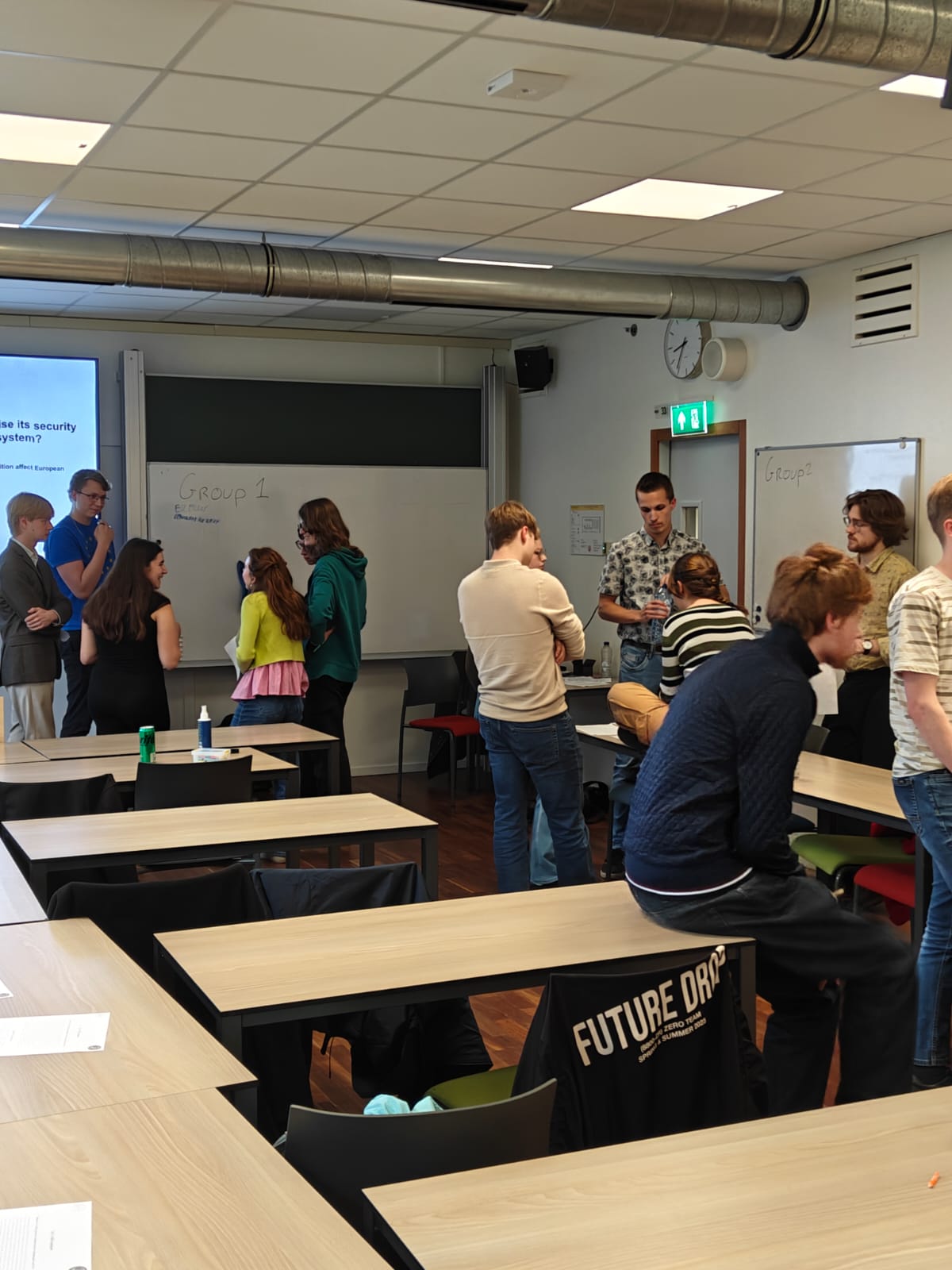
Workshop
During the workshop, attendees were divided into groups to reflect on three guiding questions related to Europe’s strategic autonomy, NATO’s future, and the path forward for European defence.
As a reminder, these were the questions:
Sub‑question 1
What does U.S.–China great power competition mean for European security and NATO?
Sub‑question 2
What are future scenarios for NATO?
Sub‑question 3
How feasible are EU armed forces?
Here is a breakdown of each group’s responses:
Group 1:
- We are at a pivotal moment where the EU and NATO have the opportunity to take decisive action. If they do not take sufficient action, they will lose their chance.
- A sudden urge for unity amidst renewed threats.
- EU armed forces are not quite feasible. If it happens, we are likely on the brink.
Group 2:
- Great power competition will benefit the EU economy, as Europe will begin investing in its industry amid the need to do so. However, there are risks of clashing narratives, as we’ve seen with the growth of populism and conflicting identities. Not just manpower but also values and identity.
- The group did not address this question in their discussion.
- Unlikely but not unthinkable. The narrative has shifted tremendously and could continue to do so.
Group 3:
- Less Chinese attacks on Europe if their focus is on the U.S., less attention by the U.S. on Europe
- Soft withdrawal
- There may be an issue of political will versus. The extension of the French and UK nuclear umbrellas may be more practical.
Group 4:
- The global situation is more chaotic (the Cold War was split in two, with blue vs. red). Now you have more powerful countries that aren’t aligned with either party (ex: India)
- The group did not address this question in their discussion.
- The group did not address this question in their discussion.
The variety of answers made for a fruitful discussion and interesting dynamics. Some groups argued that the current situation presented an opportunity and that Europe would invest further in the region. In contrast, others warned that the world was becoming more chaotic and that Europe needed to learn how to handle the new dynamic.
One of the more interesting dynamics was the views on a European army. All were somewhat sceptical, though some were mainly concerned about the logistical side. In contrast, others questioned the political will and identity. Do Europeans feel European? Would they fight for other Europeans, far from their shores?
There was then a discussion on EU identity. Audience members were asked about whether attendees felt “European” or not. Some said they do because of opportunities such as Erasmus, which they receive and that have impacted their lives. Others said no because they don’t feel any connection to the geographic borders of Europe. However, instead, they think “Western” because they grew up in a Western country that happens to be part of the European Union.
The discussion on identity reveals that there are multiple dimensions to consider when discussing Europe’s future and integration. It is not just a question of money or logistics but one of identity. What are people willing to sacrifice, and for whom? Are we strangers bound only by the continent we live on, or is there a sense of common solidarity, unity, and identity?
One audience member made a very nice point regarding identity and how Europe’s classical liberal values and identities are under stress. Many question why they do not adopt the model of the Chinese, who have redefined and created their sense of modernity. They argued that if Europe cannot establish a common identity, its people will be less likely to fight for it.
Concluding Thoughts
The session did not offer easy solutions, but it did offer insights. The opportunity for students and young people to engage with experts on these key topics is invaluable. As we head into the future, we must not only look at the present but also consider the future and the generations to come.
The presentation focused heavily on the Realist perspective, analysing Europe’s ability to challenge Russia in the context of complex numbers. This provides us with insight into critical shortcomings that Europe must address independently of the U.S. However, in addition to making policy reforms, we must also examine culture and identity.
This was a valuable insight from our workshop, as we observed that even among university-educated students interested in Europe’s future (a demographic that tends to be more open to further integration), there was hesitancy over whether some identified as European.
Not only must Europe rearm itself to combat its military threats, but it must also establish a clear message, especially to young people, about what it means to be European. When examining history, nation-states and great powers have prospered by establishing a standard set of identities and ideals. This makes the population more supportive of the state. Suppose the European project is to advance beyond its current state. In that case, it must build an identity that its population can support.
The coming years will be difficult. It will require honest discussions, questioning of priorities, reinvestment in military capabilities, sacrifices on the home front, and open conversations about what each nation and its people are willing to fight for.
That is why it is so important to have events like these, where experts get the chance to engage with young professionals who will shape tomorrow, and those young professionals can learn from those who shape today.



Leave a Reply