
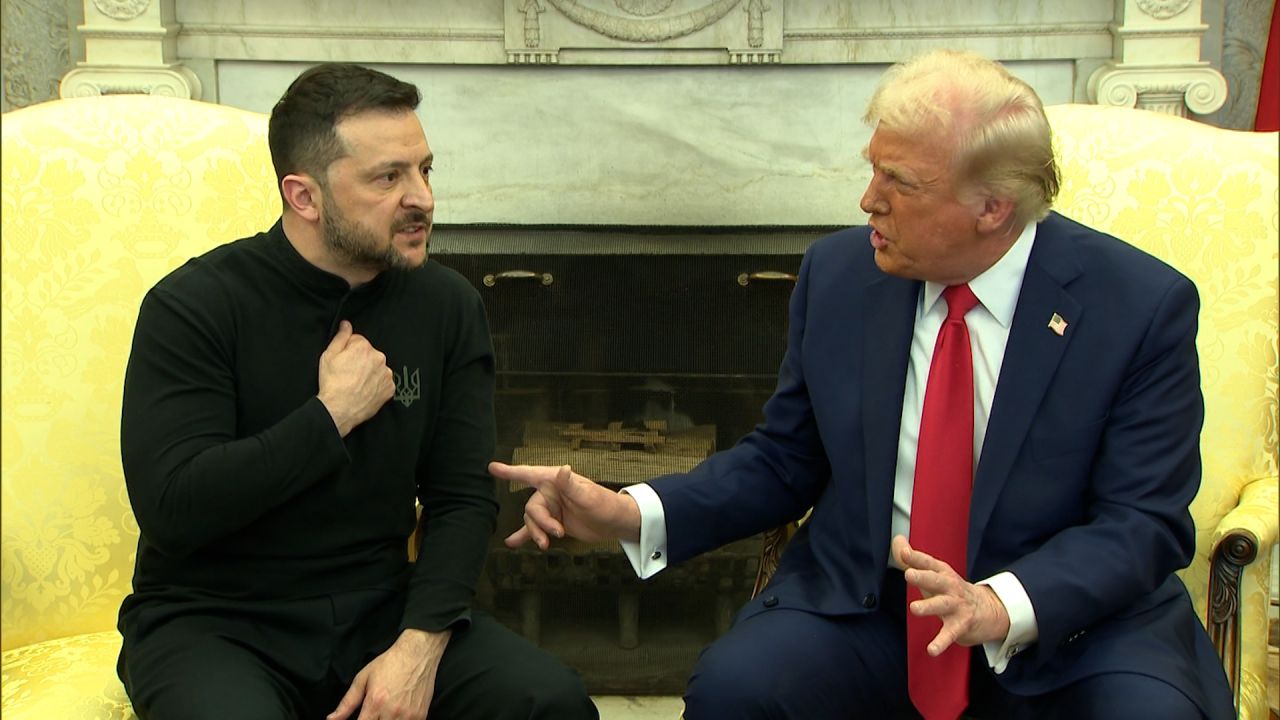
Trump and Vance erupt at Zelensky in tense Oval Office meeting
United States President Donald Trump and Vice President J.D. Vance made headlines last week after a public spat with Ukrainian President Volodymyr Zelenskyy. Zelensky was in Washington to sign a minerals deal with the U.S.
U.S. relations with Ukraine and its European allies have been tense in the past weeks. The U.S. began negotiations with Russia over the war in Ukraine without involving its allies in the European Union or Ukraine itself. Following this, the U.S. demanded half of all mineral wealth from the Ukrainians in exchange for continued military support, a deal that the Ukrainians initially refused. Last week, it seemed the two sides had come to an agreement. Zelenskyy was in the White House with the Ukrainian delegation to sign the deal.
However, during his meeting with Trump and Vance, Zelenskyy faced an unexpectedly harsh rebuke from the Vice President. Vance began chastising the Ukrainian president in front of the press and an international audience. While diplomatic meetings can be quite tense, the harsh nature of how Vance addressed Zelenskyy is not typical of public meetings in the White House. Vance also condemned Ukraine for sending conscripts to the front lines, arguing it was inhumane.
Trump initially was silent but would jump in, accusing Zelenskyy of being disrespectful and saying that Ukraine was not in a position to negotiate without the U.S. and that they “don’t have the cards.”
Following the meeting, Trump administration officials told Zelenskyy and the Ukrainian delegation to leave the White House. The Ukrainian president cancelled his speech to the Hudson Institute, a U.S. think tank, that was scheduled later in the day.
Trump and Vance were praised by former Russian President Dmitry Medvedev, who called Zelenskyy an “insolent pig” and praised the U.S. President and Vice President. Republican lawmakers praised Trump and condemned Zelenskyy. Senator Lindsey Graham, a longtime foreign policy “hawk” and previous supporter of Ukraine, defended Vance, saying he was proud of him for standing up for the country (U.S.). Senator Tommy Tuberville meanwhile called Zelenskyy “that Ukrainian weasel.”
This type of diplomatic spat is usually reserved for closed doors. Additionally, the number of undiplomatic comments by Trump and various Republicans showcased a new era of the U.S.’ foreign policy. As mentioned in a previous GA analysis, Trump’s America does not have allies, only business partners. Because of this, the U.S. views it as acceptable to condition aid on a very one-sided deal and aggressively negotiate. The U.S. has leverage, and Trump, as a businessman, knows how to use leverage to one’s advantage.
Additionally, this has been part of a several years-long shift by the political right in the U.S. and, to a lesser extent, in parts of Western Europe toward a more pro-Russian view. The War in Ukraine in the U.S. has become a predominantly partisan issue, with mostly Democrats supporting aid for Ukraine. At the same time, Republicans like Vance have been critical of Ukrainian assistance since the outbreak of the full-scale invasion.
Finally, one of the big takeaways of this whole segment is J.D. Vance’s role and influence on Trump’s foreign policy. Since being picked as Trump’s vice president, Vance has served as an attack dog. This is particularly notable in diplomacy, as he can put pressure on foreign leaders and aggressively negotiate when Trump needs him to. Additionally, Vance is educated and knowledgeable about European political dynamics. Shortly before the German election, he made waves when he met with the Alternative für Deutschland party leader, Alice Weidel. U.S. Vice Presidents often vary in how active a role they play. Vance’s involvement in foreign policy may remind some of the role Dick Cheney played during the Presidency of George W. Bush.
Trump’s administration has already had many accusing Musk of being the leading figure behind its actions; however, in terms of foreign policy, it is worth paying attention to Vance. Trump’s administration has shown that it views strength, leverage, and applying pressure as key tactics in achieving its foreign policy goals. In this framework, Vance, the attack dog, perfectly represents U.S. foreign policy interests going forward.
Six takeaways from Trump’s big speech
United States President Donald Trump gave a big speech to Congress on Tuesday night. His speech contained a few key takeaways that should indicate Trump’s priorities going forward.
Firstly, Trump is pushing through his tariff policy. Unlike many of his other policy proposals, which received standing ovations, many Republicans stayed seated when he discussed his tariff policy. This showcased that despite strong support among the Republican base, many Republican elected officials worry about the economic ramifications of Trump’s trade war policies. However, Trump is standing firm on this, saying that tariffs are about making America rich and great again. He also admitted, “There’ll be a little disturbance, but we’re okay with that. It won’t be much.”
Secondly, it seems the rift between the U.S. and Ukraine might be moving in a less hostile direction. Trump announced he received a letter from Ukrainian President Volodymyr Zelenskyy, saying he would work with Trump to end the war. The letter is seen by many as an olive branch by Ukraine following a tense exchange with Trump in the White House. Whether this will last remains to be seen, as the two countries seemed to be on the same page when they announced a minerals deal last week.
Thirdly, Trump has reinforced his territorial ambitions. He reaffirmed that the U.S. would get Greenland “one way or the other” and that the country would “reclaim” the Panama Canal. Trump also chastised his predecessor for supposedly wasteful spending, listing various African nations and the aid they received as a waste.
He specifically mentioned Lesotho, saying it was a country “no one had heard of” that received billions of dollars to promote LGBT rights. This fits both with Trump’s attack on USAID and also on the years-long backlash on the American right against LGBT rights. Since the passage of Same-Sex marriage and the increased prominence of issues such as Transgender rights, there has been an increased backlash on the right, with many conservatives emphasising such issues as keeping Trans athletes out of women’s sports as wedge issues to drum up support and rally their base. Trump, in his first term, banned Trans people from the military, which was reversed by his successor (then predecessor), Joe Biden. However, now that Trump is back, he has done it again as part of his crusade against “diversity, equity, and inclusion” (DEI). Trump listing support for LGBT rights as “wasteful spending” showcases his priorities for U.S. foreign policy going forward and the U.S.’ backlash against LGBT rights generally.
Fourthly, Trump has remained loyal to Elon Musk, defending him amid massive criticism against his involvement in U.S. and foreign politics and the cuts by his Department of Government Efficiency (DOGE). Many criticised DOGE for not being approved by Congress as it has fired thousands of government employees, attempted to buy out millions of federal workers’ contracts and gone after departments such as the Consumer Financial Protection Bureau and the National Labor Relations Board.
However, Trump has made it clear that he supports Musk and what he has done so far. Many expected a fallout between Trump and Musk early on, with reports of Trump staffers annoyed at Musk’s presence. However, it is clear that the alliance between Trump and Musk will remain strong in the foreseeable future.
Fifth, many Democrats are beginning to push back. Representative Al. Green was escorted out after he refused to stop heckling Trump. Green repeated when Trump spoke that he did not have a mandate to cut Medicaid, a U.S. program to provide Healthcare to those in poverty. The Republican-led Congress recently announced an $800 billion cut to Medicaid in a recent spending bill. Many Democrats also held signs saying, “That is a lie”, and in the official response by Representative Elisa Slotkin, she accused Trump of an unprecedented giveaway to his billionaire friends.
Finally, regarding inflation, Trump says that by opening up oil and gas drilling, he can bring prices down. This comes as only ⅓ of all Americans approve of Trump’s handling of the cost of living, one of the defining issues of last year’s election. Trump would particularly emphasise the price of eggs, which rose last year due to the bird flu outbreak. However, prices have continued to increase under Trump, and it seems unlikely they will drop anytime soon.
Germany moves to overhaul debt rules to unleash major defense spending
Germany’s incoming chancellor, Freidrich Merz, has indicated plans to exempt defence spending from the country’s constitutional debt brake. The debt brake has been a fiscal constraint on spending and investment in the country’s economy.
Germany passed a debt-brake in 2009, following the Great Recession in 2008; however, it has come under increasing scrutiny in recent years. While the country was able to spend more as part of emergency measures during the COVID-19 pandemic, after the pandemic ended, courts forced governments to abide by the debt brake, leading to a lack of investment in crucial areas.
One area where this was a concern was defence, as Germany had committed to 100 billion Euros in defence spending following the Russian invasion of Ukraine. This also came following pressure from the United States. The topic of militarisation has been sensitive in Germany, with many in Germany opposed to heavy investments in the military due to the memory of the Second World War.
In 1999, Germany took part in the NATO intervention in Serbia, which was controversial, as it was the first time the country would take part in a war since the defeat of the Nazis. It would then get involved in Afghanistan, which was also incredibly controversial. However, with the increasing shifting allegiances of the United States, Germany, like much of the European Union, feels the need to increase its own spending as the continent faces threats from an expansionist Russia, terrorism, and the growing influence of China.
Under the incoming Merz government, defense spending may be exempted from the debt brake. In order to pass this, the government needs more than a simple majority. It also needs the support of the German Greens, who have indicated that they want a stronger reform of the debt brake altogether if they are to support this.
U.S. cuts off intelligence-sharing with Ukraine
The United States recently announced it has cut off intelligence sharing with Ukraine. This comes after several chaotic weeks diplomatically between the U.S. and Ukraine. The U.S. began negotiating with the Russians directly, without Ukraine or other European allies present. Then, it demanded a large percentage of the revenue from Ukraine’s mineral wealth. The deal was initially rebuked by the Ukrainians, but it seemed the two sides came to a conclusion last week.
Then, after a tense conflict between U.S. President Donald Trump and Ukrainian President Volodymyr Zelenskyy (as mentioned in an earlier analysis), this seemed to be off the table. Then, in a speech to Congress on Tuesday, Trump indicated relations were warming up again.
Now, the U.S. has cut off intelligence sharing, something that was part of the country’s support for Ukraine since the beginning of the war.
The extent of U.S. intelligence sharing is classified. However, experts have indicated that it helped the Ukrainians understand Russian troop movements throughout the war. While Ukrainian intelligence has never said clearly what they received from the U.S., one can make educated guesses with Reaper drones and U.S. jets flying near the border and knowing that when a MiG-13 takes off, it triggers an air raid alarm in Ukraine.
This move is the latest step in Trump’s erratic foreign policy, where he keeps everyone guessing. This entire saga has reinforced worries among the U.S.’ allies, especially in Europe, about the U.S.’ unreliability. Ukraine remains in a delicate position as it does what it can to placate Trump and regain some favour. However, it is clear that the Ukrainians do not have time on their side as Trump’s position keeps shifting.
In the face of this, Ukraine may have become more receptive to a potential deal, even if it does not provide long-term security guarantees, as it hopes to secure an agreement before Trump shifts even further against them.
Exclusive: U.S. holding secret talks with Hamas on Gaza hostages
The United States. is reportedly engaging directly with Hamas in negotiations aiming to free American hostages. The move is a first as the U.S. has never engaged directly with Hamas in the past, designating them as a terrorist group in 1997.
The negotiations are led by the U.S. presidential envoy for hostage affairs, Adam Boehler. They took place in Doha, Qatar, the same place where the U.S. negotiated with the Taliban to end its involvement in Afghanistan in 2020 during Trump’s first term.
The main focus of the negotiations is the release of U.S. hostages. However, talks have included a potential broader deal for all hostages. The Israeli Defense Forces have estimated that 59 hostages are still held by Hamas, with 35 dead, 22 alive, and the status of two being unknown. Among those hostages are five Americans, with at least one believed to be alive.
Since January 2025, after 15 months of fighting between the State of Israel and Hamas, there has been a ceasefire, which has not yet broken. That said, there have been multiple threats by Israel to resume the conflict if Hamas does not release all the hostages. Additionally, Israel recently announced that it is cutting off all humanitarian aid to Gaza. It also sent troops into the West Bank last week.
Notably, relations between Israel and the U.S. remain strong despite Trump’s recent moves. Israel remains one of the few allies Trump has not alienated, with him enjoying a close personal relationship with Israel’s Prime Minister Benjamin Netanyahu (which you can read about in last week’s analysis).
However, according to reports, while the Trump administration did consult Israel about talks with Hamas, the Israeli government learned of these talks through other channels. It is too early to say whether this will shift relations between the Netanyahu government and Trump. However, it is a rare case of the U.S. bypassing Israel to secure its own interests regarding this issue.
Europe’s far-right split on Trump’s Ukraine squeeze
The European far right is often compared to United States President Donald Trump and typically has positive relations with him and his allies. However, there have been tensions within the European far right for several years over how to address Russia and Ukraine. The recent spat between Trump and Ukrainian President Volodymyr Zelensky has split the far right across the European continent.
France’s Marine Le Pen condemned the “brutality” of the U.S. holding up aid to the Ukrainians. Geert Wilders, often called the “Dutch Trump” due to their similarities in politics and hairstyles, said that he and his party support Ukraine “with conviction.” Italian Prime Minister Giorgia Meloni also stressed the importance of Western unity and reaffirmed Italian support for Ukraine.
On the other hand, the Alternative für Deutschland (AFD) party co-leader, Alice Weidel, who previously met with U.S. Vice President J.D. Vance and appeared on an X space with X owner and head of the Trump administration’s Department of Government Efficiency (DOGE), was less supportive of Ukraine. Instead, she simply said, “Historic. Trump & Vance!”
Hungarian Prime Minister Viktor Orban, another Trump ally, also backed him and mentioned the economic benefits of bringing Russia back into the Western fold. Notably, Orban had previously been an obstacle in the European Union at several points when it came to aid for Ukraine.
This highlights an increasing divide within the European far right over strategy and positioning. Previously, the AFD was in the same European Group in the EU parliament as Le Pen’s Rassemblement National (RN) party and Wilders’ Partij voor de Vrijheid (PVV). However, after increasing tensions between RN and the AFD, the Identity and Democracy Group they were all part of, collapsed, with RN and Wilders joining the Patriots for Europe (PfE) group that formed last year while the AFD helped found the Europe of Sovereign Nations (ESN) group.
Notably, Fidesz was a founder of the PfE group despite its diverging stance from RN and PVV here. Meloni’s party, Fratelli d’Italia (FDI), is part of the slightly more moderate European Conservative and Reformists group, which includes more Atlanticist and moderate parties along with strongly right-wing parties like FDI.
Ultimately, the spat showcases divides on how to approach politics. The AFD remains politically isolated in Germany, with any hints at a coalition with them being met with intense backlash. The PVV was in this position, but this broke two years ago when parties on the centre-right of the Dutch political spectrum opened the door to a coalition with them. PVV would become the largest party and join the current Dutch government. While it maintains many extreme positions, it does act more pragmatic at times due to the influence of more moderate parties.
Since becoming Prime Minister, Meloni made it clear early on that she is committed to NATO and the Atlanticist foreign policy, rebuking pro-Russia voices in her coalition and strongly supporting Ukraine. Orban and Fidesz have been in power for 15 years and have gradually moved further to the right, being accused by many in the EU of undermining Hungarian democracy. As such, it has improved ties with Russia to use as leverage against critics within the EU and NATO.
RN, meanwhile, is leading polls, and Le Pen has a very strong chance of becoming France’s next president. Since taking over the party, Le Pen has worked to “moderate” it, moving it to the mainstream. One of the positions that has changed is that she no longer advocates for a French exit from the EU.
Ultimately, this dispute is part of a broader divide between parties that seek to institutionalise within the EU and those that seek to remain on the fringes as protest parties or antagonists.



Leave a Reply