
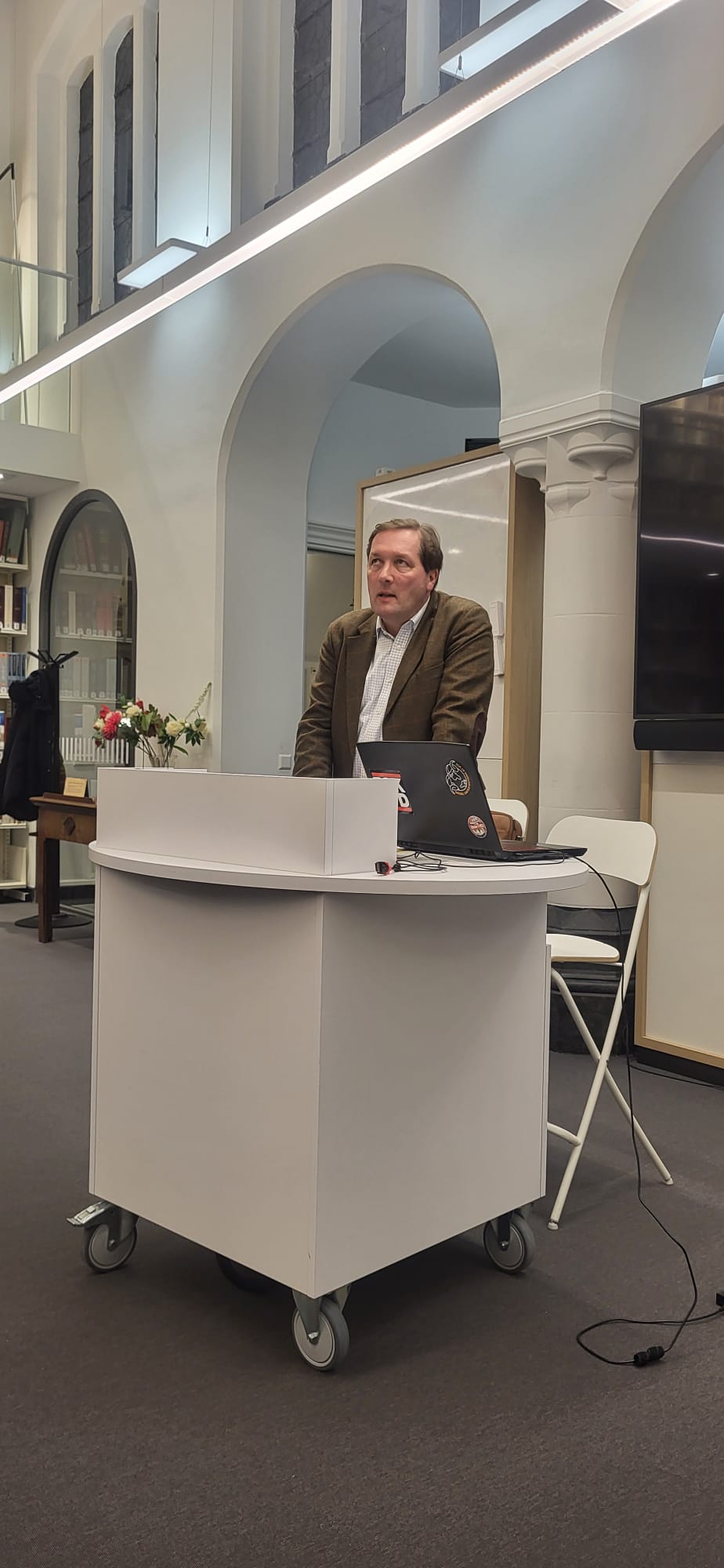
On February 10th, GA had the honour of welcoming Strategic Analyst Frederik Mertens from the Netherlands Organisation for Applied Scientific Research (TNO). Mr. Mertens has also worked previously at the Hague Centre for Strategic Studies (HCSS). He has written on topics ranging from artificial intelligence to the war in Ukraine.
During this Expert Talk, Mr. Mertens shared his expertise in military history and provided a fascinating lecture on the history and evolution of naval warfare. From the Napoleonic Era and the Battle of Trafalgar to the present day and the Russian sabotage of Black Sea cables in the war of Ukraine, Mr. Mertens detailed the development of new technology and dimensions of naval warfare in the last 200 years.
Introduction
Mr. Mertens started by discussing how, in the Napoleonic Era, there were only a few moving parts, as opposed to today, with a series of complex weapons and questions. The first question during the presentation was: “What makes naval warfare at sea different from warfare at land?” The answer was quite simple. Humans are land creatures; while we can swim, we cannot swim very far. Because of this, we need technology to survive at sea.
While all wars involve technology, naval warfare is fundamentally technologically driven. Historically, the gap in technology between navies played a far more decisive role at sea than on land. On land, you can quickly replace an army with men, but it is a more long-term investment at sea. It takes a lot of time and money to replace naval losses.
In naval warfare, sea control and denial are the two main tactics pursued.
Sea control has been used for two purposes historically.
- Economic purposes
- Trade
- Fishing
- Power projection
When sea control does not work, there is “sea denial.” Sea denial is about denying the opposition the ability to use the sea. Historically sea control is more expensive and a much greater investment than sea denial.
Napoleonic Era.
In the Napoleonic Era, there were two types of ships: the first were big heavy ships, which carried far more guns but was not as fast, and smaller ships, which had fewer guns but were much faster. The heavier ships were the ships of the line, used mainly for sea control. The smaller ships were mostly frigates, which would fight each other in battle.
Frigates have two essential functions for sea control
- Support ships of the line
- Defending trade
There is a question of balance, as bigger ships are more expensive, however, you need a big ship to destroy a big ship. In naval battles, size was crucial. Additionally, navies needed to be in many places and lacked the modern communication tools we had at the time.
The 19th Century
The 19th century was full of significant advancements, such as steam power. Steam power was hard to use, and steam machines were not very effective, requiring paddle wheels. Afterwards, there was the development of screws which were significant parts, and then there was the innovation of explosive shells. Subsequently, there was a reaction from the navies, who added armour to protect against these shells.
In the naval race between the British and French, the French added armour plates to their ships. In response, the British built the first battleship. The British responded with the first modern Battleship, HMS Warrior. This would be the first modern battleship with armour, explosive shells, and other 19th-century innovations.
Mr. Mertens points out that naval design is about balance and compromise. Simply adding a gun makes one’s ship heavier, requiring a bigger sail, more manpower, and more armour.
In the 19th century, we got the first sea mine, or as it was initially called, a torpedo. This is the first weapon that breaks the rule that you need a big ship to destroy a big ship. Now, any ship could lay a sea mine. This was superseded by a “fish torpedo,” this prototype is what we now call a torpedo today. The most significant change of the 19th century was that small ships were now dangerous to big ships.
However, getting close enough to launch a torpedo attack was still rather difficult. Big ships began carrying smaller guns, capable of sinking smaller ships carrying torpedoes. Torpedo attacks could work but require speed, stealth, and luck.
World War I
Another major technological innovation at the end of the 19th century was communication. The development of the Telegraph in the middle of the century was already a significant step. However, the development of wires and cables would allow for communication worldwide.
During the First World War, Jutland was the only massive sea battle. In this battle, we saw:
- The importance of communication, especially with radio.
- Battleships and Battlecruisers became targets because they carried large amounts of ammunition. If they were penetrated significantly, a chain would destroy an entire ship.
In World War I, we also saw the first great submarine campaign. The submarines could avoid the cruisers, and the German submarine campaign was incredibly effective at bringing the British Empire to its knees. The British would be able to counter this, however, by using a convoy. Why were convoys so effective? It is an example of sea control. It is about protecting what matters, not the whole sea, by protecting the ships and essential pieces.
World War II
Naval warfare changed once again in the Second World War because of the newest dimension: airpower. With airpower, what happens on land now affects what happens at sea and vice versa.
The development of aircraft carriers was crucial. This was especially true in the Pacific because of the sheer size of aircraft carriers. Aircraft can reach further and see farther than battleships. An aircraft carrier will always outrange a gunship, and because of this, aircraft carriers became the new sea control weapon. This is because aircraft can destroy battleships, cruisers, and other ships, and the only way to counter airpower is with your airpower.
The other major weapon in the Second World War was the submarine. Convoys remained effective in the Atlantic due to American and British industrial superiority. In the Pacific, the Japanese lacked industrial superiority and did not take convoys as seriously as they should have. However, while they were significant in the Second World War, Submarines were still hard to communicate with and remained slow, limiting their capabilities.
The third major technology of the Second World War was radar. Radar allowed navies to look further from our line of sight and into the darkness.
All these advancements made ships more advanced but also heavier. Ships would continue struggling to try to strike a balance between size/power and speed.
After the 2nd World War
There have not been any large naval conflicts since the end of the Second World War, and the U.S. has maintained naval hegemony since.
The development of guided missiles would become a new form of airpower. They can be deployed from aircraft, ships, submarines, and the coast. This was seen recently with the Houthis firing missiles at the Americans in the Red Sea.
Nuclear Submarines form an undetectable second-strike capability for nations, providing a new degree of stability. The Russians, Americans, French, and British view nuclear ballistic missile submarines as their first priority.
A central question now is the development of unmanned boats. The question remains: Are these changing the players, or are they changing the playing pieces? Suicide boats are much easier to build than getting people to drive them.
Conclusion
At the end of his talk, Mr. Mertens listed a handful of questions that he believed would be key to the future of naval warfare. How will we use unmanned systems? How will we adapt to the sea? How will sensors develop? The answer to these questions remains to be seen, but these are the key questions members of GA, and the attendees of this Expert Talk were left to consider.



Leave a Reply