
Meeting notes september 2024


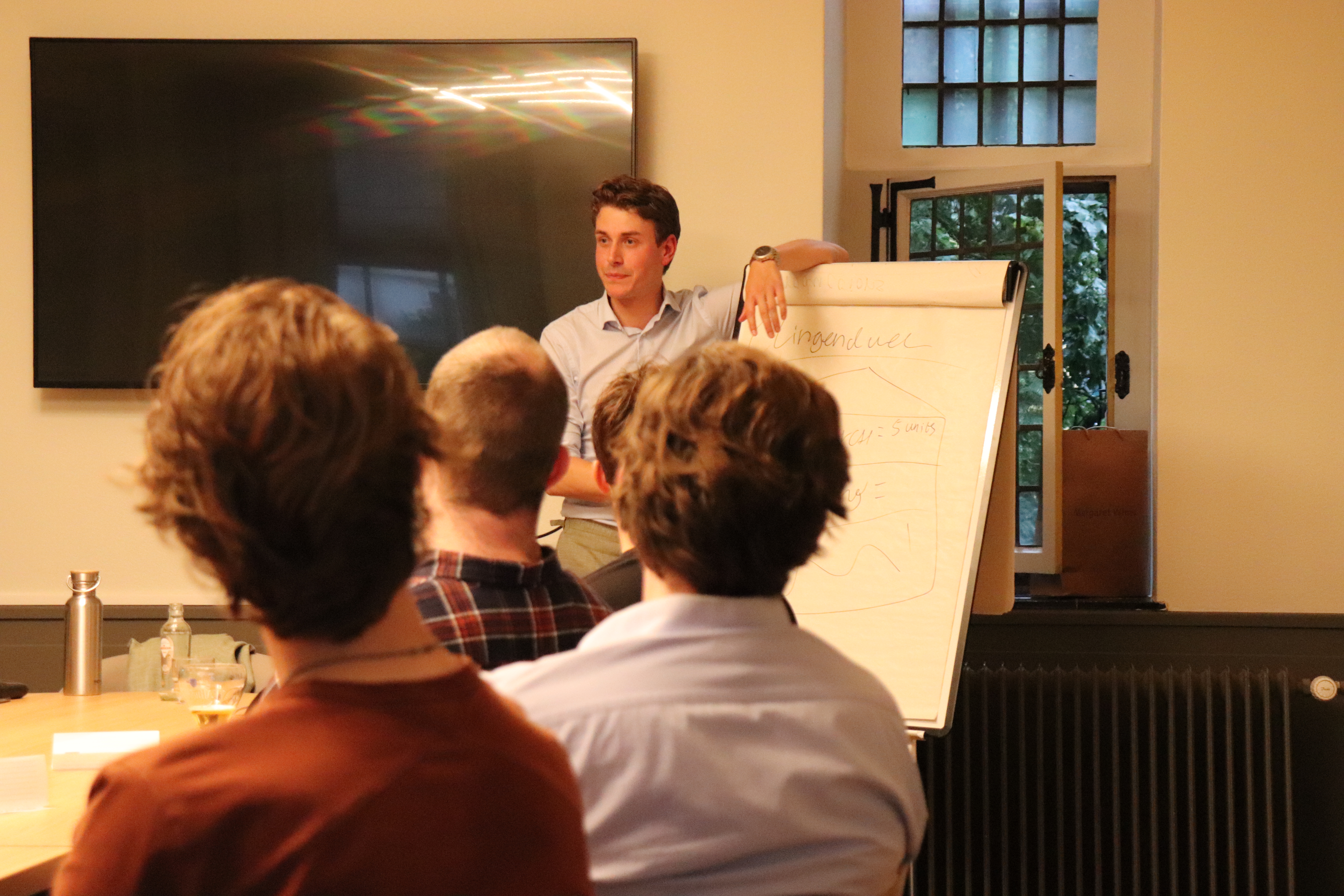
We kicked off the academic year with a brand-new Expert Talk! We were joined by Luuk Pepers, an Academy Fellow at the Clingendael Institute who specializes in (international) multilateral negotiations, conflict resolution, and democratic governance. After a general introduction about the Clingendael as an institute, the different branches within this think tank, and some questions regarding his profession and the tasks involved, we turned our attention to the concept of ‘conflict’. Although this is a fairly familiar word, it remains difficult to interpret. While it may seem logical that peace is the opposite of conflict, this is not true. For example, there can still be conflict despite no war being waged. Rather, it is the absence of violence which can be seen as the opposite of conflict.

This can then be further broken down into negative peace, i.e. the absence of direct violence, or positive peace, i.e. the absence of indirect and structural violence. It is interesting to think what peace or conflict is, as the understanding of these concepts vary immensely based on one’s individual position and perspective. A Muscovite may experience the Russia-Ukraine War much more at ease than their Siberian counterpart, who is at serious risk of being drafted and being send to the front lines. It is therefore important to acknowledge that there are many different understandings of a conflict at a time which are all equally valid; a mutual understanding is needed to come to a resolution.


Moreover, conflict is always a social endeavour, though it not bound to a singular social entity; you can be both at conflict with a person, a company, or state. We focused during the Expert Talk on negotiations within conflict resolution as negotiations are an integral tool to resolve a conflict. To understand the fundamentals of a negotiation, we attempted one ourselves. Mr. Pepers tasked us each to write a definition on ‘What makes a negotiator effective’. After we wrote down some elements, we formed different constituencies and created our final definition. All three constituencies then put forth an ambassador who would partake in 10-minute negotiations to agree on a final definition. First, a rule of conduct was decided to efficiently conduct these negotiations. This is key as such a framework often shapes which way the negotiations will go. It was interesting to see that the negotiations became more fluid when there was less and less time left. Where at the start of the negotiations the ambassador haggled about small details, at the end swift decisions were made about rather big elements of the definition.


This corresponds to other negotiations like climate deals where most deadlocks are often only broken near the end of the deadline. Before this, negotiators are mainly concerned with gaining information so that they can identify the zone of possible agreement. At last, constructive ambiguity is useful for constituencies to agree with a deal, even though such indistinctness may hinder practical implementation. Our final definition: An effective negotiator is about being politically and culturally understanding, creative, empathetic, impartial, and having credibility.


Leave a Reply