
A USSR Perspective
Antonios Paraschos

Introduction
The energy relations of Western Europe and the Soviet Union (USSR) have been an intriguing and paramount academic, but also political debate. The first and the second oil crisis, in 1973 and 1979 respectively, combined with the détente between the superpowers during the 1970s, facilitated an improvement in the East-West relations on multifarious sectors, including gas and oil trade. Under such circumstances, a project was initiated, with the aim of increasing gas supply from the USSR to Western Europe, the Urengoy-Pomary-Uzhgorod or the Yamal pipeline, that would expand from north-western Siberia to Western Europe.
A pipeline from the vast gas reserves in Urengoy was initially an initiative of the United States (US) and the Soviet Union in the early 1970s, but it was abandoned before completion, as the political and financial relations between the US and USSR started deteriorating in the mid-1970s.[1] This project was later undertaken by the Europeans, in 1980, aiming to construct a 3,000-mile pipeline supplying about 20-25 billion cubic meters (bcm) of Siberian gas to major Western European countries, such as Italy, France and the Federal Republic of Germany (FRG).[2] This would enhance the existing pipeline network, built in the late 1960s and the 1970s.

1. CIA report on the Urengoy/Yamal pipeline project. Source: https://www.antimoneylaunderinglaw.com/2023/10/cold-war-the-cia-says-it-blew-up-a-russian-gas-pipeline-in-1982-with-canadas-help-fact-or-fiction.html
Nonetheless, its construction very soon became a controversial issue that led to a ‘conflict’ among the US and Western Europe, especially under Ronald Reagan’s presidency, after January 1981. In particular, the US were concerned by the transfer of Western expertise and credits for the construction of the pipeline, but also the opportunity for the Soviet Union to strengthen its economy and its influence on Europe, whereas Western Europeans were mainly guided by financial motives. Though the Western perceptions have been sufficiently studied, the Soviet perspective seems to be rather neglected and the academic literature does not sufficiently clarify the Soviet motivations, in spite of them being an essential part of this affair.
In this respect, the research question of this paper will be: what were the political-security motives of the USSR behind the development of energy relations with Western Europe and how did these motives evolve in 1968-1973 and 1978-1982? The answer will be mainly based on USSR and German Democratic Republic (GDR) documents.
The 1968-1973 period was marked by the first gas export agreements and the construction of pipelines from the USSR to Western Europe. In 1978-1982 the Urengoy fields started being exploited and a pipeline to Western Europe was being negotiated. For a deeper understanding of motives and the fluctuations in their importance, it is imperative to examine some other issues as well. Thus, as part of the analysis, this thesis will also explore the economic and technical incentives[3] of the Soviet Union and to what extent it became actually dependent on Western Europe in this sector, combined with the role of crises (in Czechoslovakia, Afghanistan and Poland[4]) and their impact on USSR’s energy policy. Overall, this thesis will show and explain why the Soviet approach was a mix of political-security and economic-technical objectives, with the latter gradually prevailing.
The East-West energy relations have attracted several people, including the current Secretary of State, Antony Blinken, who wrote a book about the Urengoy pipeline and the disagreements between the two allies, Western Europe and the US. His analysis of the US and European perspectives is commendable, as is the way he addresses the security concerns of many US officials, regarding them rather exaggerated, though some of them were not counterintuitive.[5] Concerning the Soviets, he mainly focused on the economic-technical aspect, but he mentions that the project was also an opportunity to divide the West.[6]
Ksenia Demidova has succinctly demonstrated the disparities in the US, European Economic Community (EEC) and Soviet approaches. The first, were seriously concerned by the benefits this cooperation would entail for the Soviets, as indicated by Weinberger’s[7], memorandum to the US President, Ronald Reagan, in 1981. It would considerably increase the USSR’s hard-currency earnings and strengthen the ties among the Soviet Union and Western Europe, rendering the latter susceptible to USSR pressure and supply cutoffs. It would also endanger the entire European financial system due to the large capital investment by Western banks to the project.[8]
Regarding the Soviets and Western Europeans, the agreement for the use of the Urengoy pipeline was mutually beneficial. USSR’s oil production was declining, fostering the role of gas trade as a source of hard-currency income, but the necessary infrastructure for such exports was missing. Simultaneously, Western Europe sought to diversify its supply, as the Middle East was increasingly unstable, and was able to provide both hard-currency and the technology the project required, hence this cooperation was economically very promising.[9]
The divergence of US and European interests is also highlighted by Stephen Woolcock. The US sought in 1981 an economic containment of the USSR, similar to the one imposed in the 1950s, concerned by the ability of the Soviet Union to sustain its economy and support its military efforts, with the hard-currency earnings and Western technology.[10] To the contrary, Europeans had adopted a realistic approach regarding trade, focusing on the financial gains it would entail and were not eager to restrict it.[11]
Thane Gustafson, in his book about the Soviet energy policy during Brezhnev and Gorbachev[12] offers a very detailed overview of the Soviet energy policy, including internal debates and problems. He highlights the improvidence of the Soviet oil and gas (especially the former) policy, eventually leading to dependence on energy exports for hard-currency income, as they represented 80% of hard-currency revenues between 1973 and 1985.[13] Simultaneously, the cost of production was getting increasingly high and very soon the USSR became dependent on gas exports, which however, required steadily surging investment.[14] Nevertheless, financial factors, whilst pivotal, they do not offer a complete illustration.
Per Högselius is one of the few academics, who have conducted research aiming to disclose all the different factors that moulded Soviet policies during the Cold War (and afterwards). Having used sources, like government and media documents, in multiple languages, he has concluded that political goals were overall secondary to financial and certainly much more circumscribed than attempting to ‘capture’ Europe in the energy sector,[15] as some government officials in the US feared.
He also makes an interesting remark concerning the way gas deals affected Western Europeans in relation to the Soviet invasion of Czechoslovakia in 1968[16] and Afghanistan in 1979, making them much less eager to impose sanctions and cancel the Yamal pipeline project, in spite of US pressure to do so.[17] Nevertheless, he does not elaborate extensively on it and prefers to focus on economic issues, internal political developments and clashes within the Soviet state.
Overall, a fruitful debate over the political-security component of the USSR strategy is missing. Relevant estimations are mostly based on the consequences of the Soviet energy policy and not on Soviet intentions, as described in respective primary sources. This thesis will endeavour to cover this gap by accentuating the strategic component of gas exports for the USSR, which were boosted in the late 1960s in the light of the Conference on Security and Cooperation in Europe (CSCE)[18] and détente, and how its importance gradually faded. In particular, it will examine gas exports in the late 1960s and early 1970s as a means to render Western Europe more independent from the US (economically, militarily and politically) and thus, gradually more conducive to Soviet influence, an aspect that has not been pondered sufficiently by academics.
In general, the significance of other factors will not be questioned at any time frame. Concerning economic-technical incentives, a discussion of which is necessary for a substantial analysis of the political-security part, the role of the Polish crisis in 1981-1982 will be re-examined as well. The mainstream view examines how the US tried to influence Western Europeans and put additional pressure both on them and the Soviets and convince them to stop the pipeline project. Here its influence on the communist bloc and relations of the USSR with other communist countries will be examined. As it might have become evident, this research primarily seeks to add to existing bibliography and much less to challenge it.
At this point, a brief discussion of the détente’s and CSCE’s significance, especially concerning Soviet-Western European relations is necessary. Several factors have facilitated the improvement of relations between the two superpowers after the mid-1960s. Adam Ulam accentuates USSR’s concern over the incipient US-Chinese friendship as a critical motive for the Soviet Union, apart from minimising the possibility of a nuclear conflict,[19] while Angela Romano highlights the role of Soviet development of the second-strike capability on nuclear weapons in 1964-1965, substantially increasing the possibility of Mutual Assured Destruction, as a key-event rendering détente desirable.[20] In any case, this development enabled the initiation of a similar process between USSR and Western Europe.
A prominent feature of meetings, negotiations and discussions between the two sides was bilateral trade and its increase, whereas preparations for a conference on security in Europe were being made. It is important to mention that the Council for Mutual Economic Assistance (CMEA)[21] did not recognise de jure the EEC, but only de facto in the early 1970s. Nevertheless, already after 1965 a rapprochement between EEC and CMEA was reluctantly initiated and after 1972 Soviet officials explicitly expressed their interest in a consistent CMEA-EEC dialogue and eventually the signing of respective agreements.[22]
Concerning the CSCE, for the Western Europeans, according to Romano, it was an opportunity to come closer with the USSR and alter the political scenario in Europe, hence causing a substantial, permanent change on the continent, which required a solid basis and mutually beneficial cooperation in multiple fields, like trade.[23] The latter was considered by Kjell Goldmann a factor that could foster the stability of détente in Europe more than in US-USSR relations.[24] However, after the mid-1970s, détente’s influence on energy policy was rather circumscribed and the Afghan and Polish crises in the next years are more important to examine, concerning energy relations.
Methodology and Structure
The secondary sources, as presented above, will mainly complement, especially concerning the economic-technical part, and offer a historical background to the primary sources analysis. The latter will mainly be from the Eastern bloc in order to get a sufficient overview of Soviet perceptions and concerns over gas exports to Western Europe. Specifically, most of them originate from the GDR Ministry of Foreign Affairs, sessions of the Politburo of the Central Committee of the Communist Party of the Soviet Union (CC CPSU) and Leonid Brezhnev’s[25] communication with other Eastern bloc leaders, like Todor Zhivkov (Bulgaria) and Erich Honecker (GDR) and were found in the digital archive of the Wilson Centre and the US National Security Archive[26]. Thus, the analysis will include sources in German, Bulgarian and mostly in English (translated) and Russian. This will provide valuable and fascinating information regarding the Soviet perspective, giving this research a very innovative character.
GDR primary sources, mainly from 1968-1973, contain very interesting information concerning the way détente and its respective opportunities were regarded in the USSR, which is crucial, given that pipeline projects started based exactly on these circumstances. Furthermore, East Germany was a close ally of the Soviet Union, thus it can irrefutably offer valuable insights. Of course, it could be argued that its documents might not be as precise as respective Soviet primary sources would be, but conclusions from these sources will also be combined with other documents and historiography exactly in order to assess and enhance their credibility.
Precisely this combination of the context and conclusions that can be derived from disparate sources will be a vital part of this analysis, given that one source might not be sufficiently clear, but pondering multiple documents can offer a different perspective. This can yield much more useful information about goals and perceptions in the Eastern bloc. Throughout the paper, it will be clear when a conclusion stems directly from one primary source and when it is elaborated by the writer, having used data from disparate, but related, sources.
USSR primary sources, mainly from 1981, also constitute a vital part of the analysis, especially concerning the Polish crisis and the way it affected Soviet gas and oil exports. Sessions of the Politburo CC CPSU, the supreme political organ of the USSR,[27] are credible and interesting sources of information concerning the problems the Soviets faced because of the crisis and the ways they endeavoured to solve them. Conversations with leaders of other communist countries in Europe indicate the significance of USSR’s energy policy collectively for the Eastern bloc, as well as the way it was affected by the situation in Poland. They also demonstrate, along with some documents related to the invasion of Afghanistan, perceptions of Western Europe and how they shifted throughout the years.
Overall, combining primary sources from variegated countries is an ideal way to gain an insightful overview of events and it will be a prominent feature of this research. The main focus will be on how the Soviet Union aspired to promote its security, financial and political interests, particularly through the export of critical materials, such as oil and gas.
The thesis consists of two time-based parts. The first will expand from about 1968,[28] when the gas-export agreement was concluded with Austria and gradually negotiations for similar contracts with other Western European countries commenced, to 1973, when the first agreements with other European countries, like the FRG, were already signed and in effect. In addition, this is a crucial period for the détente between the East and the West and the preparation for the CSCE, leading to the Helsinki Final Act in 1975. It will be argued that the Soviets viewed these international conditions as an opportunity to form financial ties with Western states and their elites, aspiring to gradually augment their influence on Europe, whilst economically, the foundations for an increasing dependence on hard-currency and technology flows from the West were set.
The second will stretch from 1978, when the Urengoy fields started being exploited and discussions between FRG and USSR for a new pipeline commenced, to 1982, when the agreements for the new pipeline were signed. The marked diminution of the political-security part will be discussed. It is assumed that this was facilitated by two developments. One is the further growth of the economic-technical component, as a result of the increasing dependence on gas exports and other incidents, like the Polish crisis, rendering augmented gas and oil exports a vital necessity. The other reason, is the (at least partial) success of the political-security targets set in the previous period, as Eastern bloc primary sources indicate.
The 1973-1978 period, while interesting, it is not marked by particular events with major influence on USSR-Western European energy relations. No considerable new projects were initiated nor are documents that could offer particularly interesting information available. Those years were mainly characterised by the adequate function of the pipelines and the development of the energy trade. Of course, this had an impact on the 1978-1982 timeframe, but a separate chapter with a detailed examination of the period would not contribute much to the tracing of motives this thesis seeks.
Having conducted this analysis, an overview of the Soviet motives will be given. Through this, an enhanced academic debate that will include perspectives from all sides and will instigate further research on similar or other factors, is endeavoured. Other reasons that led to the considerable economic-technical dependence of the USSR can be searched, or why no new political targets were set in 1978-1982, requires further research. The complex interests and aspirations that characterise energy politics, but also their ability to shift depending on the circumstances, even to this day, will be highlighted.
1. Analytical and Historical Framework
Whereas this thesis will focus on two periods, 1968-1973 and 1978-1982, some key features of the previous years, might be useful to demonstrate the significance and the peculiarity of the two timeframes. It is important to bear in mind that before the late 1960s, trade between the East and the West, including oil,[29] was existent, but it can be claimed that it was used as a weapon much more by Western Europe and the US than it was by the USSR.
In particular, until the 1960s, East-West trade was viewed as a privilege by many Western European leaders, a privilege they could decide to deny the Soviet Union, due to their disagreement with Soviet actions and policies.[30] Konrad Adenauer, for instance, in 1963 stated that grain deliveries should be conditional to the demolition of the Berlin Wall.[31] Oil was somewhat more significant, especially for Italy (20% of total oil imports), FRG (7.5% of total oil imports) and France, while it was a necessary source of hard-currency income for the Soviets.[32] Nevertheless, this relationship would not prevent Western Europeans from imposing an embargo on steel pipes exports to the USSR, in November 1962, after the crises in Berlin and Cuba.[33] Actually, the energy relations with the Middle East were far-more important until the 1970s, with Middle Eastern oil amounting to around 80% of Western European oil imports in 1970.[34]
Under such circumstances, the margins for political maneuverers by the Soviets were probably limited, regardless of their potential ambitions. However, the conditions would start changing in the second half of the 1960s with détente. East-West trade grew, especially in the energy sector, this trend continued in the 1970s, and, more importantly, this growth was not subject to any political ‘losses’ for the USSR, such as the destruction of the Berlin Wall, as Adenauer had proposed in 1963.[35] Although Western Europeans were not against sanctions in response to specific Soviet actions, they had concluded that sanctions did not influence Soviet behaviour.[36] Consequently, according to Oudenaren, the Soviets could assume that East-West antagonisms would not affect the commercial negotiations involving Europe.[37] This shift would allow the Soviets to set and pursue not only economic targets, but also political and security goals. Interestingly, Soviet political objectives did seem to be of considerably less (if any) Western concern in 1968-1973 than in 1978-1982.
Before starting the analysis, it is useful to distinguish and ponder the two categories of incentives that have been mentioned and will be examined here. Political-security objectives refer to the strategic component of the USSR energy policy and they are mostly non-material gains, like influence or even control over policies. The ‘political’ refers to both domestic[38] and international affairs, but the latter will be dominant here and are basically linked to relations with the Western European states and the endeavour to affect their policies. Security is the defensive aspect of the Soviet foreign policy, specifically it is associated with the Soviet concern to protect itself from what it perceived as malignant Western influence that would undermine its political system and its international position. They constitute the two sides of the same coin, as they are both associated with non-material matters, like (political) influence, diplomatic relations and perceptions of what is a threat and what is not.
Högselius views the political use of gas mainly as part of a ‘divide and rule’ strategy, favouring some countries over others aspiring to divide Western states, or as a rhetorical weapon to strengthen USSR’s legitimacy on the international arena.[39] Oudenaren and to a lesser extent Blinken also refer to divisions within the Atlantic alliance, as a political aim of trade.[40] This division aspect is critical for this thesis as well, especially concerning the relations of the US with Western Europe. The Soviets aspired to gain through energy relations an important role in Western European economies, to the detriment of the US, weakening anti-Soviet elements in Western European policies[41] and facilitating the respective growth of Soviet influence.
Economic and technical objectives represent the most prominent material gains of gas and oil exports for the USSR. Economic goals refer mainly to the hard-currency[42] income from exports, and trade balance. The term technical includes the transfer of technology and materials, mostly for pipelines, but also know-how, all of which the USSR lacked to a great extent. Unlike the previous category, both terms here are basically material and easier to define and measure. Furthermore, they are very closely interconnected, given that in order to facilitate the exports and the flow of hard-currency, pipelines were indispensable and Western pipes were far superior to the Soviet ones. Thus, importing pipes or materials and know-how for the construction and maintenance of the pipelines was essential.
Overall, there is agreement in literature that the economic value of trade, especially in energy, with the West was of utmost significance for the USSR. Högselius, Gustafson, Blinken and others, often stress the importance of hard-currency and technology flows from the West to the East as the most paramount gains for the Soviet Union. The economic-technical incentives in this thesis represent the same, dominant discourse and their role will be auxiliary to provide an overview of Soviet targets that will be useful for the innovative part of the thesis, the political-security objectives.
Both categories have offered significant incentives to the Soviets in order to not just start, but also gradually increase gas exports to Western Europe. As already stressed, given that it is impossible to examine and comprehend the aforementioned shift in the political-security motives of the USSR without the economic-technical aims, the latter will be discussed too, though less extensively than the political-security category.[43]
In this sense, the thesis will also answer the following sub-questions: what were the economic-technical incentives of the Soviet Union and to what extent did the USSR become dependent on Western Europe in this sector, mainly concerning hard-currency income and high-quality, energy-related products? What targets were set in détente-related policy papers in 1968-1973 and has the first gas agreement with Austria encouraged the pursuit of these goals?
How was the Soviet energy policy affected by the Polish crisis (1980-1982)? Does the reaction of Western Europeans to the Afghan and Polish crises, show that political-security targets, set in 1968-1973, were met, at least partially? How did the Soviets view their relations[44] with the Western Europeans?
2. The First Steps: 1968-1973
The Soviet Union was the largest country on the globe. It also contained similarly large reserves of many significant resources, such as oil and gas. Unsurprisingly, it wanted to avail itself of this fortune and use these reserves in a beneficial way. The reasons for the decisions and the policies that were eventually implemented were multifarious, as were the challenges the USSR faced.
Bearing in mind the categorisation of incentives, as outlined above, this chapter will examine the economic-technical interests of the USSR and how some of the foundations for their significance to escalate during the 1970s and 1980s were set, which will be very helpful in discussing the alteration of Soviet goals in 1978-1982. Of course, the political-security aims of the Soviet Union will be elaborated here too, as they constitute the main subject of this analysis and, again, the acquaintance with the targets set in 1968-1973 is essential for analysing the extent to with they were met by the 1978-1982 period. Economic-technical incentives
Gas was not always particularly significant for the USSR and even in 1959, when the CPSU General Secretary, Nikita Khruschev, demonstrated internationally Soviet advancements in gas, its production (and use) was far behind oil, but rapidly rising.[45] New reserves were being discovered in Siberia, hence, with a potentially ascending gas production, the question of its utilisation arose. Should this gas be reserved for Soviet consumption (mostly in Siberia) or for the Western European market?
In the 1950s and early 1960s, the plan was constructing pipelines for the domestic transfer of gas to USSR cities and regions creating in this way an all-Soviet pipeline grid. Vital for such a project were pipeline materials and infrastructure, both of which were insufficient in the USSR, a challenge that was overcome by importing Western pipes. Compressors were of major significance, but their import from the West was much more complicated, thus domestic production was necessary.[46] However, whereas there was serious progress by 1965, the Soviet gas system had overgrown the compressor-construction development and imports from the West remained very enticing. Simultaneously, Western Europeans were aware of the considerable production increase and started seeing the USSR as a potential new supplier.[47]

2. Map of the Soviet pipeline system in the early 1960s. Source: Högselius Per. Red Gas. Russia and the Origins of European Energy Dependence. New York: Palgrave Macmillan, 2013, 22. https://search.worldcat.org/title/1005829076
It is important to mention that at that time, the main source of gas was the European part of the USSR, but the focus would soon shift to Siberia. With the growth rate of the country’s commercially available gas reserves declining in 1962 and the number of discovered Siberian reserves rising, utilising them as a basis for sustainable growth, was taken seriously into consideration.[48]
Alexei Kortunov in particular, director of Glavgaz[49] from 1957 to 1963 and Minister of the Gas Industry from 1965 to 1972, was in favour of exploiting Siberia and would actively pursue this goal in the next years. Glavgaz was the main agency for gas exploration and only in 1965 would it become a ministry, the Mingazprom, whilst a respective ministry for oil already existed for decades, signifying the prominence gas was gaining.[50] Interestingly, exploration of newly found reserves, primarily in Western Siberia, at the time was not so much an oil and gas ministries’ task, but of the Ministry of Geology and its activities (geophysical surveying and mapping) were mainly funded by the state budget, unlike the oil and gas ministries’ activities (deep drilling) that were funded by their own capital investment[51]. However, in 1971 Mingazprom got its own geophysical service, enhancing its autonomy compared to the Oil Ministry, which conducted geophysical work for oil exploration jointly with the Ministry of Geology.[52] The ‘fighting’ between disparate ministries and agencies for the allocation of resources constituted a limiting factor, impeding the development of the Soviet economy and the reification of big ideas, as Brezhnev himself recognised,[53] delaying the exploitation of Siberian gas, as Kortunov wanted. Would the latter be able to find significant support for his plans?
According to Högselius, Kortunov was trying to highlight the economic benefits of gas trade with the West in internal Soviet discussions and envisaged a countertrade scheme, gas for advanced industrial items, that would further boost gas production and transportation.[54] The Ministry of Foreign Trade was positive about this plan, which would foster its hard-currency reserves assuring imports of grain in vast quantities from the West, after a major agricultural crisis in 1963 had ensued.[55] Therefore, a mutually beneficial trade scheme admittedly seemed a viable and very beneficial solution for the Soviets.
Nonetheless, its adoption was not very straightforward. The Ministry of Foreign Trade presided over a state monopoly, domestic prices were determined by internal politics, regardless of the world prices, and a big part of Soviet bureaucracy viewed foreign trade as a necessary evil to cover the imports necessary for the accomplishment of domestic goals.[56] It is important to bear in mind that even when the differences between the two blocs appeared to be alleviated, they did not disappear. Condescending approaches and opinions on many features of capitalist societies, like the pursuit of profit or the political power of business (the bourgeoisie), were quite ubiquitous among the Soviets and consequently this affected their perceptions and policies.
Oil transportation was flexible enough to serve an equalising purpose, by adjusting annually the amount to be exported. Similar adjustments in gas exports were not possible because they were conducted through pipelines that required long-term, instead of annual, agreements. The risk was bigger too, as replacing buyers, should the current ones decide not to pay, was difficult. Nevertheless, relevant opposition was eventually rather limited and objections were mainly linked to the desire of some conservatives in Soviet bureaucracy to keep Siberian gas for Siberia and the Urals and export gas from other sources to Europe.[57]
In any case, by 1966, such immense gas reserves had been found in Siberia’s Tyumen, about 10,000 bcm, that the majority of pivotal Soviet officials, including Brezhnev and Prime Minister Kosygin, favoured exporting Siberian gas to the West. Thus, the prodigious pipeline network from Siberia to Western Europe Kortunov and Mingazprom envisaged was supported by the political leadership. According to the calculations, conducted by Kortunov, within 5-6 years the export-investments would have been covered by the export-revenues and thereafter the profits could be used in the national economy, the energy sector in particular. The next step, was finding states, willing to import ‘red gas’.[58]
The first Western country to sign an agreement for gas exports from the USSR, after extensive negotiations, would be Austria and trade would commence in 1968. It is significant to take into consideration that the Soviets made great efforts to provide the Austrians with the agreed amount of gas and while in the first years this would not always happen, the deal was overall regarded a success. However, there were serious shortages in Ukraine, Belarus and the Baltics, of which the Europeans were not aware. The main problem was the inadequate pipeline infrastructure, combined with a domestic industry, unable to produce high-quality equipment. Kortunov intended to face these domestic issues by importing Western pipes, as foreseen in the countertrade scheme agreed with Austria.[59]

3. The vision of a Trans-European Pipeline for exports of Siberian natural gas to Austria, Italy and France. Source: Högselius Per. Red Gas. Russia and the Origins of European Energy Dependence. New York: Palgrave Macmillan, 2013, 56. https://search.worldcat.org/title/1005829076
After 1968 there was also renewed interest from EEC countries, like France and Italy, but eventually the second gas agreement would be signed between USSR and West-Germany in early 1970 and the first gas deliveries would start in 1973. Willy Brandt[60], maintained that economy should remain FRG’s main weapon in its Eastern Europe policy[61] and apparently it mattered for his communist counterparts as well. The negotiations among Soviet and German representatives, about the price of gas and the quantity that would be exported, were very tough[62]. This accentuates that economic-technical incentives were paramount for the Soviets in the late 1960s and they did not seek ties with Western Europeans at any cost.
Moreover, the Soviets were negotiating simultaneously with the French and the Italians with the aim of constructing one pipeline passing through the countries, which was economically efficient for the Soviets, as it would ensure a gas demand of over 10 bcm that would render the project beneficial. As for the Western Europeans, it would enable each country to import a smaller (and desired) amount of gas, given that individually none of them wanted to import 10-12 bcm, but collectively they could. This would also enhance their energy security, since reducing gas flows, for instance to FRG due to political issues, would impact France and Italy too,[63] hence diminishing the interest for such an action, unless the Soviets wanted to cut supplies to all Western European countries.[64]
In any case, available archives do not imply that such a scenario was seriously considered by the USSR policy-makers. An analysis of the GDR’s Ministry of Foreign Affairs in October 1970, year of the agreements’ signing, on the approach of the Warsaw Treaty Organisation (WTO) states to the convening of a conference on security and cooperation in Europe is indicative of USSR’s complex[65] perception of relations with Western Europe. Economic cooperation, including, trade relations, was one of the main objectives and it had to develop in a way that would improve their own economic performance, though, of course, without being affected by anti-socialist elements the capitalist states would try to spread.[66]
The economic-technical value of such agreements would be further stressed in the next years. Difficulties in oil production since already 1970, would be mentioned by Siberian geologists.[67] These warnings were only partially heeded, according to Gustafson, given that, whilst funding for West-Siberian oil and gas exploration tripled from 1965 to 1975, it did not result in respective performance improvement and no other substantial measures were taken at the time.[68] Hence, gas was already becoming a necessary means to deal with the looming oil crisis.
2.2 Laying the foundations for dependence
As the 1970s unfolded, issues, some of them coming from the previous decade, but also new ones, highlight that economic-technical motives would remain prominent. Facing the difficulties would prove a herculean task for the Soviets and would require even more expertise from the West and boosted investment. Therefore, maintaining and further fostering gas trade with Western Europe would gradually become a vital necessity. So, what were the main challenges?
The Soviets had to turn eastwards to cover both domestic and external demand, but, given that gas needs remained to the west, this entailed bigger costs and much more difficult transportation.[69] The cold in Siberia required steel of very high quality in order to construct a pipeline and whereas, according to the agreed countertrade scheme, USSR received the first German pipes in July 1970, instead of being able to commence the construction without serious disruptions and fetters, new technical issues emerged.[70]
The railways and roads to transport the pipes to the designated pipeline routes were insufficient (if existent) and eventually, the pipeline route would follow an old railway track, which was not ideal for the transmission of gas, but it was preferred because the alternative, more convenient (for gas transportation) route was longer and there were not enough Western pipes.[71] The already described compressor-quality problem further worsened the situation.[72]
Moreover, the process of drilling gas proved to be a major problem. Antony Blinken calling producing gas in Siberia a ‘technological nightmare’ was more than accurate.[73] Mingazprom concluded that a new technological approach was needed and this of course, included among others delays in production.[74] Delivering gas from Siberia to FRG and Italy in 1973 was not possible and eventually it was shipped from gas fields in Ukraine, though even this project faced great challenges, including dealing with concerns of Soviet republics, like the Baltic states and Ukraine itself, which were threatened by gas shortages in winter.[75] Western Europeans, being unaware of the crisis that had ensued within the USSR, regarded the project successful and the disturbances could be dealt with and were later compensated with increased flows.[76]
Nevertheless, the entire system was built on an unstable basis, which would continue to cause problems to the Soviets in the years to come.[77] Elaborating in detail the success of the gas agreements’ first years is out of the scope of this analysis, but this overview stresses some pivotal matters that must be taken into consideration in the next chapter.
There are two critical issues that were already of considerable size and would impede a robust and sustainable economic progress through the energy policy of the Soviet Union. One was the skyrocketing cost of production, for instance, the cost of a meter of an exploratory hose rose by 230% from 1966 to 1977[78] and in Siberia, whereas expenditures increased 4.8 times from 1971 to 1975, the output grew only 3.6 times.[79] The need to buy pipes was another factor, making the cost of gas production to rise, as Brezhnev had also stated in a meeting with other Eastern bloc leaders in Crimea, in 1971,[80] when the Soviets were still preparing for the first gas shipments to FRG.
In 1987, Mikhail Gorbachev, General Secretary of the CPSU, would accuse the previous leadership of the USSR[81] of not facilitating the sustainable economic growth of the country, selling oil and gas to balance budget deficits, instead of fostering the effectiveness and modernisation of the Soviet economy.[82] Gustafson claims that the expenditures were actually made for useful causes, if not of economic, then of political significance, but admits that, with a few exceptions, the hard-currency income from energy trade was not utilised in a way that would modernise the oil and gas sectors, making them more efficient.[83]
This is also linked to the second problem. The Soviet ability to integrate effectively Western technology and even further improve it, like the Japanese did, was rather circumscribed.[84] Actually, imported technology operated at about 60% of its usual efficiency in the Soviet Union, according to American businessmen.[85] Additionally, an extensive pipeline network would require not only for its construction, but also for its maintenance products and expertise stemming from the West. Thus, demand for Western, especially US, technology would remain very high.[86] These two factors are not exclusive of additional factors that might have occurred over the next years, but they are highlighted here exactly because their roots can be traced in the 1968-1973 period.

4. Figures on energy and overall industrial investment. Transfer costs, like pipelines, are not included. Source: Gustafson Thane. Crisis amid Plenty: The Polics of Soviet Energy under Brezhnev and Gorbachev. Princeton University Press, 1989, 25. https://ebookcentral.proquest.com/lib/uunl/reader.action?docID=3031031
In general, the economic-technical motives pondered in this section have largely been discussed and the goal here was to accentuate some particular, significant matters. Their role is not questioned, but, as it will be shown below, during the same period there were similarly dynamic political-security aims.
2.3 Political-security considerations
Along with economic-technical targets, the Soviets had also set some political-security goals, which facilitated and also guided their energy policy towards Western Europe in 1968-1973. Their strategy was closely linked to détente and the CSCE that was being prepared at the time. The Soviets were concerned, on the one hand, by the potentially detrimental Western influence to their political system, on the other hand, they saw an opportunity for themselves to not only enhance their economy, but also increase their own influence on Western Europe. In particular, they aspired to foster Europe’s independence from US financial, political and military control, which would gradually render Europe more susceptible to Soviet influence.
Of course, political incentives include domestic developments in the USSR political system as well and though they are quite interesting and important, they are examined only marginally here. According to Gustafson, until the 1960s the Soviets had not fathomed the full potential of their land, especially Siberia, in terms of oil and gas, thus pessimists, setting low targets and ambitions, would dominate in the respective ministries and consequently, policy-making.[87] However, the awareness of Siberia’s prodigious resource wealth altered the perceptions of the leadership and policy-planners, hence pessimists were discredited, in favour of the optimists,[88] facilitating a more dynamic and ambitious gas policy.
Soon, political ambitions on the international chessboard also appeared. Actually, disparities between Western European and US approaches of East-West trade already existed and the Europeans had doubts about the effectiveness of tools like sanctions, but the size of East-West trade and the US dominance in the security sector, diminished clashes between the allies.[89] The instigation of more trade between Western and Eastern Europe in the late 1960s and early 1970s, under the détente framework with US blessing,[90] and the initiative for a European conference on security and cooperation would prompt the Soviets to set some particular political-security goals. Where and when exactly can these be found?
1968 was an interesting year for the USSR. It was the year of the Prague Spring, ending with the USSR-led WTO troops invasion of Czechoslovakia on the 20th of August, but also the year of the first major gas agreement with a Western country, namely Austria, on the 1st of June. The interplay between these can be seen as a rather enlightening experience for the Soviets.
The negotiations in the previous years for the deal were mainly conducted between representatives of the Soviet state and of Austrian companies, like the ÖMV and VÖEST, and less of the Austrian state,[91] accentuating the significance of businesses and their potential to influence their governments. Of course, the belief that the state (in capitalism) merely serves the interests of the financial elites, the bourgeoisie, which constitutes one of the reasons it will eventually collapse along with the capitalist system, is as old as communism itself.
Furthermore, direct corollary of this is also the belief, as famously expressed by Lenin, that the need of the capitalist states to expand incessantly in order to satisfy their ever-growing economic needs, would lead to imperialism and eventually conflicts among them in order to increase their sphere of economic influence, causing their demise. This perception remained quite prominent and promoted by Soviet propaganda in the 1950s. Profit-pursuit was seen as a weakness that could be exploited in order to facilitate economic and political developments in the West, an approach that would maintain its influence over the next years, as a 1956 CIA report, based on publications and books of Soviet economists and members of the USSR government, demonstrates.[92] Indubitably, this source is rather old, yet it should not be surprising if some of the elements presented there, were still present more than a decade later.
Actually, the Soviets aspiring to avail themselves of this combination of capitalist contradictions and the critical role of the bourgeoisie is reflected on an Internal Notification of the GDR Ministry of Foreign Affairs, in April 1968, sent by the Soviet Union’s Department Director to the West Germany’s Department Director, on the USSR’s policies in order to guarantee European security. There, reducing US influence and championing the self-determination of Western European states, are some of the targets, whereas forming ties with the ‘‘highly influential economic elites’’through cooperation, appears to be the key to their accomplishment.[93]
Energy trade, a sector of insurmountable significance for Western economies, is irrefutably ideal in order to form ties, like the ones the Soviets envisaged in 1968. The signing of the gas agreement with Austria, with the Soviets seeking to sign similar agreements at the time with even more Western countries,[94] cannot easily be considered a coincidence. Of course, a relatively broad reference to ties with Western economic elites in a GDR document might not seem adequately convincing. However, about a decade later, in 1981, a prominent Soviet official, Yuri Andropov,[95] would mention again the dynamic role of the Western European bourgeoisie and its significance for the materialisation of Soviet objectives.[96] The Marxist-Leninist perception of the economic elites’ power as a weakness of the capitalist system, as described above, can be traced in Andropov’s words and the Soviet strategy.
A few months after this document about the Soviet policy was written, the invasion of Czechoslovakia in late August, less than a month before the first gas deliveries to Austria were about to commence, would prove the value of the aforementioned tactic, thus encouraging the Soviets to proceed with the gas pipelines’ expansion to Western Europe, not only to improve the performance of their economy, but also for political gains. After the invasion on the 20th of August, voices in the West, not just the Americans, would urge the Austrians to cancel, or at least delay the gas deliveries, protesting against Soviet brutality towards Czechoslovakia. On the other hand, the Soviets, assured them that gas deliveries would not be disrupted by the events in Czechoslovakia and even expressed their willingness (and ability) to start deliveries ahead of schedule.[97]
The latter emerged victorious. The Austrians accepted the Soviet offer and gas deliveries began on the 1st of September, nine days before the designated date. They were not eager to confront the USSR, especially in a way that would have repercussions on the gas trade, because it would require from them to redefine their energy supply strategy in a very short period, which indisputably would be rather inconvenient and difficult. The Soviets did not (need to) put additional pressure to the Austrians, the agreement itself offered apparently sufficient leverage.[98]
In this sense, the gas deal with Austria could be viewed by the Soviets as a double success, economically and politically, rendering gas agreements a potentially very useful weapon in their renewed approach to Western Europe as détente was developing. Such bonds would dissuade the Western Europeans from putting pressure on the USSR and attempt in any way to undermine its political system. So, how did the political-security considerations develop, after the agreement with Austria?
On the 1st of February 1970 during the signing of the gas agreement with FRG, discussions between the two sides were not solely about gas and economic issues. The FRG Minister of Economy, Karl Schiller, and the Soviet Minister of Foreign Trade, Nikolai Patolichev, would talk about political matters for an hour, after the official ceremony in Essen for the signing of the agreement, during which, Nikolai Osipov[99] accentuated in his speech that the spirit of this agreement could eventually lead to the solution of all political problems in Europe.[100]
Moreover, in Moscow at the same period, Egon Bahr, Willy Barndt’s closest advisor, and Soviet Foreign Minister Andrei Gromyko met and talked about crucial foreign policy issues, like the status of Germany’s postwar borders and the convening of the CSCE.[101] It has already been mentioned that economy was pivotal in Brandt’s policy towards USSR and GDR, but respectively the USSR also aspired to promote its interests, political and economic, through ties in the energy sector.
The GDR document from October 1970, an aspect of which has already been discussed, demonstrates both the opportunities to strengthen the influence of the communist bloc on Europe and the security threats posed by the West. It refers to the anti-socialist influence of the Ostpolitik and the effort of NATO’s main powers to promote détente-related theories with the aim of ‘‘ideological infiltration’’ in Eastern bloc countries.[102] The unity of communist countries is stressed multiple times as the only way to resist the multifarious anti-communist initiatives, maintain the bloc’s power and effectively pursue their goals in Europe, the full development of a communist society.[103]
This strategy, as the one outlined in 1968, also foresaw approaching as many people as possible, including the bourgeoisie.[104] Once again, in the same year that a gas agreement is signed between the USSR and a Western European country, a GDR document discussing Soviet/Eastern bloc relations with the Western bloc, explicitly mentions that developing ties with Western economic elites is an important political-security objective of the Soviet Union. Hardly can this be considered a coincidence and it indicates that political-security considerations were quite robust concerning gas trade with Western Europe.
The 1968 and 1970 GDR documents show how political interests, decreasing US influence to the benefit of USSR, and security concerns, (perceived) Western European efforts to undermine communism in the Eastern bloc, were intertwined and of substantial significance. Energy trade appeared to be the best way to accommodate all these needs and goals. The positive experience with Austria in 1968 indisputably reinforced this belief, that energy trade can have an impact on political-security matters.[105]
Nevertheless, there is no direct reference to gas, or oil, as the way to ties with the business people. Yet, it is more than evident that energy was the key. Oil and gas were critical sources for Western Europe, they were the most prominent good in East-West trade and the driving force of its considerable increase from the late 1960s to the early 1980s.[106] Therefore, they were the obvious choice to form ties not only with the Western European governments, but also with their elites, which were very significant and could exert influence on their states, a feature that the Soviets did not neglect and thought they could exploit.
In the aforementioned Brezhnev’s speech to other Eastern bloc leaders in Crimea, 1971, some progress in the relations with Western Germany was discernible, without of course concerns and suspicion being eliminated. The Soviet leader also stressed the importance of developing relations with FRG that would have major implications in Europe, including the role of NATO, the current weakening of which was significant for the continent.[107] Indubitably, gas should not take all the credit for the gradual rapprochement between USSR, GDR and FRG and other political developments, but its role in the pursuit of variegated political-security goals cannot be denied.
In 1972-1973, the Soviets and the US started negotiating the North Star project, envisaging gas trade from Urengoy to the US, with the involvement of several US private companies.[108] In September 1973, after his meeting with US president Richard Nixon in June, Brezhnev expressed his satisfaction over the global situation to Todor Zhivkov,[109] referring among others to the fact that American monopolies were interested in increasing trade with the USSR, disturbing monopolies in other countries.[110] As mentioned earlier, such capitalist contradictions were expected to eventually destroy capitalism.
At the time, the USSR had just signed a preliminary energy-agreement with a three-company US consortium in June and another with Occidental Petroleum in July, indicating the serious efforts for an enhanced energy relation not only with Western Europe, but also with the US. Furthermore, tensions were surging again in the Middle East that would lead to the Yom Kippur War in October and the oil embargo of the Arab states to the West. The Soviet Union, while declaring its support for the Arabs, it sought to avail itself of the circumstances to convince the US that its market should be opened and discriminatory trade measures against the Eastern bloc ought to be removed. Nevertheless, the US Congress would impede this process, mainly with the Trade Act of 1974, thus the North Star lost momentum.[111]
Having examined all these sources, a substantial remark concerning the political-security incentives of the USSR, is the central role of the US, which might not be obvious at first site. The US role in Europe was a major concern for the Soviets and bonds with Western Europe endeavoured to circumscribe the significance of the US for the Europeans, which implies a belief that Western Europe itself was much less a threat and its affiliation with the US made it a considerable rival. Without the US, it would be much easier for the USSR to impose its will.[112] In this sense, except when discussing the FRG, which was almost until about 1970 treated with great animosity, the ‘threat’ would predominantly stem from the US, NATO, or the ‘imperialists’, terms that would also include the US and individual European countries were rarely described as a big danger or enemy.
Overall, energy trade, especially the incipient gas exports to Western Europe, was promoted by political-security factors cohabiting with economic-technical considerations. For instance, aspiring to create a single pipeline from the USSR to France, through among others, FRG, had a very plausible economic explanation. Simultaneously, it would diminish the margins for the Soviets to reduce deliberately flows to Western Europe, for which Western Europeans were anyway prepared, having alternative sources for a fuel that was not extensively used at the time.[113] Yet, this kind of network would not prevent the Soviets from forming ties with Western economic elites, as envisaged in 1968 and 1970, facilitating in this way their political-security ambitions as well.
The immense gas reserves discovered in the 1960s would enable the emergence of gas as a potential solid basis for economic development. Nevertheless, the exploitation and transportation of gas required technology and infrastructure that only the trade with the West could provide. The technical difficulties the Soviets faced would set the foundations for their dependence on the West, for essential materials and hard-currency income. Simultaneously, the Soviets were presented with an opportunity to reduce the American influence on Europe by strengthening their bonds with Western European states and economic elites that could give them a leverage in Europe. The Austrian reaction to the invasion of Czechoslovakia, in light of the imminent gas deliveries from the USSR, manifested the political-security value of energy relations and encouraged the Soviets to proceed with this policy.
How would these factors evolve in the late 1970s and early 1980s, when a new project, the Urengoy/Yamal pipeline, was initiated? The next section will ponder this question. This chapter has provided a starting point for the content and the significance of the two categories and has also pinpointed some features that would affect their importance in the next years, of course combined with various other factors that would emerge.

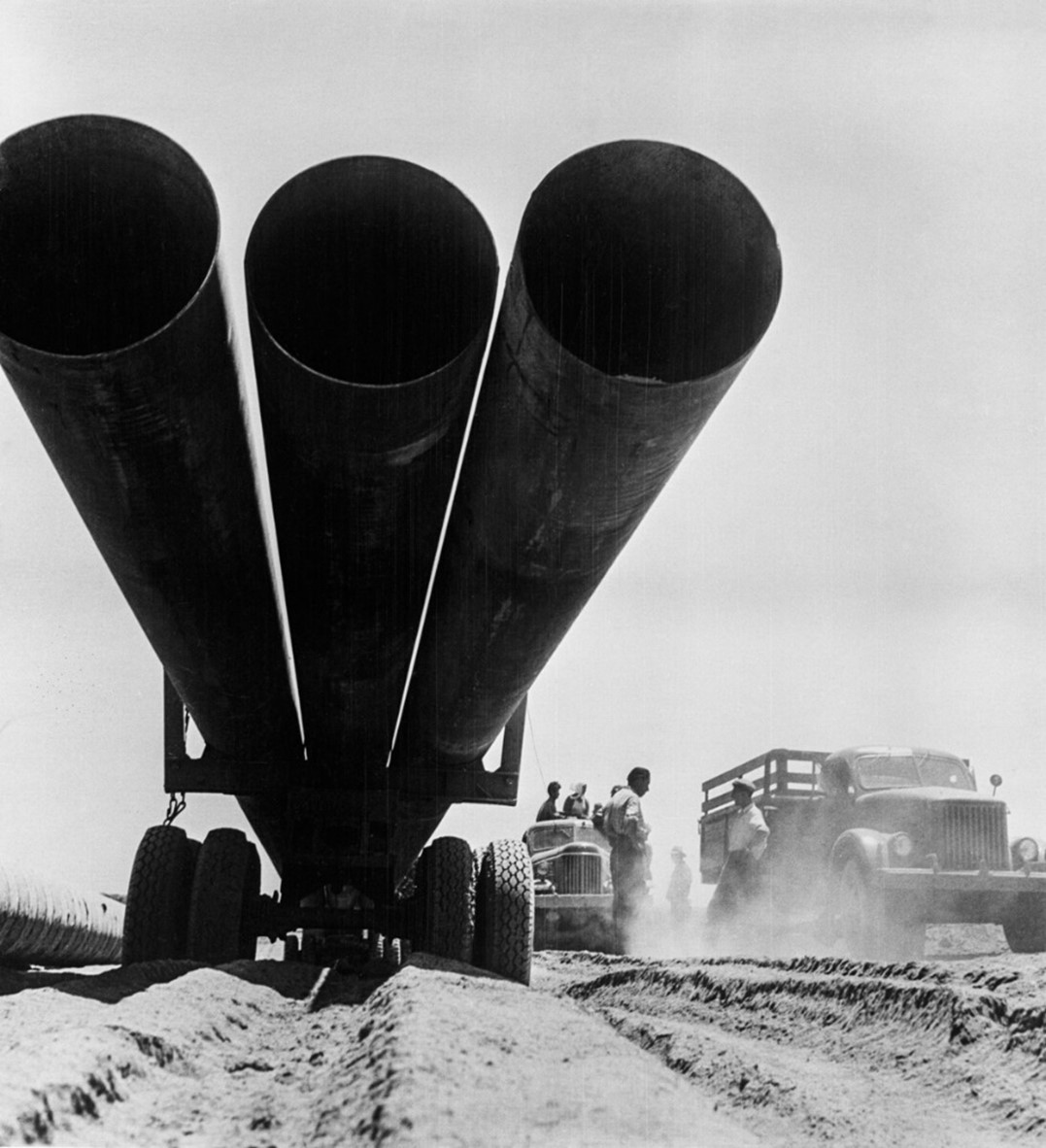
5. Pipes in the USSR. Source: https://www.rbth.com/history/335439-how-ussr-got-europe-gas
3. The Urengoy/Yamal Pipeline and the Altered Soviet Motives: 1978-1982
After 1973, gas trade would continue between USSR and Western Europe without major problems. Disturbances that would occasionally appear were usually dealt with and any losses would be covered.[114] This instigated the further enhancement of energy trade[115] requiring not only additional amounts of gas exported to Western Europe, but also the creation of new routes and pipelines. One of them would be the Siberian pipeline, a vast project, stretching from the exuberant Urengoy gas reserves, in north-western Siberia to Western Europe. This caused a fierce reaction by the US, which opposed the deal, warning their allies, particularly under Reagan (after 1981), that this would perilously augment the Soviet influence and leverage over Western Europe.[116]
The latter, however, had adopted a much more economic approach of the matter and security issues were disregarded, which can also be attributed to the great effort of the Soviets to be consistent and stable suppliers, with disruptions being results of technical and not political problems.[117] In this sense, an analysis of the economic-technical and political-security motives of the USSR in this new background, with the latter being inadequately examined by existing historiography, is essential in order to obtain a complete image of the debate and the variegated stakes around the Urengoy pipeline.
3.1 Economic-Technical Dependence
In the 1968-1973 period, gas and oil trade were basically discussed as a solid basis for the development of the Soviet economy, when it came to economic-technical factors. What was the rhetoric and the perceptions in the USSR after 1978? Was this optimism still discernible, or replaced by more ominous sentiments? It ought to be noted that this sub-chapter does not seek to demonstrate the economic-technical incentives’ content in detail, but their significance.
As mentioned in the first chapter, many Soviet officials had reservations concerning the exploitation of Siberian gas. Nevertheless, by the second half of the 1970s, such considerations had almost vanished and the Soviets were convinced that they could rely on Siberia, as a trustworthy source of gas.[118] The decline in oil production already in the late 1970s, further enhanced the importance of gas for the USSR, rendering it a paramount source of hard-currency income.[119]
With the creation of a new pipeline from Siberia, there would be a complete segregation of the gas flows to cover domestic needs and the ones destined for exports, something that would foster the credibility of the Soviets as reliable suppliers[120]. Furthermore, the ‘gasification’ of the Soviet economy was facilitated by the increasing exploitation of western Siberian gas.[121] Of course this included new, big pipeline infrastructure projects and consequently, new increased imports of relevant Western materials, given that the Soviet pipe and compressor technology remained inadequate. Later though, the US compressor embargo imposed from 1981 to 1983, would instigate the Soviets to increase the quality and quantity of their respective production, but not with great success.[122]
How did the Soviet leadership view the situation in the oil/gas sector? In November 1978, two years before the negotiations for the Urengoy pipeline started,[123] Brezhnev would say to other WTO leaders that it was ‘‘necessaryto get technology from the capitalist countries’’,thus they would require foreign currency and, in this way, would ‘‘depend on the capitalist market’’.[124]He aspired to stress in this way the need for cooperation in the CMEA to make sure that only necessary materials would be bought in the West[125] (like pipeline-related products) and avoid dependence in other sectors.
A trend of utmost significance must be taken into consideration. The share of raw materials in Soviet exports skyrocketed in the 1970-1980 period from 26% to 51,5%. However, this growth was driven, among others, by imports of equipment and machinery from the West, with the trade deficit for the USSR in the sector growing from 3,709 million dollars in 1970, to 12,309 million already in 1975. Moreover, since the mid-1970s the Soviet economy had entered a phase of economic stagnation, hence, a project that would boost the credibility of the Soviets and increase the flow of Western technology and hard-currency into the USSR, was a perfect match to Brezhnev’s considerations and concerns.[126]
1978 was marked by the Siberian gas campaign, an effort to instigate more people to work in Siberia, including newspapers and even posters with titles like ‘Give Siberia’ or ‘Siberian might’, aspiring to foster production there. Brezhnev himself went on a two-week tour in Siberia delivering speeches, in an attempt to ‘encourage’ the people already working there and attract residents of other USSR areas as well. At the same time, Brezhnev also travelled to FRG seeking to strengthen economic relations and on several occasions, he would complain about the economical ineffectiveness and problems in many industrial sectors, including oil and gas.[127]
From 1966 to 1980, Soviet gas investment had grown immensely, from 4.05 billion roubles, to 19.3 respectively, whereas Brezhnev’s declaration of an oil emergency in 1977 and decision to shift towards western Siberia, also instigated a rise in Soviet oil investment, which doubled from 1977 to 1982.[128] In this sense, it should not be surprising that the Soviets urgently required more hard-currency to fund an energy policy that was becoming incessantly more expensive.
Moreover, economic relations between the East and the West during détente, had developed in a quite unequal way, bringing many Eastern bloc countries in a disadvantageous position, especially concerning indebtedness and technical dependence, with the trade between the two sides being disproportionately more significant for the East than it was for the West.[129] The Soviet (successful initially) effort in 1980 to increase the amount of credit to receive from Western banks, which eventually surpassed the money needed to buy the necessary materials for the Urengoy pipeline, by negotiating separately with each European bank,[130] highlights the concern of the officials to obtain as much hard-currency as possible. The Soviet economic system had been considerably influenced by relations with the West, whilst the opposite did not seem to happen.[131] So, what role did the Soviets envisage for gas in the 1980s?
The Alexandrov Commission, which drafted the Soviet energy programme in the early 1980s, was in favour of gradually shifting from oil to gas, with Gustafson offering two potential explanations for this position.[132] The one is that Western Europeans at the time were eager to buy more gas, as its market share and consequently its use had increased considerably[133] throughout the 1970s,[134] another indication of how the Soviets followed Western economy trends.[135] The second and more possible, according to Gustafson, was that the oil-related costs were surging, thus gas was preferable, but since replacing oil domestically with gas did not seem possible at the time, doing so in exports appeared to be the only solution,[136] highlighting again the prominence of economic-technical considerations. Of course, a combination of both is also plausible.
Another illustration of the augmented magnitude of economic-technical concerns in the 1980s, fostering the need to continue gas exports to the West and support projects, such as the Urengoy pipeline, was given by Andropov in 1981. In a conversation with Erich Mielke,[137] focusing among others on the situation in the USSR and the crisis in Poland,[138] while he was satisfied with USSR’s current economic performance, he also expressed his worries regarding the exploitation of raw materials, linked to the need to shift from the Soviet Union’s European part, to Siberia.[139] This meant increased expenses and given that he was not convinced that the economy could become more efficient, the benefits of cooperation with Western Europe and projects like the Siberian pipeline, which was then negotiated, were paramount and could not be neglected.[140]

6. Soviet gas output, 1970-1988. Source: Gustafson Thane. Crisis amid Plenty: The Polics of Soviet Energy under Brezhnev and Gorbachev. Princeton University Press, 1989, 138. https://ebookcentral.proquest.com/lib/uunl/reader.action?docID=3031031
At the time, the Soviet economy reflected much more the concerns of Andropov, than his general satisfaction. Being in stagnation since the mid-1970s, the country’s economy was also negatively affected by its militarisation, which was a repercussion of the Afghan crisis, but also the rise of Ronald Reagan in the US and the revival of military competition and big mutual suspicion. This increased military expenses, while using technological innovation for civilian purposes was neglected.[141]
The new five-year plan from 1981 to 1985 echoed the matters presented in the previous pages. It was decided to continue heavily investing in energy, though with more emphasis on gas instead of oil.[142] Of course, the necessary technology to develop energy production had to be bought from the West, as also some other essential agricultural and industrial products, which required hard-currency that would be obtained by energy exports to the West and even the construction of six new pipelines was foreseen.[143] The needs shaping the five-year plan vividly illustrate an economic vicious circle for the Soviets.
A case that is also enlightening to briefly discuss, is the case of compressors in the 1980s, because it will accentuate the problematic characteristics of the Soviet energy policy. Already in the previous chapter the inadequacy of the Soviet domestic production has been observed. Simultaneously, importing them was difficult,[144] especially when the US imposed an embargo on the USSR due to the crisis in Poland, rendering the improvement of domestic production a matter of insurmountable significance, yet the advances in compressor production remained insufficient.[145]
Interestingly, the Soviets had chosen to continue not buying compressors from the West, even after the American embargo was lifted, but they were still buying compressor parts.[146] In the 1970s, even for domestic projects, like the Soyuz pipeline in 1975,[147] compressors were bought from Western companies, like Rolls-Royce and General Electric.[148]

7. Soviet Imports of gas- versus oil- related equipment. Source: Gustafson Thane. Crisis amid Plenty: The Polics of Soviet Energy under Brezhnev and Gorbachev. Princeton University Press, 1989, 197. https://ebookcentral.proquest.com/lib/uunl/reader.action?docID=3031031
This highlights two features of the Soviet energy policy. The first is that their policies were not always rational and this indubitably affected negatively their ability to sustainably develop their gas industry, which as a corollary would increase their technical dependence that leads to the second point. Their technical dependence was of such a size that even when they aspired to rely on domestic production, they would still import materials, evidently because even a lower-quality production was not feasible without at least some Western materials.
Throughout the 1968-1982 period, economic-technical incentives had been a guiding force for the Soviet energy policy, especially when it came to exports. In 1968-1973, the exponentially growing gas reserves, combined with the already dynamic oil production, were seen as a solid basis for the sustainable economic development of the USSR and trade with the West would provide the country with the technology and the hard-currency that would boost its development.
Nevertheless, the economic development proved to be quite unsustainable. The conditions in Siberia, where the Soviets had to turn, in order to extract the desired amount of oil and gas, were totally unfavourable to such operations. In addition, the Soviet industry remained far inferior to Western industry and could not satisfy the needs of the oil and gas sectors. Therefore, export agreements with Western Europe, envisaging pipeline construction and sizeable Western technology imports, were almost mandatory for the USSR. The US embargo in 1982 on several materials, because of the Polish crisis, combined with the existing compressor embargo had a negative impact on Soviet pipeline construction, resulting in the network facing many operational problems.
The rhetoric in 1978-1982 primary sources is also markedly different, compared to the one pondered in 1968-1973. Energy exports to the West are not discussed as a great opportunity or a significant weapon for the materialisation of Soviet political and economic objectives. To the contrary, when it comes to raw materials, like gas and oil, remarks are rather ominous and energy relations with the West are presented as a vital necessity for the USSR, without which they would face great problems. This accentuates that economic-technical targets were a core-factor for the new agreements, including the Urengoy pipeline, overshadowing other motives.
In 1978-1982 the Soviets would embark on new ‘adventures’ that would challenge their economy, army and even their political system. One of them, the Polish crisis, can offer some valuable insights concerning not only the economic and political challenges the Soviets faced in the 1980s, but also the versatility of their energy policy.
3.2 The Polish Crisis: A Multifaced Energy Policy
The founding of ‘Solidarity’[149] in Poland in 1980 and its activity, which included protests and strikes, thus was viewed as subversive by communist authorities, would pose a serious threat to the entire Eastern bloc. As the months passed, it seemed increasingly difficult to contain the movement, raising concerns to communist countries. The USSR, not wanting to directly interfere, would try to control the situation indirectly. To this cause, the energy policy would appear to be a trump card and the interplay between energy policy and the Polish crisis is extremely interesting, but also very informative of Soviet perceptions, problems and strategies.
One major implication of the protracted crisis in Poland were the increased expenses for the Soviet Union in order to support the Polish government. That was stressed almost immediately after the crisis started by a letter from Brezhnev to Erich Honecker, leader of East Germany, in November 1980, in which the Soviet leader mentions that the situation in Poland is dire and assistance in hard-currency and goods[150] was a vital necessity.[151] However, the USSR faced financial difficulties as well, thus required a contribution from other communist countries. They did not want money, but to reduce the volume of oil shipments to them (600,000-650,000 tons for GDR), which would instead be sold on the capitalist market, with the aim of boosting USSR’s hard-currency revenues.[152] The energy policy gained a prominent role in the crisis from its early stages.
It should not be forgotten that in 1980 negotiations for the Urengoy pipeline with Western Europeans also started and the Soviets already had an extra economic incentive to proceed dynamically with the negotiations. A deal would facilitate the flow of hard-currency to the country, through loans, which were negotiated simultaneously,[153] and later gas purchases. This would be important to cover the losses of the crisis.
In August 1981, when the crisis had been unfolding for about a year and was getting increasingly worse for the Polish government and the Soviets, its strong economic impact could be quite visible. Stanislaw Kania, Leader of Poland, and prime minister Jaruzelski, who would soon succeed the former, accentuated in a meeting with Brezhnev that the economic situation in Poland was dire and it was actually a fundamental reason for the extended length of the political crisis.[154]
Brezhnev notified them that the CC CPSU had decided to transfer the payment of Poland’s debts for the next five-year period and reminded them that all the countries in the bloc were trying to assist, with the USSR, only in the previous period having given 4 billion dollars,[155] a prodigious number. With negotiations for the pipeline ongoing, the situation in the Eastern bloc would only make the already significant economic-technical objectives more urgent.
Actually, in the last months before martial law was imposed on the 13th of December 1981 by Jaruzelski, under Soviet pressure to finally deal with the crisis, the concerns of the USSR leadership because of the Polish crisis’ exorbitant costs were repeatedly stressed. Economy constituted a pivotal discourse even in the Session of CC CPSU Politburo on the 10th of December, just a few days before martial law was introduced. Nikolai Baibakov[156] mentioned that the assistance requested by the Polish leadership in a list that was given to him amounted to 1.4 billion roubles,[157] which combined with what the Soviets planned to give them in 1982 would make a total of about 4.4 billion roubles in that year.[158] Furthermore, granting that much assistance would mean, according to Baibakov, that they would have to either use state reserves, or reduce deliveries to the internal market, a quite unpleasant situation.[159]
So, why did the Soviets not consider an invasion (like in Czechoslovakia in 1968) in order to deal with the crisis, which had lasted so long and deeply worried all the Eastern bloc countries? Economy (and technical reasons concerning the oil and gas industries) would again play a crucial role. Whereas there were concerns in the West that the Soviets were considering an invasion,[160] Andropov accentuated that any kind of military intervention would be too risky for the Soviets.[161] He would actually contend that even if ‘Solidarity’ prevailed, the USSR should not act, because the Western powers had already agreed on political and economic sanctions, whose cost would be ‘‘very heavy’’[162]for the USSR.[163] That is why he considered it paramount that the Poles proceed with the introduction of martial law.[164]
Western sanctions against the Eastern bloc were hardly an innovation throughout the Cold War, but rarely had they seriously deterred Soviet actions. Yet, this could not be the case in the 1980s economically and technically dependent USSR. Therefore, a ‘domestic’ solution, with the imposition of martial law, was the preferable alternative for the Soviets and would try to convince Poland to act accordingly.[165]
The US had, even before Reagan rose to power in 1981, warned that the consequences would be devastating, should the WTO invade Poland, and sanctions would be increased,[166] which eventually happened, after the introduction of martial law. It is important to bear in mind that Western Europeans did not follow the US, but had the Soviets chosen to fully invade Poland, it would have probably been impossible to do so. Such a development would have irrefutably multiplied the repercussions of the sanctions.
The introduction of martial law put finally an end to the Polish crisis. Did it also put an end to the economic burdens of the USSR, reducing the need to divert money and resources to Poland? Discussions in the Session of the CC CPSU Politburo on the 14th of January 1982 indicate that this was not the case. Brezhnev stressed that the counterrevolution had affected Poland economically and it still required assistance,[167] with Jaruzelski asking for even more Soviet help, yet the USSR, was able to afford perhaps only a marginal increase.[168] It is important to take into consideration that the economic consequences outlived the crisis itself, thus it cannot be assumed that the end of the crisis reduced the necessity of the Urengoy pipeline and even more, the flow of hard-currency loans, the agreements for which were signed later in 1982.
A letter of Yaruzelski to Brezhnev, from the 3rd of January 1982 was also circulated among Politburo members, in which the Polish leader asked for more oil, oil-products and petrol.[169] Nonetheless, Baibakov was not in favour of such an increase, saying that it was not possible.[170] This leads to another aspect of the crisis, directly linked to energy, in particular, how did the Polish crisis affect the energy trade within the Eastern bloc? We have already observed that the gas agreements in the early 1970s negatively influenced Soviet republics, like Ukraine. The USSR was a major oil/gas provider for the other countries of the Eastern bloc, which would, on the one hand grant it a leverage and on the other, result in being pressed by other countries to adequately cover their energy needs.
Bulgarian leader, Todor Zhivkov, a very significant and trustworthy ally of the Kremlin, constitutes a prime example. Already in 1973, the year gas deliveries to FRG commenced, Zhivkov had raised the issue of the inadequacy of Soviet-Bulgarian energy relations to Brezhnev, in a discussion between them in Bulgaria. Although he was aware of the Soviet obligations to Western states and of the fact that other Eastern bloc countries would express similar requests[171], he asked for an increase of oil shipments to Bulgaria, because the current amount could not cover the needs of the country, in spite of the efforts to economise.[172]
Dealing with the needs of Western Europeans, Eastern bloc states, but also other countries, like Cuba, was not an easy task, especially with the difficulties of extracting and transporting Siberian gas and oil.[173] Brezhnev would have to stress this to communist leaders in March 1975, which was also the year the Soyuz pipeline’s construction started.[174] In December 1979, when the project was finished, he received a letter from Zhivkov expressing his gratitude for the USSR’s promise to cover the energy needs of Bulgaria in 1980, because this was very important for Bulgaria, as the Soviet leader could understand,[175] given that this was an extensively discussed issue.
Nevertheless, it is not a bold assumption that the Soviets had not a preference for oil and gas shipments to Eastern bloc countries. After the first oil crisis in 1973, the Soviets sold oil at subsidised prices to their communist allies, unlike the Western Europeans, but these lower prices were uneconomical for the USSR, rendering the West a much better market.[176] It should be noted that gas was sold at competitive prices in Eastern Europe, which is why the Soviets also sought to replace oil with gas and sell displaced oil to Western Europe.[177] How did the Polish crisis affect this matter?[178]
As mentioned in the beginning of the sub-chapter, soon after the situation in Poland started deteriorating, Brezhnev declared to Erich Honecker his intention to reduce oil shipments to Eastern Europe in order to increase sales to the West. Yet the trend in Eastern Europe, already since the 1970s was increasing energy demands,[179] resulting in requests for augmented oil and gas shipments, like Zhivkov did.
In late October 1981, in a session of the CC CPSU Politburo, Konstantin Rusakov,[180] who had returned from a trip to GDR, Czechoslovakia, Hungary and Bulgaria, informed his counterparts that Kadar (Hungary), Husak (Czechoslovakia) and Zhivkov, understanding the difficulty and danger of the crisis, accepted the decrease in oil supply, though they stressed that adjusting would be difficult. To the contrary, Honecker expressed his disagreement with this decision, because it would be very harmful for GDR. Nevertheless, while Brezhnev was concerned by the difficulties his allies would face and mentioned that they should give more oil, if possible, this did not seem to be the case.[181]
At the time, it was decided that Tichonov,[182] Rusakov and Baibakov, would further review the issue of oil supply,[183] but eventually, under the crisis’ pressure the initial decision was not changed (only perhaps alleviated). Oil exports to Eastern Europe would slightly decrease, while the ones to the West grew and the share of Eastern Europe in gross Soviet energy exports would drop from 51.9% in 1981 to 47.9% in 1982 and would remain near 45% in the next years,[184] after the end of the crisis, a development that was to the economic interest of the USSR.

8. Soviet gross oil exports to the West versus Eastern Europe. In thousands of barrels per day. Source: Gustafson Thane. Crisis amid Plenty: The Polics of Soviet Energy under Brezhnev and Gorbachev. Princeton University Press, 1989, 276. https://ebookcentral.proquest.com/lib/uunl/reader.action?docID=3031031
Thus, the Soviets were able to reduce the uneconomical oil shipments to Eastern Europe without great resistance, while the urgency of the crisis rendered it feasible to counter Honecker’s objections as well. Besides, the latter was aware of the crisis’ seriousness and feared that socialist Poland would collapse, already in November 1980, as he clearly demonstrated in his response to Brezhnev’s letter, in which he asked Honecker to accept reduced oil imports from the USSR.[185]
Furthermore, energy policy and the USSR’s critical role in Poland’s oil supply, would be used for political reasons, in order to instigate a more dynamic reaction by the Polish government, including the imposition of martial law. The Poles were often reminded of the Soviet sacrifices on their behalf, to prevent the state from collapsing, which would probably happen, should the Soviets decide to cut the flows.[186]
In a CC CPSU Politburo session in early April 1981, discontent was expressed because the Poles were not aware of the Soviet sacrifices, how much oil and other products they were giving to them and it was a goal of the Soviet policy to raise awareness of Poland’s economic dependence on the USSR.[187] In October 1981, Ivan Arkhipov[188] proposed that the Soviets should reduce the amount of oil given to Poland,[189] because the latter was not providing the USSR with coal and other products, due to the crisis, and only after the Polish shipments returned back to normal, should the oil exports rise again.[190]
Bearing in mind all these ways the Soviets utilised their energy leverage in Eastern Europe will be very useful in pondering energy relations with Western Europe during the same period. Tracing differences and similarities in rhetoric and practice, will be enlightening regarding the way the USSR aspired to utilise gas and oil vis-à-vis the Western Europeans.
3.3 Political-Security Targets: Mission (partially) Accomplished
In the first part of this analysis, a rather balanced relation between economic-technical and political-security objectives in the Soviet energy policy has been observed. The second so far, has illustrated the escalation of the economic-technical considerations’ significance. But what about political-security goals? Unlike the 1968-1973 period there are no particular political-security targets linked to energy. One assumption has been that the predominance of economic-technical dependence, diminished the interest in other objectives.
A second is that there was actually satisfaction with the progress in relations with Western Europe after 1968, thus setting similar goals in 1978-1982 was redundant. In this sense, the first question that should be asked, is how did the Soviets view their relations with Western Europe in the late 1970s and early 1980s? Some CC CPSU Politburo sessions concerning the Soviet invasion of Afghanistan can provide valuable insights.
In January 1980, about a month after the invasion of Afghanistan started, divergence between the US and Western Europe was evident, to the satisfaction of the Soviets. Foreign Minister Gromyko mentioned in a CC CPSU Politburo session, when the Afghan crisis was discussed, that there was no unity in NATO, with many Western European countries, including FRG and Italy, unwilling to follow the US and adopt a strongly anti-Soviet stance.[191] Furthermore, a report of the CC CPSU accentuated FRG’s and France’s role in serving USSR’s interests with their evident differentiation from the US.[192] Τhey had adopted an ambivalent position, declaring their solidarity with Washington, but also their determination to find other ways solving the crisis.[193] This is evidently very close to the US-independent Europe the Soviets envisaged in 1968-1973 and were indisputably gratified by these developments.
In 1981, Andropov would further demonstrate the success of political-security endeavours initiated after 1968. In the aforementioned dialogue with Mielke, when discussing energy relations with Western Europe and US efforts to impede the construction of the Urengoy pipeline, he was not particularly concerned, because ‘‘in the end, the business people would prove stronger than the rulers’’.[194] He expressed similar optimism concerning credits, though they would have to wait for everything to be arranged.[195]
What can be concluded from this? Evidently the Soviets considered the European businessmen their allies in energy affairs. They also surmised that this would prevent the Western Europeans from yielding to US pressure and cancelling negotiations for the pipeline. In other words, the economic elites played the role the Soviets envisaged in 1968 and 1970, when forming ties with Western financial elites was not a fact, but a target. The successful outcome of the negotiations in 1982 and the pipeline’s completion in 1984, in spite of US objections, would prove Andropov right. This highlights that ties with Western economic elites were indeed a significant political-security goal in 1968-1973 and would serve the Soviets in the years to come, facilitating European autonomy towards the US.
A report from the Soviet embassy in Washington, in February 1982, would also demonstrate the energy policy’s success. Despite Reagan’s efforts to weaken the economic relations between Western Europe and USSR, the divergence of interests between the allies was evident, with US circles regarding as major losses the FRG-USSR agreement on compressor equipment in September 1981 and an agreement on gas in November.[196] In particular, this agreement was the first that included West Berlin, accentuating the progress of FRG-USSR relations (and perhaps USSR’s desperate need for hard-currency) and opening the way for similar agreements with other Western European countries.[197]
These developments imply why forging connections with Western economic elites for political-security reasons was not existent in 1978-1982 documents. There was no reason to pursue a target that was already achieved. Thus, the Urengoy pipeline was not necessary for the Soviets to increase their influence on Europe, to the contrary, it was the result of the 1968-1973 political-security strategy and the influence they had gained.
Besides, it should not be forgotten that the Polish crisis had escalated at the time and the martial law in December 1981 prompted US, but not Western European sanctions. French president François Mitterrand, for example, condemned the USSR for inciting the introduction of martial law, but when it came to action, just a few weeks later, Gaz de France,[198] having resisted politicisation of the Yamal pipeline, signed the gas-agreement with the USSR, which was paramount for France’s gas supply.[199]
The similarities between 1968 Austria and 1980s Western Europe are obvious. In both cases no sanctions were imposed without Soviet pressure, as it was unnecessary. Europeans always doubted the effectiveness of sanctions, considered them detrimental to their commercial interests[200] and FRG, Italy or France were not eager to substantially disrupt their energy policy in 1979 and 1982, like the Austrians in 1968.[201] Thus, history would repeat itself and according to Högselius, it is likely that Soviet officials estimated that geopolitical considerations and military aggression mattered little compared to the expansion of East-West energy relations, taking the Czechoslovakia and Afghanistan experience into consideration.[202]
Irrefutably, the USSR was probably not indifferent to political-security gains. Blinken mentions, without doubting economy’s significance, that the Soviets aspired to weaken the solidarity within the Western alliance by enhancing trade relations.[203] Nonetheless, the role of such considerations in USSR’s strategy regarding the Urengoy pipeline should not be exaggerated. Just because the divergence between Western Europe and USSR became more evident in the 1980s does not mean that it was then sought by the Soviets. Motives have to do with the intentions of the actors, not the results of their actions. Further growing the already existing rift between the two allies was irrefutably welcome, but it is rather debatable whether it was pursued and not merely accepted as a positive side-effect.
Another issue that is important to bear in mind is the extent to which the Soviets could really threaten[204] Western Europe. There have been cases, for instance, during the extremely cold winters of 1976-1977 and 1978-1979, when there was a 25% reduction in supply, because of a pressure drop in the pipelines and the Soviet decision to cover the augmented needs of CMEA countries.[205]
This reduction was not linked to any ‘political requests’ and the losses were made up in the summer. In any case though, Western Europeans were prepared to deal with such shortages. Some sectors had dual-firing capability, rendering switch from one energy source to another easy and in the Groningen field in the Netherlands, production could grow quickly during a crisis and mitigate its impact on the EEC. In addition, in 1983 Western Europeans were renegotiating their contracts with the USSR to decrease the amount of gas imports, due to declines in demand.[206]
Perhaps the Soviets could cause problems to particular domains or regions, but again, this capability should not be exaggerated. Applying some pressure would be possible, but being able to blackmail a country, or even more the whole EEC seemed impossible and attempting it would probably be naive. Hence, even if the Soviets had such malignant political-security goals, their efforts would be unsuccessful.
Blinken also questions the extent to which gas exports would fund the Afghan campaign and the Red Army’s empowering. Cutting military expenditures was not considered a choice in the USSR, even during economic stagnation and the Soviets would prefer to reduce spending on the civilian economy and the hard-currency earnings would probably be used to deal with matters like balancing old debts.[207] It could be said that while there was progress regarding the 1968-1973 political-security goals in 1978-1982, there was no particular interest in political-security matters.
Overall, the 1978-1982 period was a very interesting and challenging period for the Soviet energy policy and the USSR in general. The stagnation of the economy and the economic-technical dependence on Western Europe rendered the further development of the pipeline network a vital necessity for the survival of the Soviet economy. The Polish crisis, aggravated those needs and facilitated increased energy exports to the West, to the expense of CMEA countries. Simultaneously, Western European reactions to the Afghan and the Polish crises and their choice to proceed with the construction of the Urengoy pipeline, in spite of US objections, gratified the Soviets. Therefore, the political-security goals set in 1968-1973 were not regarded as objectives, but more as facts, whereas available archives do not mention new political-security targets linked to the energy policy.

9. Workers in the Urengoy field, 1978.Source: https://www.rbth.com/history/335439-how-ussr-got-europe-gas
Conclusion
So, what were the political-security motives of the USSR behind the energy relations with Western Europe and how did they evolve in 1968-1973 and 1978-1982? This research has shown that apart from its economic value, the energy policy was also viewed as a means to foster Western European independence from the USA, rendering it more conducive to Soviet influence. Nevertheless, the importance of this aspect was diminished by the early 1980s.
In 1968-1973 increasing oil and gas exports to Western Europe was part of a two-pronged strategy. Energy exports could constitute a solid basis for the economic development of the USSR, as a result of the growing flow of hard-currency and advanced-technology and quality products, like pipes. Simultaneously, the Soviets were concerned that the Westerners would use détente to undermine their communist political system and wanted to make sure that economic relations would develop in a way that would foster Western European independence from the US by forming close ties between Western economic elites and the Soviet state.[208] The value of such bonds was accentuated by the gas deal with Austria in 1968 and the country’s decision not to impose sanctions and condemn the USSR, after it invaded Czechoslovakia.
In 1978-1982, the landscape had changed markedly, yet again the energy sector was a valuable ‘weapon’ with multiple uses. The economic-technical value of energy exports had become much more urgent and the Soviets were almost entirely dependent on Western Europeans buying oil and gas and building pipelines jointly, in order to maintain the flow of hard-currency and high-quality technology, without which their economy would be devastated. To the contrary, political-security considerations were hardly existent, concerning the energy policy. However, sessions of the CC CPSU Politburo indicate that the Soviets were content with the progress of political-security targets set in 1968-1973. A more US-independent Western Europe was pursuing its own policy concerning East-West relations, as the Afghan and Polish crises also indicated. During the latter, except for its hard-currency needs further increasing, the USSR would stress its leverage in energy to Poland, so that more decisive action against ‘Solidarity’ would be undertaken. The political use of energy towards Eastern Europe was markedly different from its use towards Western Europe.
Of course, this does not mean that the USSR did not have concrete political-security objectives in 1978-1982 concerning Western Europe. Nonetheless, these were not tied to the energy policy, as they were in 1968-1973, thus were out of the scope of this thesis, which focused on political-security objectives through energy policy, not political-security objectives of the USSR in general. The Soviets could use diplomacy, military might, propaganda or other tools, whilst trade (including gas and oil) could also be utilised sometimes, but its role was primarily economic and only in some cases political.[209]
Many academics that have pondered the Soviet energy policy, accentuate the role of economic-technical factors. Concerning 1968-1973, it has been shown that political-security targets were similarly important. Regarding 1978-1982, it is accepted here that the economy had become the central factor, but while the Urengoy pipeline is seen in historiography also as a way to amplify divisions between the US and Western Europe (a secondary goal), this thesis claims that the construction of the pipeline was possible because such divisions already existed. Weakening Western unity, while welcome, there is no evidence indicating that it was pursued. These conclusions concerning the energy policy of the USSR in 1968-1973 and 1978-1982, are based on a variety of primary sources, including untranslated archives from the Soviet Union. Many of these sources have not been used, or examined from an ‘energy perspective’, rendering this research really innovative.
Indubitably, more Soviet documents, especially from the 1968-1973 period, focusing on the energy policy of the USSR vis-a-vis Western Europe, would have been a very insightful addition. Yet, this is why the GDR documents used here are combined with existing historiography and Soviet documents from the 1978-1982 period to ensure their validity. Further research that includes more Soviet archives on energy-related projects, is strongly encouraged. Another matter requiring further research, is the reason the Soviets, having at least partially achieved the 1968-1973 targets, did not set new, more ambitious political-security goals. The documents examined here, do not provide a clear answer. The dominance of economic-technical factors might have deterred the Soviets, but certainly more research is required and encouraged.
Overall, this thesis has stressed the multifarious uses energy can have in various sectors. The Soviets might not have been very flexible in extracting and transporting oil and gas, nonetheless, they had fathomed how ‘flexible’ these resources were in order to pursue many, diverse goals, exploiting the permeability of the borders between the two Cold War blocs. Therefore, maintaining an open-minded approach and taking disparate factors into consideration, when dealing with energy issues is encouraged by this research.
Antonios Paraschos

10. A pipeline in the USSR. Source: Högselius Per. Red Gas. Russia and the Origins of European Energy Dependence. New York: Palgrave Macmillan, 2013. https://search.worldcat.org/title/1005829076
Bibliography
Primary Sources
CIA
‘Soviet Views on Capitalism’, CIA.gov, Ceasar V-A-56. January 30, 1956. https://www.cia.gov/readingroom/docs/DOC_0000499768.pdf
National Security Archive (United States of America) https://nsarchive.gwu.edu/
Российские Страницы (Russian Pages). Collections: Афганистан 1979-1989 (Afghanistan), Эпоха Брежнева 1964-1982 (Brezhnev era), Польский кризис 1980-1982 (Polish crisis)
CC CPSU ‘О дальнейших мероприятиях по обеспечению государственных интересов СССР в связи с событиями в Афганистане’. National Security Archive. January 28 1980. (Translated by author). https://nsarchive.gwu.edu/rus/text_files/Afganistan/January%2028,%201980.pdf On further measures for the ensuring of state interests of the USSR as a result of the developments in Afghanistan
CC CPSU ‘О развитии обстановки в Польше и некоторых шагах с нашей стороны’. National Security Archive. April 23 1981. (Translated by author). https://nsarchive.gwu.edu/sites/default/files/documents/r16jg5-nm09r/1981.04.23%20Politburo%20Report%20on%20Poland.pdf On the improvement of the situation in Poland and some moves/steps from our side
USSR Embassy in the US. ‘Аннотация отчета Посольства СССР в США за 1981 год’. National Security Archive. February 3 1982. (Translated by author). https://nsarchive.gwu.edu/document/26587-document-49-annotaciya-otcheta-posolstva-sssr-v-ssha-za-1981-god Abstract of the USSR’s Embassy in the USA report for the year 1981
‘Заседание Политбюро ЦК КПСС’. National Security Archive. April 2 1981. (Translated by author). https://nsarchive.gwu.edu/sites/default/files/documents/r16jg5-nm09r/1981.04.02%20Session%20of%20CC%20CPSU%20Politburo%20Poland.pdf Session of the CC CPSU Politburo
‘Заседание Политбюро ЦК КПСС’. National Security Archive. December 10 1981. (Translated by author). https://nsarchive.gwu.edu/rus/text_files/BrezhnevEpoch/1981.12.10%20Session%20of%20Politburo%20CCCPSU%20to%20the%20Questionof%20Situation%20in%20Poland.pdf
‘Заседание Политбюро ЦК КПСС’. National Security Archive. January 14 1982. (Translated by author). https://nsarchive.gwu.edu/sites/default/files/documents/r16ju7-t79t4/1982.01.14.pdf
‘Заседание Политбюро ЦК КПСС’. National Security Archive. January 17 1980. (Translated by author). https://nsarchive.gwu.edu/rus/text_files/Afganistan/January%2017,%201980.pdf
‘Заседание Политбюро ЦК КПСС’. National Security Archive. October 29 1981. (Translated by author). https://nsarchive.gwu.edu/rus/text_files/BrezhnevEpoch/1981.10.29%20Politburo%20Minutes%20on%20Poland.pdf
‘О Встрече Тов. Л. И. Брежнева с тт. С. Каней и В. Ярузельским’. National Security Archive. August 22 1981. (Translated by author). https://nsarchive.gwu.edu/sites/default/files/documents/1981.08.22%20Meeting%20between%20Brezhnev%2C%20Kanya%20and%20Jaruzelski%2C%20Crimea.pdf On the Meeting of comrade Brezhnev with Kania and Yaruzelski
Wilson Archive https://digitalarchive.wilsoncenter.org/
Collections: USSR 1968-1982, East Germany 1968-1982 and Bulgaria 1968-1982
“Attitudes and Measures of the Warsaw Treaty States for Convening a Conference on Security and Cooperation in Europe, 1970-1971”, Wilson Center Digital Archive, PA AA: MfAA C 366/78. October 20, 1970. (Translated in English). https://digitalarchive.wilsoncenter.org/document/110087
“Current Essential questions in the Soviet Union’s Politics of Ensuring European Security”. Wilson Center Digital Archive, PA AA: MfAA C 326/77. April 26, 1968. (Translated in English). https://digitalarchive.wilsoncenter.org/document/110078
“Letter from Honecker to Brezhnev”. Wilson Center Digital Archive, SED-Politburo und polnische Krise 1980/1982 (Band 1: 1980). November 26, 1980. (Translated in English). https://digitalarchive.wilsoncenter.org/document/111992
“Letter from Leonid Brezhnev to Erich Honecker”. Wilson Center Digital Archive, SAPMDB, ZPA, J IV 2/202-550, first published in CWIHP Special Working Paper 1. November 4, 1980. (Translated in English). https://digitalarchive.wilsoncenter.org/document/112716
“Letter from Todor Zhivkov to Leonid Ilyich Brezhnev, Sofia”. Wilson Center Digital Archive, Central State Archive, Sofia, Fond 378-B, File 979. Obtained by the Bulgarian Cold War Research Group. December 6, 1979. (Translated by author). https://digitalarchive.wilsoncenter.org/document/111113
“Meeting of the Political Consultative Committee of the Warsaw Treaty Member Countries”. Wilson Center Digital Archive, Contributed to CWIHP by Ambassador Vasile Sandru from his personal files. Included in CWIHP e-Dossier No. 24, by Mircea Munteanu. November 22, 1978. (Translated in English). https://digitalarchive.wilsoncenter.org/document/110836
“Minutes of Conversation between Todor Zhivkov – Leonid I. Brezhnev, Voden Residence [Bulgaria]”. Wilson Center Digital Archive, Central State Archive, Sofia, Fond 378-B, File 360. Obtained by the Bulgarian Cold War Research Group. September 20, 1973. (Translated in English). https://digitalarchive.wilsoncenter.org/document/111183
“Record of Conversation of Brezhnev with Leaders of Fraternal Parties of Socialist Countries”. Wilson Center Digital Archive, Library of Congress, Manuscript Division, Dmitriĭ Antonovich Volkogonov papers, 1887-1995, mm97083838, Reel 16, Container 24. Translated by Svetlana Savranskaya for the National Security Archive. March 18, 1975 https://digitalarchive.wilsoncenter.org/document/121171
“Record of the Meeting Between Leonid Brezhnev and East European Party Leaders in the Crimea (Including Discussion on China)”. Wilson Center Digital Archive, SAPMO-BArch, DY 30 J IV 2/201. August 2, 1971. Included in the document reader for the international conference “China and the Warsaw Pact in the 1970-1980s” held by CWHIP and the Parallel History Project March 2004 in Beijing. (Translated by author). https://digitalarchive.wilsoncenter.org/document/114823
“Stasi Note on Meeting Between Minister Mielke and KGB Chairman Andropov”. Wilson Center Digital Archive, Office of the Federal Commissioner for the Stasi Records (BStU), MfS, ZAIG 5382, p. 1-19. Translated from German for CWIHP by Bernd Schaefer. July 11, 1981. https://digitalarchive.wilsoncenter.org/document/115717
Всемирная История/Global History (Historic.ru)
Gorbachev Mikhail. ‘О задачах партии по коренной перестройке управления экономикой’. Plenary Session of the CC CPSU. Historic.Ru: Всемирная История. June 25 1987. (Translated by author). http://historic.ru/books/item/f00/s00/z0000235/st019.shtml
Secondary Sources
Alta.ru ‘Русский экспорт. Товары. Нефть. От послевоенных лет до наших дней’. September 28 2019. https://www.alta.ru/articles/70428/
Blinken Antony J. Ally vs Ally. America, Europe and the Siberian Pipeline Crisis. New York: Praeger, 1987.
Britannica. ‘Politburo’. Accessed 7 March 2024. https://www.britannica.com/topic/Politburo
Demidova Ksenia “The deal of the century: the Reagan administration and the Soviet Pipeline”, in Patel and Weisbrode European Integration and the Academic Community in the 1980s. Cambridge: Cambridge university press 2013, 59—82. https://www-cambridge-org.proxy.library.uu.nl/core/services/aop-cambridge-core/content/view/07A6DC112C2148F61BD8EE190EA394F4/9781139381857c4_p59-82_CBO.pdf/deal_of_the_century_the_reagan_administration_and_the_soviet_pipeline.pdf
Goldmann, Kjell. “Change and Stability in Foreign Policy: Detente as a Problem of Stabilization.” World Politics 34, no. 2 (1982): 230–66. https://doi.org/10.2307/2010264
Gompert David C., Hans Binnendijk and Bonny Lin. “The Soviet Decision Not to Invade Poland, 1981.” In Blinders, Blunders, and Wars: What America and China Can Learn, 139–50. RAND Corporation, 2014. http://www.jstor.org/stable/10.7249/j.ctt1287m9t.19
Goncharov C. A. ‘Газовая Промышленность СССР в 1970-х гг. Уроки истории’. In История. Газовая Промышленность 746, no 12 (2016): 112-116. https://cyberleninka.ru/article/n/gazovaya-promyshlennost-sssr-v-1970-h-gg-uroki-istorii/viewer The Gas Industry of the USSR in the 1970s. History Lessons
Gorlin, Alice C. “Soviet Industry and Trade.” Current History 83, no. 495 (1984): 318–38. http://www.jstor.org/stable/45315370
Gustafson Thane. Crisis amid Plenty: The Polics of Soviet Energy under Brezhnev and Gorbachev. Princeton University Press, 1989. https://ebookcentral.proquest.com/lib/uunl/reader.action?docID=3031031
Hakkarainen Petri. A State of Peace in Europe: West Germany and the CSCE 1966-1975. New York, Oxford: Berghahn Books, 2011. https://www.berghahnbooks.com/title/HakkarainenState
Högselius Per. Red Gas. Russia and the Origins of European Energy Dependence. New York: Palgrave Macmillan, 2013. https://search.worldcat.org/title/1005829076
Killham Edward L. “The Madrid CSCE Conference.” World Affairs 146, no. 4 (1984): 340–57. http://www.jstor.org/stable/20671999
Köves A. “Some Questions of Energy Policy in East European Countries: Energy Supply and Foreign Economic Policy.” Acta Oeconomica 35, no. 3/4 (1985): 345–57. http://www.jstor.org/stable/40729196
Marsh Peter. ‘The European Community and East-West Economic Relations’. Journal of Common Market Studies 23, no. 1 (1984): 1-13. https://onlinelibrary.wiley.com/doi/abs/10.1111/j.1468-5965.1984.tb00056.x
Mastny Vojtech. ‘The Soviet Non-Invasion of Poland in 1980/1981 and the End of the Cold War’. The Cold War History Project, no 23 (1998). https://www.wilsoncenter.org/sites/default/files/media/documents/publication/ACFB35.PDF
Maull Hanns M. and Michel Vale. “The Natural Gas Pipeline Transaction with the Soviet Union – A Danger for Economic Security?” Soviet and Eastern European Foreign Trade 19, no. 1 (1983): 17–31. http://www.jstor.org/stable/27748761
Mazat Numa. Structural analysis of the economic decline and collapse of the Soviet Union. 2016. https://www.boeckler.de/pdf/v_2015_10_24_mazat.pdf
Moreton Edwina. “The Soviet Union and Poland’s Struggle for Self-Control.” International Security 7, no. 1 (1982): 86–104. https://doi.org/10.2307/2538690
Newell Richard S. “International Responses to the Afghanistan Crisis.” The World Today 37, no. 5 (1981): 172–81. http://www.jstor.org/stable/40395288
OSCE. ‘History’. Accessed 28 May, 2024. https://www.osce.org/who/87
Oudenaren John van. Soviet Policy Toward Western Europe. Objectives, Instruments, Results. Santa Monica: Rand, 1986. https://www.rand.org/content/dam/rand/pubs/reports/2006/R3310.pdf
Perović Jeronim and Dunja Krempin. “‘The Key Is in Our Hands:’ Soviet Energy Strategy during Détente and the Global Oil Crises of the 1970s.” Historical Social Research / Historische Sozialforschung 39, no. 4 (150) (2014): 113–44. http://www.jstor.org/stable/24145530
Romano Angela. “Détente, Entente, or Linkage? The Helsinki Conference on Security and Cooperation in Europe in U.S. Relations with the Soviet Union.” Diplomatic History 33, no. 4 (2009): 703–722. http://www.jstor.org/stable/44214077
Schlotter, Peter. “Problems of Detente in Europe.” Current Research on Peace and Violence 2, no. 3/4 (1979): 146–56. http://www.jstor.org/stable/40724878
Ulam Adam B. “Detente under Soviet Eyes.” Foreign Policy, no. 24 (1976): 145–59. https://doi.org/10.2307/1147982
Verny Sophie, and Michel Vale. “The EEC and CMEA: The Problem of Mutual Recognition.” Soviet and Eastern European Foreign Trade 24, no. 2 (1988): 6–25. http://www.jstor.org/stable/27749149
Woolcock Stephen. “East-West Trade after Williamsburg: An Issue Shelved but Not Solved.” The World Today 39, no. 7/8 (1983): 291–96. http://www.jstor.org/stable/40395534
Woolcock, Stephen. “East-West Trade: US Policy and European Interests.” The World Today 38, no. 2 (1982): 51–59. http://www.jstor.org/stable/40395359
[1] Blinken Antony J. Ally vs Ally. America, Europe and the Siberian Pipeline Crisis. New York: Praeger, 1987, 28-30.
[2] Högselius Per. Red Gas. Russia and the Origins of European Energy Dependence. New York: Palgrave Macmillan, 2013, 180-181. https://search.worldcat.org/title/1005829076
[3] See chapter 1 for a precise categorisation of the Soviet incentives and relevant sub-questions.
[4] In 1968 and after 1979 and 1980 respectively.
[5] Blinken Antony J. Ally vs Ally. America, Europe and the Siberian Pipeline Crisis. New York: Praeger, 1987, 49.
[6] Ibid 89.
[7] Secretary of Defence (US).
[8] Demidova Ksenia “The deal of the century: the Reagan administration and the Soviet Pipeline”, in Patel and Weisbrode European Integration and the Academic Community in the 1980s. Cambridge: Cambridge university press 2013, 63-66. https://www-cambridge-org.proxy.library.uu.nl/core/services/aop-cambridge-core/content/view/07A6DC112C2148F61BD8EE190EA394F4/9781139381857c4_p59-82_CBO.pdf/deal_of_the_century_the_reagan_administration_and_the_soviet_pipeline.pdf
[9] Ibid 62-63.
[10] Woolcock Stephen. “East-West Trade after Williamsburg: An Issue Shelved but Not Solved.” The World Today 39, no. 7/8 (1983): 291, 295. http://www.jstor.org/stable/40395534
[11] Ibid 294.
[12] General Secretaries of the Communist Party of the USSR in 1964-1982 (Brezhnev) and 1985-1991 (Gorbachev).
[13] Gustafson Thane. Crisis amid Plenty: The Polics of Soviet Energy under Brezhnev and Gorbachev. Princeton University Press, 1989, 10-21. https://ebookcentral.proquest.com/lib/uunl/reader.action?docID=3031031
[14] Ibid 5-6 and 9-20.
[15] Högselius Per. Red Gas. Russia and the Origins of European Energy Dependence. New York: Palgrave Macmillan, 2013, 7 and 37. https://search.worldcat.org/title/1005829076
[16] This refers to the Austrian reaction, as Austria had then signed a gas agreement with the USSR.
[17] Högselius Per. Red Gas. Russia and the Origins of European Energy Dependence. New York: Palgrave Macmillan, 2013, 91-92 and 184. https://search.worldcat.org/title/1005829076
[18] The CSCE was created in the early 1970s to serve as a multilateral forum for dialogue and negotiation between East and West. Source: OSCE. ‘History’. Accessed 28 May, 2024. https://www.osce.org/who/87
[19] Ulam Adam B. “Detente under Soviet Eyes.” Foreign Policy, no. 24 (1976): 154. https://doi.org/10.2307/1147982
[20] Romano Angela. “Détente, Entente, or Linkage? The Helsinki Conference on Security and Cooperation in Europe in U.S. Relations with the Soviet Union.” Diplomatic History 33, no. 4 (2009): 703–704. http://www.jstor.org/stable/44214077
[21] The EEC’s communist equivalent in the Eastern bloc, also known as the COMECON.
[22] Verny Sophie, and Michel Vale. “The EEC and CMEA: The Problem of Mutual Recognition.” Soviet and Eastern European Foreign Trade 24, no. 2 (1988): 6–7. http://www.jstor.org/stable/27749149
[23] Romano Angela. “Détente, Entente, or Linkage? The Helsinki Conference on Security and Cooperation in Europe in U.S. Relations with the Soviet Union.” Diplomatic History 33, no. 4 (2009): 716–717. http://www.jstor.org/stable/44214077
[24] Goldmann, Kjell. “Change and Stability in Foreign Policy: Detente as a Problem of Stabilization.” World Politics 34, no. 2 (1982): 260–263. https://doi.org/10.2307/2010264
[25] Leader of the USSR, as the General Secretary of the CPSU.
[26] Its Soviet/Russian section.
[27] A rather small group of about 12-15, high-ranking Soviet officials. Source: Britannica. ‘Politburo’. Accessed 7 March 2024. https://www.britannica.com/topic/Politburo
[28] Mainly for the economic-technical part some further information from the early 1960s will be given.
[29] Gas was not particularly significant then.
[30] Oudenaren John van. Soviet Policy Toward Western Europe. Objectives, Instruments, Results. Santa Monica: Rand, 1986, 82. https://www.rand.org/content/dam/rand/pubs/reports/2006/R3310.pdf
[31] Ibid.
[32] Perović Jeronim and Dunja Krempin. “‘The Key Is in Our Hands:’ Soviet Energy Strategy during Détente and the Global Oil Crises of the 1970s.” Historical Social Research / Historische Sozialforschung 39, no. 4 (150) (2014): 116-117. http://www.jstor.org/stable/24145530
[33]Nonetheless, this situation did not constitute an obstacle to the completion of the ‘Druzhba’ pipeline (= Friendship. An oil pipeline from the European part of the USSR to Eastern and Central European states, completed in the 1970s). Source: Perović Jeronim and Dunja Krempin. “‘The Key Is in Our Hands:’ Soviet Energy Strategy during Détente and the Global Oil Crises of the 1970s.” Historical Social Research / Historische Sozialforschung 39, no. 4 (150) (2014): 117. http://www.jstor.org/stable/24145530
[34] Perović Jeronim and Dunja Krempin. “‘The Key Is in Our Hands:’ Soviet Energy Strategy during Détente and the Global Oil Crises of the 1970s.” Historical Social Research / Historische Sozialforschung 39, no. 4 (150) (2014): 117. http://www.jstor.org/stable/24145530
[35] Oudenaren John van. Soviet Policy Toward Western Europe. Objectives, Instruments, Results. Santa Monica: Rand, 1986, 82-83. https://www.rand.org/content/dam/rand/pubs/reports/2006/R3310.pdf
[36] Ibid 83.
[37] Ibid.
[38] For a more elaborate discussion of this matter: Gustafson Thane. Crisis amid Plenty: The Polics of Soviet Energy under Brezhnev and Gorbachev. Princeton University Press, 1989. https://ebookcentral.proquest.com/lib/uunl/reader.action?docID=3031031and Högselius Per. Red Gas. Russia and the Origins of European Energy Dependence. New York: Palgrave Macmillan, 2013. https://search.worldcat.org/title/1005829076
[39] Högselius Per. Red Gas. Russia and the Origins of European Energy Dependence. New York: Palgrave Macmillan, 2013, 7. https://search.worldcat.org/title/1005829076
[40] Oudenaren John van. Soviet Policy Toward Western Europe. Objectives, Instruments, Results. Santa Monica: Rand, 1986, 82. https://www.rand.org/content/dam/rand/pubs/reports/2006/R3310.pdf and Blinken Antony J. Ally vs Ally. America, Europe and the Siberian Pipeline Crisis. New York: Praeger, 1987, 89.
[41] A prime example is the Austrian reaction to the Soviet invasion of Czechoslovakia in 1968, or Western European reactions to invasion of Afghanistan and the Polish crisis, in 1979 and 1981-1982 respectively. These events will be pondered in the relevant chapters.
[42] Currencies whose value is expected to remain stable and liquid in the foreign exchange market.
[43] Again, Gustafson’s and Högselius’ books offer a much more detailed approach, while Blinken Antony J. Ally vs Ally. America, Europe and the Siberian Pipeline Crisis. New York: Praeger, 1987 contains useful information as well.
[44] Not only energy, but also economic and political relations (for instance, the Western European reaction to the invasion of Afghanistan).
[45] Högselius Per. Red Gas. Russia and the Origins of European Energy Dependence. New York: Palgrave Macmillan, 2013, 18-19. https://search.worldcat.org/title/1005829076
[46] Because they were also used for military purposes, like producing jet engines for the aerospace sector.
[47] Högselius Per. Red Gas. Russia and the Origins of European Energy Dependence. New York: Palgrave Macmillan, 2013, 18-29. https://search.worldcat.org/title/1005829076
[48] Ibid 32.
[49] The Central Administrative Board of the gas industry.
[50] Ibid 40.
[51] Gustafson Thane. Crisis amid Plenty: The Polics of Soviet Energy under Brezhnev and Gorbachev. Princeton University Press, 1989, 70-72. https://ebookcentral.proquest.com/lib/uunl/reader.action?docID=3031031
[52] Ibid 70-71.
[53] Perović Jeronim and Dunja Krempin. “‘The Key Is in Our Hands:’ Soviet Energy Strategy during Détente and the Global Oil Crises of the 1970s.” Historical Social Research / Historische Sozialforschung 39, no. 4 (150) (2014): 122. http://www.jstor.org/stable/24145530
[54] A similar trade scheme, oil for steel pipes, had been established in the past and had benefited Glavgaz significantly. Source: Högselius Per. Red Gas. Russia and the Origins of European Energy Dependence. New York: Palgrave Macmillan, 2013, 36. https://search.worldcat.org/title/1005829076
[55] Ibid 36-37.
[56] Gustafson Thane. Crisis amid Plenty: The Polics of Soviet Energy under Brezhnev and Gorbachev. Princeton University Press, 1989, 267-268. https://ebookcentral.proquest.com/lib/uunl/reader.action?docID=3031031
[57] Högselius Per. Red Gas. Russia and the Origins of European Energy Dependence. New York: Palgrave Macmillan, 2013, 37-38. https://search.worldcat.org/title/1005829076
[58] Ibid 40-42.
[59] Ibid 97-103.
[60] FDR’s Foreign Minister at the time (1966-1969).
[61] Högselius Per. Red Gas. Russia and the Origins of European Energy Dependence. New York: Palgrave Macmillan, 2013, 106-107. https://search.worldcat.org/title/1005829076
[62] Ibid 114-118.
[63] This would undermine a potential ‘divide and rule’ policy by favouring some countries over others in Western Europe.
[64] Högselius Per. Red Gas. Russia and the Origins of European Energy Dependence. New York: Palgrave Macmillan, 2013, 125. https://search.worldcat.org/title/1005829076
[65] Other aspects of this document will be examined later.
[66] “Attitudes and Measures of the Warsaw Treaty States for Convening a Conference on Security and Cooperation in Europe, 1970-1971”, Wilson Center Digital Archive, PA AA: MfAA C 366/78. October 20, 1970. (Translated in English) https://digitalarchive.wilsoncenter.org/document/110087
[67] Gustafson Thane. Crisis amid Plenty: The Polics of Soviet Energy under Brezhnev and Gorbachev. Princeton University Press, 1989, 79-80. https://ebookcentral.proquest.com/lib/uunl/reader.action?docID=3031031
[68] Ibid 80-81.
[69] Ibid 60.
[70] Högselius Per. Red Gas. Russia and the Origins of European Energy Dependence. New York: Palgrave Macmillan, 2013, 139-140. https://search.worldcat.org/title/1005829076
[71] Ibid 140-141.
[72] Ibid 142.
[73] Blinken Antony J. Ally vs Ally. America, Europe and the Siberian Pipeline Crisis. New York: Praeger, 1987, 26.
[74] Högselius Per. Red Gas. Russia and the Origins of European Energy Dependence. New York: Palgrave Macmillan, 2013, 143. https://search.worldcat.org/title/1005829076
[75] Ibid 143-147 and 162.
[76] Ibid 162-166.
[77] Ibid 166.
[78] Gustafson Thane. Crisis amid Plenty: The Polics of Soviet Energy under Brezhnev and Gorbachev. Princeton University Press, 1989, 73. https://ebookcentral.proquest.com/lib/uunl/reader.action?docID=3031031
[79] Blinken Antony J. Ally vs Ally. America, Europe and the Siberian Pipeline Crisis. New York: Praeger, 1987, 26.
[80] “Record of the Meeting Between Leonid Brezhnev and East European Party Leaders in the Crimea (Including Discussion on China)”. Wilson Center Digital Archive, SAPMO-BArch, DY 30 J IV 2/201. August 2, 1971. Included in the document reader for the international conference “China and the Warsaw Pact in the 1970-1980s” held by CWHIP and the Parallel History Project March 2004 in Beijing. (Translated by the author).
https://digitalarchive.wilsoncenter.org/document/114823
[81] Basically Leonid Brezhnev (and perhaps less his short-lived successors) Yuri Andropov and Konstantin Chernenko.
[82] Gorbachev Mikhail. ‘О задачах партии по коренной перестройке управления экономикой’. Plenary Session of the CC CPSU. Historic.Ru: Всемирная История. June 25 1987. (Translated by the author). http://historic.ru/books/item/f00/s00/z0000235/st019.shtml
[83] Gustafson Thane. Crisis amid Plenty: The Polics of Soviet Energy under Brezhnev and Gorbachev. Princeton University Press, 1989, 57. https://ebookcentral.proquest.com/lib/uunl/reader.action?docID=3031031
[84] Blinken Antony J. Ally vs Ally. America, Europe and the Siberian Pipeline Crisis. New York: Praeger, 1987, 130-131.
[85] Gorlin Alice C. “Soviet Industry and Trade.” Current History 83, no. 495 (1984): 320. http://www.jstor.org/stable/45315370
[86] Ulam Adam B. “Detente under Soviet Eyes.” Foreign Policy, no. 24 (1976): 157-158. https://doi.org/10.2307/1147982
[87] Gustafson Thane. Crisis amid Plenty: The Polics of Soviet Energy under Brezhnev and Gorbachev. Princeton University Press, 1989, 61. https://ebookcentral.proquest.com/lib/uunl/reader.action?docID=3031031
[88] Ibid.
[89] Woolcock, Stephen. “East-West Trade: US Policy and European Interests.” The World Today 38, no. 2 (1982): 51. http://www.jstor.org/stable/40395359
[90] Ibid 51-52.
[91] Of course, that does not imply that the Austrian state, or other Western European states later were completely inactive.
[92] ‘Soviet Views on Capitalism’, CIA.gov, Ceasar V-A-56. January 30, 1956. https://www.cia.gov/readingroom/docs/DOC_0000499768.pdf
[93] “Current Essential questions in the Soviet Union’s Politics of Ensuring European Security”. Wilson Center Digital Archive, PA AA: MfAA C 326/77. April 26, 1968. (Translated in English).
https://digitalarchive.wilsoncenter.org/document/110078
[94] Especially with Italy and France, using and expanding the pipelines to Austria.
[95] Then KGB’s head and later General Secretary of the CPSU, thus leader of the USSR.
[96] “Stasi Note on Meeting Between Minister Mielke and KGB Chairman Andropov”. Wilson Center Digital Archive, Office of the Federal Commissioner for the Stasi Records (BStU), MfS, ZAIG 5382, p. 1-19. Translated from German for CWIHP by Bernd Schaefer. July 11, 1981.
https://digitalarchive.wilsoncenter.org/document/115717
This source will be further pondered in the second chapter, which discusses the early 1980s.
[97] Högselius Per. Red Gas. Russia and the Origins of European Energy Dependence. New York: Palgrave Macmillan, 2013, 92. https://search.worldcat.org/title/1005829076
[98] Ibid.
[99] Deputy Minister of Foreign Trade of the USSR and a leading figure in the negotiations.
[100] Högselius Per. Red Gas. Russia and the Origins of European Energy Dependence. New York: Palgrave Macmillan, 2013, 129. https://search.worldcat.org/title/1005829076
[101] Högselius Per. Red Gas. Russia and the Origins of European Energy Dependence. New York: Palgrave Macmillan, 2013, 129-130. https://search.worldcat.org/title/1005829076 and Hakkarainen Petri. A State of Peace in Europe: West Germany and the CSCE 1966-1975. New York, Oxford: Berghahn Books, 2011, 74-76. https://www.berghahnbooks.com/title/HakkarainenState
[102] “Attitudes and Measures of the Warsaw Treaty States for Convening a Conference on Security and Cooperation in Europe, 1970-1971”, Wilson Center Digital Archive, PA AA: MfAA C 366/78. October 20, 1970. (Translated in English). https://digitalarchive.wilsoncenter.org/document/110087
[103] Ibid.
[104] Ibid.
[105] Its effect on other Western European countries, like FRG and France, will be pondered in the third chapter.
[106] Gorlin, Alice C. “Soviet Industry and Trade.” Current History 83, no. 495 (1984): 320. http://www.jstor.org/stable/45315370
[107] “Record of the Meeting Between Leonid Brezhnev and East European Party Leaders in the Crimea (Including Discussion on China)”. Wilson Center Digital Archive, SAPMO-BArch, DY 30 J IV 2/201. August 2, 1971. Included in the document reader for the international conference “China and the Warsaw Pact in the 1970-1980s” held by CWHIP and the Parallel History Project March 2004 in Beijing. (Translated by author).
https://digitalarchive.wilsoncenter.org/document/114823
[108] Blinken Antony J. Ally vs Ally. America, Europe and the Siberian Pipeline Crisis. New York: Praeger, 1987, 28-29.
[109] The leader of Bulgaria from 1954 to 1989.
[110] “Minutes of Conversation between Todor Zhivkov – Leonid I. Brezhnev, Voden Residence [Bulgaria]”. Wilson Center Digital Archive, Central State Archive, Sofia, Fond 378-B, File 360. Obtained by the Bulgarian Cold War Research Group. September 20, 1973. (Translated in English).
https://digitalarchive.wilsoncenter.org/document/111183
[111] Perović Jeronim and Dunja Krempin. “‘The Key Is in Our Hands:’ Soviet Energy Strategy during Détente and the Global Oil Crises of the 1970s.” Historical Social Research / Historische Sozialforschung 39, no. 4 (150) (2014): 127-131. http://www.jstor.org/stable/24145530
[112] Killham Edward L. “The Madrid CSCE Conference.” World Affairs 146, no. 4 (1984): 355. http://www.jstor.org/stable/20671999
[113] Not only due to political mistrust, but also mistrust towards the Soviet capabilities to supply gas consistently. Source: Högselius Per. Red Gas. Russia and the Origins of European Energy Dependence. New York: Palgrave Macmillan, 2013, 168. https://search.worldcat.org/title/1005829076
[114] Högselius Per. Red Gas. Russia and the Origins of European Energy Dependence. New York: Palgrave Macmillan, 2013, 168. https://search.worldcat.org/title/1005829076
[115] Especially after the first oil crisis in 1973 and of course the second in 1979, indicating the necessity for the Europeans to further diversify their energy mix.
[116] Demidova Ksenia “The deal of the century: the Reagan administration and the Soviet Pipeline”, in Patel and Weisbrode European Integration and the Academic Community in the 1980s. Cambridge: Cambridge university press 2013, 65. https://www-cambridge-org.proxy.library.uu.nl/core/services/aop-cambridge-core/content/view/07A6DC112C2148F61BD8EE190EA394F4/9781139381857c4_p59-82_CBO.pdf/deal_of_the_century_the_reagan_administration_and_the_soviet_pipeline.pdf
[117] Marsh Peter. ‘The European Community and East-West Economic Relations’. Journal of Common Market Studies 23, no. 1 (1984): 8-9 https://onlinelibrary.wiley.com/doi/abs/10.1111/j.1468-5965.1984.tb00056.x and Högselius Per. Red Gas. Russia and the Origins of European Energy Dependence. New York: Palgrave Macmillan, 2013, 168. https://search.worldcat.org/title/1005829076.
[118] Gustafson Thane. Crisis amid Plenty: The Polics of Soviet Energy under Brezhnev and Gorbachev. Princeton University Press, 1989, 146. https://ebookcentral.proquest.com/lib/uunl/reader.action?docID=3031031
[119] Demidova Ksenia “The deal of the century: the Reagan administration and the Soviet Pipeline”, in Patel and Weisbrode European Integration and the Academic Community in the 1980s. Cambridge: Cambridge university press 2013, 61. https://www-cambridge-org.proxy.library.uu.nl/core/services/aop-cambridge-core/content/view/07A6DC112C2148F61BD8EE190EA394F4/9781139381857c4_p59-82_CBO.pdf/deal_of_the_century_the_reagan_administration_and_the_soviet_pipeline.pdf
[120] Högselius Per. Red Gas. Russia and the Origins of European Energy Dependence. New York: Palgrave Macmillan, 2013, 179-180. https://search.worldcat.org/title/1005829076
[121] Perović Jeronim and Dunja Krempin. “‘The Key Is in Our Hands:’ Soviet Energy Strategy during Détente and the Global Oil Crises of the 1970s.” Historical Social Research / Historische Sozialforschung 39, no. 4 (150) (2014): 139. http://www.jstor.org/stable/24145530
[122] Gustafson Thane. Crisis amid Plenty: The Polics of Soviet Energy under Brezhnev and Gorbachev. Princeton University Press, 1989, 156 and 206-208. https://ebookcentral.proquest.com/lib/uunl/reader.action?docID=3031031
[123] In this year the Urengoy reserves would also start being substantially exploited in the USSR.
[124] “Meeting of the Political Consultative Committee of the Warsaw Treaty Member Countries”. Wilson Center Digital Archive, Contributed to CWIHP by Ambassador Vasile Sandru from his personal files. Included in CWIHP e-Dossier No. 24, by Mircea Munteanu. November 22, 1978. (Translated in English).
https://digitalarchive.wilsoncenter.org/document/110836
[125] Ibid
[126] Mazat Numa. Structural analysis of the economic decline and collapse of the Soviet Union. 2016, 3 and 9-10. https://www.boeckler.de/pdf/v_2015_10_24_mazat.pdf
[127] Perović Jeronim and Dunja Krempin. “‘The Key Is in Our Hands:’ Soviet Energy Strategy during Détente and the Global Oil Crises of the 1970s.” Historical Social Research / Historische Sozialforschung 39, no. 4 (150) (2014): 135-137. http://www.jstor.org/stable/24145530
[128] Gustafson Thane. Crisis amid Plenty: The Polics of Soviet Energy under Brezhnev and Gorbachev. Princeton University Press, 1989, 64 and 147-148. https://ebookcentral.proquest.com/lib/uunl/reader.action?docID=3031031
[129] Schlotter, Peter. “Problems of Detente in Europe.” Current Research on Peace and Violence 2, no. 3/4 (1979): 151-152. http://www.jstor.org/stable/40724878
[130] In the first deals in the 1970s European banks formed a single consortium. Source: Blinken Antony J. Ally vs Ally. America, Europe and the Siberian Pipeline Crisis. New York: Praeger, 1987, 36-37.
[131] Schlotter, Peter. “Problems of Detente in Europe.” Current Research on Peace and Violence 2, no. 3/4 (1979): 152. http://www.jstor.org/stable/40724878
[132] Gustafson Thane. Crisis amid Plenty: The Polics of Soviet Energy under Brezhnev and Gorbachev. Princeton University Press, 1989, 271. https://ebookcentral.proquest.com/lib/uunl/reader.action?docID=3031031
[133] Indisputably, the effect of the Second Oil Crisis in 1979 should also be taken into consideration.
[134] Gustafson Thane. Crisis amid Plenty: The Polics of Soviet Energy under Brezhnev and Gorbachev. Princeton University Press, 1989, 271. https://ebookcentral.proquest.com/lib/uunl/reader.action?docID=3031031
[135] Of course, the Soviets had also contributed to some extent to this trend with their energy policy.
[136] Gustafson Thane. Crisis amid Plenty: The Polics of Soviet Energy under Brezhnev and Gorbachev. Princeton University Press, 1989, 271. https://ebookcentral.proquest.com/lib/uunl/reader.action?docID=3031031
[137] The head of Stasi, GDR.
[138] More on the crisis in the next sub-chapter.
[139] “Stasi Note on Meeting Between Minister Mielke and KGB Chairman Andropov”. Wilson Center Digital Archive, Office of the Federal Commissioner for the Stasi Records (BStU), MfS, ZAIG 5382, p. 1-19. Translated from German for CWIHP by Bernd Schaefer. July 11, 1981. https://digitalarchive.wilsoncenter.org/document/115717
[140] Ibid.
[141] Mazat Numa. Structural analysis of the economic decline and collapse of the Soviet Union. 2016, 6. https://www.boeckler.de/pdf/v_2015_10_24_mazat.pdf
[142] Blinken Antony J. Ally vs Ally. America, Europe and the Siberian Pipeline Crisis. New York: Praeger, 1987, 31.
[143] Ibid.
[144] Because of their potential usefulness in the military sector.
[145] Gustafson Thane. Crisis amid Plenty: The Polics of Soviet Energy under Brezhnev and Gorbachev. Princeton University Press, 1989, 202-208. https://ebookcentral.proquest.com/lib/uunl/reader.action?docID=3031031
[146] According to Gustafson they would not have stopped purchasing compressors (as much as possible), had the embargo not been imposed by the US. Source: Gustafson Thane. Crisis amid Plenty: The Polics of Soviet Energy under Brezhnev and Gorbachev. Princeton University Press, 1989, 207-208. https://ebookcentral.proquest.com/lib/uunl/reader.action?docID=3031031
[147] Союз=Union. It would ship gas from the Orenburg fields in the south of the Urals, to the western borders of the USSR, in countries like Czechoslovakia and GDR.
[148] Goncharov C. A. ‘Газовая Промышленность СССР в 1970-х гг. Уроки истории’. In История. Газовая Промышленность 746, no 12 (2016): 112-116. https://cyberleninka.ru/article/n/gazovaya-promyshlennost-sssr-v-1970-h-gg-uroki-istorii/viewer
[149] A Polish, non-communist trade union.
[150] The assistance was mainly provided by the USSR of course.
[151] “Letter from Leonid Brezhnev to Erich Honecker”. Wilson Center Digital Archive, SAPMDB, ZPA, J IV 2/202-550, first published in CWIHP Special Working Paper 1. November 4, 1980. (Translated in English).
https://digitalarchive.wilsoncenter.org/document/112716
[152] ibid.
[153] Even though the Soviets did not eventually receive the initially agreed amount of money (more than 10 billion dollars, exceeding the cost of the pipeline) because of disagreement over interest rates, it shows, as it has already been mentioned, the soaring hard-currency needs of the USSR. The final package was agreed in July 1982 (after martial law in Poland had been declared) and was 5-6 billion dollars. Source: Blinken Antony J. Ally vs Ally. America, Europe and the Siberian Pipeline Crisis. New York: Praeger, 1987, 36-37.
[154] ‘О Встрече Тов. Л. И. Брежнева с тт. С. Каней и В. Ярузельским’. National Security Archive. August 22 1981. (Translated by author). https://nsarchive.gwu.edu/sites/default/files/documents/1981.08.22%20Meeting%20between%20Brezhnev%2C%20Kanya%20and%20Jaruzelski%2C%20Crimea.pdf
[155] Ibid.
[156] Head of the Gosplan (State Planning Committee).
[157] Mostly in goods, such as grain, meat and iron.
[158] ‘Заседание Политбюро ЦК КПСС’. National Security Archive. December 10 1981. (Translated by author). https://nsarchive.gwu.edu/rus/text_files/BrezhnevEpoch/1981.12.10%20Session%20of%20Politburo%20CCCPSU%20to%20the%20Questionof%20Situation%20in%20Poland.pdf
[159] Ibid.
[160] Mastny Vojtech. ‘The Soviet Non-Invasion of Poland in 1980/1981 and the End of the Cold War’. The Cold War History Project, no 23 (1998):28-32. https://www.wilsoncenter.org/sites/default/files/media/documents/publication/ACFB35.PDF
[161] ‘Заседание Политбюро ЦК КПСС’. National Security Archive. December 10 1981. (Translated by author). https://nsarchive.gwu.edu/rus/text_files/BrezhnevEpoch/1981.12.10%20Session%20of%20Politburo%20CCCPSU%20to%20the%20Questionof%20Situation%20in%20Poland.pdf
[162] There is an English translation in the last pages of the document, which uses the phrase ‘very burdensome’, but I have preferred to use the term ‘very heavy’, which is closer to the Russian phrase Andropov uses (очень тяжело).
[163] ‘Заседание Политбюро ЦК КПСС’. National Security Archive. December 10 1981. (Translated by author). https://nsarchive.gwu.edu/rus/text_files/BrezhnevEpoch/1981.12.10%20Session%20of%20Politburo%20CCCPSU%20to%20the%20Questionof%20Situation%20in%20Poland.pdf
[164] Andropov also referred to the ‘Operation X’, which included the imposition of martial law. Source: ‘Заседание Политбюро ЦК КПСС’. National Security Archive. December 10 1981. (Translated by author). https://nsarchive.gwu.edu/rus/text_files/BrezhnevEpoch/1981.12.10%20Session%20of%20Politburo%20CCCPSU%20to%20the%20Questionof%20Situation%20in%20Poland.pdf
[165] Gompert David C., Hans Binnendijk and Bonny Lin. “The Soviet Decision Not to Invade Poland, 1981.” In Blinders, Blunders, and Wars: What America and China Can Learn, 142-143. RAND Corporation, 2014. http://www.jstor.org/stable/10.7249/j.ctt1287m9t.19
[166] Ibid 142.
[167] There is no direct reference to the kind of assistance, probably again goods, but potentially also money, in order to assist for instance in the subway’s construction.
[168] ‘Заседание Политбюро ЦК КПСС’. National Security Archive. January 14 1982. (Translated by the author). https://nsarchive.gwu.edu/sites/default/files/documents/r16ju7-t79t4/1982.01.14.pdf
[169] Ibid.
[170] Ibid.
[171] This implies that there was a general problem with the resource supply in the Eastern bloc.
[172] “Minutes of Conversation between Todor Zhivkov – Leonid I. Brezhnev, Voden Residence [Bulgaria]”. Wilson Center Digital Archive, Central State Archive, Sofia, Fond 378-B, File 360. Obtained by the Bulgarian Cold War Research Group. September 20, 1973. (Translated in English). https://digitalarchive.wilsoncenter.org/document/111183
[173] “Record of Conversation of Brezhnev with Leaders of Fraternal Parties of Socialist Countries”. Wilson Center Digital Archive, Library of Congress, Manuscript Division, Dmitriĭ Antonovich Volkogonov papers, 1887-1995, mm97083838, Reel 16, Container 24. Translated by Svetlana Savranskaya for the National Security Archive. March 18, 1975 https://digitalarchive.wilsoncenter.org/document/121171
[174] A project undertaken with Bulgaria, Poland, Hungary, GDR and Czechoslovakia, in order to deal with the Eastern bloc’s energy needs.
[175] “Letter from Todor Zhivkov to Leonid Ilyich Brezhnev, Sofia”. Wilson Center Digital Archive, Central State Archive, Sofia, Fond 378-B, File 979. Obtained by the Bulgarian Cold War Research Group. December 6, 1979. (Translated by author).
https://digitalarchive.wilsoncenter.org/document/111113
[176] Gustafson Thane. Crisis amid Plenty: The Polics of Soviet Energy under Brezhnev and Gorbachev. Princeton University Press, 1989, 273-274. https://ebookcentral.proquest.com/lib/uunl/reader.action?docID=3031031 and Alta.ru ‘Русский экспорт. Товары. Нефть. От послевоенных лет до наших дней’. September 28 2019. https://www.alta.ru/articles/70428/
[177] Gustafson Thane. Crisis amid Plenty: The Polics of Soviet Energy under Brezhnev and Gorbachev. Princeton University Press, 1989, 274. https://ebookcentral.proquest.com/lib/uunl/reader.action?docID=3031031
[178] It is not implied that the Soviets wanted, or even more caused the Polish crisis to sell less oil to Eastern Europe. One potentially beneficial aspect of the crisis is examined, without implications about motives.
[179] Köves A. “Some Questions of Energy Policy in East European Countries: Energy Supply and Foreign Economic Policy.” Acta Oeconomica 35, no. 3/4 (1985): 346-349. http://www.jstor.org/stable/40729196
[180] Responsible for relations with ruling communist parties.
[181] Заседание Политбюро ЦК КПСС’. National Security Archive. October 29 1981. (Translated by the author). https://nsarchive.gwu.edu/rus/text_files/BrezhnevEpoch/1981.10.29%20Politburo%20Minutes%20on%20Poland.pdf
[182] Prime Minister of the USSR (1980-1985).
[183] Заседание Политбюро ЦК КПСС’. National Security Archive. October 29 1981. Translated by the author. https://nsarchive.gwu.edu/rus/text_files/BrezhnevEpoch/1981.10.29%20Politburo%20Minutes%20on%20Poland.pdf
[184] Gustafson Thane. Crisis amid Plenty: The Polics of Soviet Energy under Brezhnev and Gorbachev. Princeton University Press, 1989, 275-276. https://ebookcentral.proquest.com/lib/uunl/reader.action?docID=3031031
[185] “Letter from Honecker to Brezhnev”. Wilson Center Digital Archive, SED-Politburo und polnische Krise 1980/1982 (Band 1: 1980). November 26, 1980. (Translated in English).
https://digitalarchive.wilsoncenter.org/document/111992
[186] Moreton Edwina. “The Soviet Union and Poland’s Struggle for Self-Control.” International Security 7, no. 1 (1982): 97. https://doi.org/10.2307/2538690
[187] ‘Заседание Политбюро ЦК КПСС’. National Security Archive. April 2 1981. (Translated by author). https://nsarchive.gwu.edu/sites/default/files/documents/r16jg5-nm09r/1981.04.02%20Session%20of%20CC%20CPSU%20Politburo%20Poland.pdf and CC CPSU ‘О развитии обстановки в Польше и некоторых шагах с нашей стороны’. National Security Archive. April 23 1981. (Translated by author). https://nsarchive.gwu.edu/sites/default/files/documents/r16jg5-nm09r/1981.04.23%20Politburo%20Report%20on%20Poland.pdf
[188] Deputy of the Council of Ministers.
[189] Nevertheless, this did not happen.
[190] Заседание Политбюро ЦК КПСС’. National Security Archive. October 29 1981. (Translated by author). https://nsarchive.gwu.edu/rus/text_files/BrezhnevEpoch/1981.10.29%20Politburo%20Minutes%20on%20Poland.pdf
[191] ‘Заседание Политбюро ЦК КПСС’. National Security Archive. January 17 1980. (Translated by the author). https://nsarchive.gwu.edu/rus/text_files/Afganistan/January%2017,%201980.pdf
[192] CC CPSU ‘О дальнейших мероприятиях по обеспечению государственных интересов СССР в связи с событиями в Афганистане’. National Security Archive. January 28 1980. (Translated by the author). https://nsarchive.gwu.edu/rus/text_files/Afganistan/January%2028,%201980.pdf
[193] Newell, Richard S. “International Responses to the Afghanistan Crisis.” The World Today 37, no. 5 (1981): 172 and 179-180. http://www.jstor.org/stable/40395288
[194] “Stasi Note on Meeting Between Minister Mielke and KGB Chairman Andropov”. Wilson Center Digital Archive, Office of the Federal Commissioner for the Stasi Records (BStU), MfS, ZAIG 5382, p. 1-19. Translated from German for CWIHP by Bernd Schaefer. July 11, 1981. https://digitalarchive.wilsoncenter.org/document/115717
[195] Ibid.
[196] USSR Embassy in the US. ‘Аннотация отчета Посольства СССР в США за 1981 год’. National Security Archive. February 3 1982. (Translated by author). https://nsarchive.gwu.edu/document/26587-document-49-annotaciya-otcheta-posolstva-sssr-v-ssha-za-1981-god
[197] Maull Hanns M. and Michel Vale. “The Natural Gas Pipeline Transaction with the Soviet Union – A Danger for Economic Security?” Soviet and Eastern European Foreign Trade 19, no. 1 (1983): 17–18. http://www.jstor.org/stable/27748761
[198] A major French gas provider.
[199] Högselius Per. Red Gas. Russia and the Origins of European Energy Dependence. New York: Palgrave Macmillan, 2013, 187. https://search.worldcat.org/title/1005829076
[200]Woolcock, Stephen. “East-West Trade: US Policy and European Interests.” The World Today 38, no. 2 (1982): 51. http://www.jstor.org/stable/40395359 and Marsh Peter. ‘The European Community and East-West Economic Relations’. Journal of Common Market Studies 23, no. 1 (1984): 9. https://onlinelibrary.wiley.com/doi/abs/10.1111/j.1468-5965.1984.tb00056.x
[201] Perhaps it would have been difficult to avoid imposing sanctions, had the USSR invaded Poland, but since the matter was resolved ‘domestically’, it was easier for Western Europeans to overlook USSR’s more indirect role.
[202] Högselius Per. Red Gas. Russia and the Origins of European Energy Dependence. New York: Palgrave Macmillan, 2013, 184. https://search.worldcat.org/title/1005829076
[203] Blinken Antony J. Ally vs Ally. America, Europe and the Siberian Pipeline Crisis. New York: Praeger, 1987, 89.
[204] A reference to the ‘energy blackmail’ US officials feared at the time.
[205] Blinken Antony J. Ally vs Ally. America, Europe and the Siberian Pipeline Crisis. New York: Praeger, 1987, 53.
[206] ibid 51-53 and 120.
[207] Ibid 56-59.
[208] I prefer the term ‘Soviet state’ over ‘Soviet economic elites’, as the extent to which they were economic and not political is rather debatable, whereas it is certainly not a term the Soviets would have used.
[209] Oudenaren John van. Soviet Policy Toward Western Europe. Objectives, Instruments, Results. Santa Monica: Rand, 1986, v and 5. https://www.rand.org/content/dam/rand/pubs/reports/2006/R3310.pdf
[1] Ibid 60.
[2] Högselius Per. Red Gas. Russia and the Origins of European Energy Dependence. New York: Palgrave Macmillan, 2013, 139-140. https://search.worldcat.org/title/1005829076
[3] Ibid 140-141.
[4] Ibid 142.
[5] Blinken Antony J. Ally vs Ally. America, Europe and the Siberian Pipeline Crisis. New York: Praeger, 1987, 26.
[6] Högselius Per. Red Gas. Russia and the Origins of European Energy Dependence. New York: Palgrave Macmillan, 2013, 143. https://search.worldcat.org/title/1005829076
[7] Ibid 143-147 and 162.
[8] Ibid 162-166.
[9] Ibid 166.
[10] Gustafson Thane. Crisis amid Plenty: The Polics of Soviet Energy under Brezhnev and Gorbachev. Princeton University Press, 1989, 73. https://ebookcentral.proquest.com/lib/uunl/reader.action?docID=3031031
[11] Blinken Antony J. Ally vs Ally. America, Europe and the Siberian Pipeline Crisis. New York: Praeger, 1987, 26.
[12] “Record of the Meeting Between Leonid Brezhnev and East European Party Leaders in the Crimea (Including Discussion on China)”. Wilson Center Digital Archive, SAPMO-BArch, DY 30 J IV 2/201. August 2, 1971. Included in the document reader for the international conference “China and the Warsaw Pact in the 1970-1980s” held by CWHIP and the Parallel History Project March 2004 in Beijing. (Translated by the author).
[13] Basically Leonid Brezhnev (and perhaps less his short-lived successors) Yuri Andropov and Konstantin Chernenko.
[14] Gorbachev Mikhail. ‘О задачах партии по коренной перестройке управления экономикой’. Plenary Session of the CC CPSU. Historic.Ru: Всемирная История. June 25 1987. (Translated by the author). http://historic.ru/books/item/f00/s00/z0000235/st019.shtml
[15] Gustafson Thane. Crisis amid Plenty: The Polics of Soviet Energy under Brezhnev and Gorbachev. Princeton University Press, 1989, 57. https://ebookcentral.proquest.com/lib/uunl/reader.action?docID=3031031
[16] Blinken Antony J. Ally vs Ally. America, Europe and the Siberian Pipeline Crisis. New York: Praeger, 1987, 130-131.
[17] Gorlin Alice C. “Soviet Industry and Trade.” Current History 83, no. 495 (1984): 320. http://www.jstor.org/stable/45315370
[18] Ulam Adam B. “Detente under Soviet Eyes.” Foreign Policy, no. 24 (1976): 157-158. https://doi.org/10.2307/1147982
[1] FDR’s Foreign Minister at the time (1966-1969).
[2] Högselius Per. Red Gas. Russia and the Origins of European Energy Dependence. New York: Palgrave Macmillan, 2013, 106-107. https://search.worldcat.org/title/1005829076
[3] Ibid 114-118.
[4] This would undermine a potential ‘divide and rule’ policy by favouring some countries over others in Western Europe.
[5] Högselius Per. Red Gas. Russia and the Origins of European Energy Dependence. New York: Palgrave Macmillan, 2013, 125. https://search.worldcat.org/title/1005829076
[6] Other aspects of this document will be examined later.
[7] “Attitudes and Measures of the Warsaw Treaty States for Convening a Conference on Security and Cooperation in Europe, 1970-1971”, Wilson Center Digital Archive, PA AA: MfAA C 366/78. October 20, 1970. (Translated in English) https://digitalarchive.wilsoncenter.org/document/110087
[8] Gustafson Thane. Crisis amid Plenty: The Polics of Soviet Energy under Brezhnev and Gorbachev. Princeton University Press, 1989, 79-80. https://ebookcentral.proquest.com/lib/uunl/reader.action?docID=3031031
[9] Ibid 80-81.
[1] Ibid 32.
[2] The Central Administrative Board of the gas industry.
[3] Ibid 40.
[4] Gustafson Thane. Crisis amid Plenty: The Polics of Soviet Energy under Brezhnev and Gorbachev. Princeton University Press, 1989, 70-72. https://ebookcentral.proquest.com/lib/uunl/reader.action?docID=3031031
[5] Ibid 70-71.
[6] Perović Jeronim and Dunja Krempin. “‘The Key Is in Our Hands:’ Soviet Energy Strategy during Détente and the Global Oil Crises of the 1970s.” Historical Social Research / Historische Sozialforschung 39, no. 4 (150) (2014): 122. http://www.jstor.org/stable/24145530
[7] A similar trade scheme, oil for steel pipes, had been established in the past and had benefited Glavgaz significantly. Source: Högselius Per. Red Gas. Russia and the Origins of European Energy Dependence. New York: Palgrave Macmillan, 2013, 36. https://search.worldcat.org/title/1005829076
[8] Ibid 36-37.
[9] Gustafson Thane. Crisis amid Plenty: The Polics of Soviet Energy under Brezhnev and Gorbachev. Princeton University Press, 1989, 267-268. https://ebookcentral.proquest.com/lib/uunl/reader.action?docID=3031031
[10] Högselius Per. Red Gas. Russia and the Origins of European Energy Dependence. New York: Palgrave Macmillan, 2013, 37-38. https://search.worldcat.org/title/1005829076
[11] Ibid 40-42.
[12] Ibid 97-103.
[1] Högselius Per. Red Gas. Russia and the Origins of European Energy Dependence. New York: Palgrave Macmillan, 2013, 18-19. https://search.worldcat.org/title/1005829076
[2] Because they were also used for military purposes, like producing jet engines for the aerospace sector.
[3] Högselius Per. Red Gas. Russia and the Origins of European Energy Dependence. New York: Palgrave Macmillan, 2013, 18-29. https://search.worldcat.org/title/1005829076
[1] Gas was not particularly significant then.
[2] Oudenaren John van. Soviet Policy Toward Western Europe. Objectives, Instruments, Results. Santa Monica: Rand, 1986, 82. https://www.rand.org/content/dam/rand/pubs/reports/2006/R3310.pdf
[3] Ibid.
[4] Perović Jeronim and Dunja Krempin. “‘The Key Is in Our Hands:’ Soviet Energy Strategy during Détente and the Global Oil Crises of the 1970s.” Historical Social Research / Historische Sozialforschung 39, no. 4 (150) (2014): 116-117. http://www.jstor.org/stable/24145530
[5]Nonetheless, this situation did not constitute an obstacle to the completion of the ‘Druzhba’ pipeline (= Friendship. An oil pipeline from the European part of the USSR to Eastern and Central European states, completed in the 1970s). Source: Perović Jeronim and Dunja Krempin. “‘The Key Is in Our Hands:’ Soviet Energy Strategy during Détente and the Global Oil Crises of the 1970s.” Historical Social Research / Historische Sozialforschung 39, no. 4 (150) (2014): 117. http://www.jstor.org/stable/24145530
[6] Perović Jeronim and Dunja Krempin. “‘The Key Is in Our Hands:’ Soviet Energy Strategy during Détente and the Global Oil Crises of the 1970s.” Historical Social Research / Historische Sozialforschung 39, no. 4 (150) (2014): 117. http://www.jstor.org/stable/24145530
[7] Oudenaren John van. Soviet Policy Toward Western Europe. Objectives, Instruments, Results. Santa Monica: Rand, 1986, 82-83. https://www.rand.org/content/dam/rand/pubs/reports/2006/R3310.pdf
[8] Ibid 83.
[9] Ibid.
[10] For a more elaborate discussion of this matter: Gustafson Thane. Crisis amid Plenty: The Polics of Soviet Energy under Brezhnev and Gorbachev. Princeton University Press, 1989. https://ebookcentral.proquest.com/lib/uunl/reader.action?docID=3031031and Högselius Per. Red Gas. Russia and the Origins of European Energy Dependence. New York: Palgrave Macmillan, 2013. https://search.worldcat.org/title/1005829076
[11] Högselius Per. Red Gas. Russia and the Origins of European Energy Dependence. New York: Palgrave Macmillan, 2013, 7. https://search.worldcat.org/title/1005829076
[12] Oudenaren John van. Soviet Policy Toward Western Europe. Objectives, Instruments, Results. Santa Monica: Rand, 1986, 82. https://www.rand.org/content/dam/rand/pubs/reports/2006/R3310.pdf and Blinken Antony J. Ally vs Ally. America, Europe and the Siberian Pipeline Crisis. New York: Praeger, 1987, 89.
[13] A prime example is the Austrian reaction to the Soviet invasion of Czechoslovakia in 1968, or Western European reactions to invasion of Afghanistan and the Polish crisis, in 1979 and 1981-1982 respectively. These events will be pondered in the relevant chapters.
[14] Currencies whose value is expected to remain stable and liquid in the foreign exchange market.
[15] Again, Gustafson’s and Högselius’ books offer a much more detailed approach, while Blinken Antony J. Ally vs Ally. America, Europe and the Siberian Pipeline Crisis. New York: Praeger, 1987 contains useful information as well.
[16] Not only energy, but also economic and political relations (for instance, the Western European reaction to the invasion of Afghanistan).
[1] See chapter 1 for a precise categorisation of the Soviet incentives and relevant sub-questions.
[2] In 1968 and after 1979 and 1980 respectively.
[3] Blinken Antony J. Ally vs Ally. America, Europe and the Siberian Pipeline Crisis. New York: Praeger, 1987, 49.
[4] Ibid 89.
[5] Secretary of Defence (US).
[6] Demidova Ksenia “The deal of the century: the Reagan administration and the Soviet Pipeline”, in Patel and Weisbrode European Integration and the Academic Community in the 1980s. Cambridge: Cambridge university press 2013, 63-66. https://www-cambridge-org.proxy.library.uu.nl/core/services/aop-cambridge-core/content/view/07A6DC112C2148F61BD8EE190EA394F4/9781139381857c4_p59-82_CBO.pdf/deal_of_the_century_the_reagan_administration_and_the_soviet_pipeline.pdf
[7] Ibid 62-63.
[8] Woolcock Stephen. “East-West Trade after Williamsburg: An Issue Shelved but Not Solved.” The World Today 39, no. 7/8 (1983): 291, 295. http://www.jstor.org/stable/40395534
[9] Ibid 294.
[10] General Secretaries of the Communist Party of the USSR in 1964-1982 (Brezhnev) and 1985-1991 (Gorbachev).
[11] Gustafson Thane. Crisis amid Plenty: The Polics of Soviet Energy under Brezhnev and Gorbachev. Princeton University Press, 1989, 10-21. https://ebookcentral.proquest.com/lib/uunl/reader.action?docID=3031031
[12] Ibid 5-6 and 9-20.
[13] Högselius Per. Red Gas. Russia and the Origins of European Energy Dependence. New York: Palgrave Macmillan, 2013, 7 and 37. https://search.worldcat.org/title/1005829076
[14] This refers to the Austrian reaction, as Austria had then signed a gas agreement with the USSR.
[15] Högselius Per. Red Gas. Russia and the Origins of European Energy Dependence. New York: Palgrave Macmillan, 2013, 91-92 and 184. https://search.worldcat.org/title/1005829076
[16] The CSCE was created in the early 1970s to serve as a multilateral forum for dialogue and negotiation between East and West. Source: OSCE. ‘History’. Accessed 28 May, 2024. https://www.osce.org/who/87
[17] Ulam Adam B. “Detente under Soviet Eyes.” Foreign Policy, no. 24 (1976): 154. https://doi.org/10.2307/1147982
[18] Romano Angela. “Détente, Entente, or Linkage? The Helsinki Conference on Security and Cooperation in Europe in U.S. Relations with the Soviet Union.” Diplomatic History 33, no. 4 (2009): 703–704. http://www.jstor.org/stable/44214077
[19] The EEC’s communist equivalent in the Eastern bloc, also known as the COMECON.
[20] Verny Sophie, and Michel Vale. “The EEC and CMEA: The Problem of Mutual Recognition.” Soviet and Eastern European Foreign Trade 24, no. 2 (1988): 6–7. http://www.jstor.org/stable/27749149
[21] Romano Angela. “Détente, Entente, or Linkage? The Helsinki Conference on Security and Cooperation in Europe in U.S. Relations with the Soviet Union.” Diplomatic History 33, no. 4 (2009): 716–717. http://www.jstor.org/stable/44214077
[22] Goldmann, Kjell. “Change and Stability in Foreign Policy: Detente as a Problem of Stabilization.” World Politics 34, no. 2 (1982): 260–263. https://doi.org/10.2307/2010264
[1] Blinken Antony J. Ally vs Ally. America, Europe and the Siberian Pipeline Crisis. New York: Praeger, 1987, 28-30.
[2] Högselius Per. Red Gas. Russia and the Origins of European Energy Dependence. New York: Palgrave Macmillan, 2013, 180-181. https://search.worldcat.org/title/1005829076



Leave a Reply