
Theoretical Perspective on BRICS Formation
A Realist and constructivist Analysis

A theoretical framework
As GA! endeavours to unravel the implications of the BRICS and discern its historical significance within the evolving landscape of international relations, this article serves as a prelude to the magazine. Its primary objective is to establish a theoretical framework guiding exploration throughout the publication, addressing pivotal questions such as: Who constitutes the BRICS? What motivated their collaboration and convergence? This paper compares two texts that explore BRICS formation from distinct realist and constructivist perspectives. Realism emphasizes power dynamics and strategic interests, while constructivism views it as a product of interactions and ideas. The comparison aims to uncover overlooked nuances, arguing for the relevance of the constructivist perspective, particularly given recent BRICS additions. It begins with a literature overview, followed by explanations of Realism and Constructivism, a historical overview, and an analysis of the chosen texts.
Realism and Constructivism as IRTheories
The first text, by Leslie Elliott Armijo, examines the formation of BRICS within a political Realist framework, emphasizing their partnership to enhance material capabilities. The second text, authored by Mielniczuk, adopts a Constructivist perspective, highlighting the changing identities of BRICS as the primary driver behind their converging interests in the global sphere and explaining the emerging political structure.
To comprehend the perspectives of the selected authors, a brief exploration of realism and constructivism is crucial. Realism, with its numerous variants, prominently features Classical Realism and Structural Realism (also known as Neorealism). Classical realism, epitomized by Morgenthau’s thoughts, traces its origins to the fundamental nature of humanity—the will and power to dominate. 6 Morgenthau’s book Politics among Nations, a foundational text of realism, outlines six principles, positioning realism as a worldview that interprets the global stage through the lens of interest, defined in terms of power. In his framework, the definition and substance of interests are subject to change. 7 The balance of power is another important concept in Realism. For Morgenthau, the balance of power, which can only exist within a community of values and morality, signifies an equilibrium: a self-regulatory system.8 Due to the system’s inherent uncertainty, a continuous assessment of the balance of power becomes imperative. A state’s survival hinges not only on its material resources but also on alliances with other governments. 9 Beyond raw power attributes, leaders’ methods to convert power into political influence become pivotal, given that influence is a psychological relationship requiring adept navigation.10
That is why, securitization, triggered by the perception of another nation’s powers as a threat, coupled with the pursuit of power to maintain global standing, is central to realists in the anarchic system. As Waltz puts it “the political clout of nations correlates closely with their economic power and military might”. 11 Structural realism diverges from classical realism, particularly in addressing the motivation behind states seeking power. Neorealist Mearsheimer would contend that it is due of the international system’s structure, while classical realist Morgenthau would respond that it is because of human nature. Nations are wary of other nations because they are aware of the anarchic nature of the international system and live in a self-help setting. 12 They also quickly realize that the only way to survive is to be incredibly powerful. 13 Great powers, motivated by the imperative of survival, actively seek ways to tip the scales in their favor.14 Therefore, although power is a means to a goal—survival—for neorealists, it is an end in and of itself for classical realists.15
Constructivists present a radically distinct approach to international relations, critiquing the conventional assumption of its static material nature, such as the unalterable essence of human nature that forms the basis of IR. Their focus is on explaining and comprehending change on the international stage. While embracing a wide spectrum of other schools of thought, such as Weberian interpretative sociology, Poststructuralism, and hermeneutics, constructivism commonly emphasizes three themes.16 Firstly, the concept of social construction implies variability across contexts rather than a singular, objective reality. Secondly, constructivism highlights the social dimensions inherent in international relations. For constructivists, a meticulous study of norms, rules, and language at this level is crucial for understanding international relations, offering insights into fundamental social concepts like identity and a sense of belonging. Lastly, countering the neorealist emphasis on structure, constructivists underscore the agency of actors and the interactive processes through which choices are made, giving rise to distinct new realities.17 As now the theoretical framework has been sketched, the historical context of the formation of the BRICS is unmissable.
The historical context of BRICS
To gain a better understanding of the subject, a brief historical context is essential. The acronym BRIC originally referred to the countries Brazil, Russia, India, and China and was coined by Goldman Sachs economist Jim O’Neill, who envisioned these nations dominating the global economy. South Africa joined the group nine years later, causing a discrepancy in the term “BRIC” as used by the authors in this magazine.
Beginning with informal meetings of foreign ministers from 2006 onwards, the first BRICS Summit in Yekaterinburg in 2009 showed the desire for the BRICS governments for a more institutionalized cooperation. In a joint statement, they outlined their will to “advance the reform of international financial institutions, so as to reflect changes in the global economy.” 18 Stressing the need for greater representation of emerging and developing economies in these institutions, they pledged support to existing multilateral bodies such as the United Nations, WTO, and the G20, along with the implementation of sustainable development concepts outlined in the Rio Declaration. 19 Furthermore, they declared their intent to strengthen coordination and cooperation in the energy field to reduce uncertainty and ensure stability and sustainability. Subsequent summits witnessed increased economic cooperation as they reiterated the vital role of emerging economies.20 During the second BRICS summit in June 2010, they announced regional monetary arrangements and discussed cooperation modalities, particularly in fostering local currency trade.21 South Africa was officially welcomed in the BRICS in 2011 during the third BRICS Summit in Sanya, following China’s invitation and South Africa’s accession in December 2010. Thirteen years later, the BRICS expanded again.22 With this historical context established, the analysis will proceed with the first author from the realist perspective, Armijo.

The realist Armijo
Armijo’s analysis underscores a realist perspective, emphasizing that the economic size and material power of the BRICS are pivotal factors in their formation. While the Goldman Sachs team labeled the BRICS as ‘engines of growth,’ suggesting lucrative investment opportunities, Armijo contends that their formation is not solely driven by their growth rate or potential for investor profit but, crucially, by their substantial economic size.
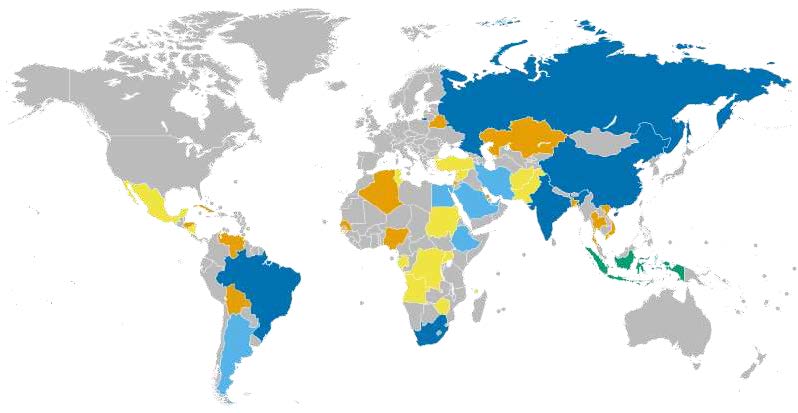
In 2007, the world’s largest economies were the U.S., China, India and Japan; whereas Brazil and Russia’s economies were equivalent in size to Germany, France and Italy.23 The central claim of the argument is based on the relative economic Figure 1: The BRICS member prior to August 2023 (dark blue) and the admitted member (light blue), applicant countries (orange), countries that expressed an interest in joining (yellow), countries that rejected an invitation offer (green). 7 sizes of the four nations, both at the present and in the near future, and the underlying presumption that economies of large size are inherently dynamic. The relative size of economies says little of the attractiveness of climate of investments. It says more about their relative capabilities and thus their power. Given their size, the parallel institutionalization of a group of the biggest economies in the world in order to reflect better the changes in the global economy in international financial institutions, gives clear power in those same institutions. Relative gains from trade by one party will benefit one party more than the other.24 This has evident implication for the balance of power in the international system.
In other words, by uniting due to their economic size, the BRICS have amplified their collective voice and potential influence on the international stage. Initially perceived as an odd set of countries, Armijo argues that their common ground lies in the pursuit of increased power, primarily in economic terms. He analyzes: “If economic size is the sine qua non of state power, then the BRICS be new major powers by the early mid-twenty-first century”, thus tipping the balance of power.25 Furthermore, their diverse energy profiles, coupled by their controlling of 30% of the world energy production, make them become less vulnerable as a group and wield together more power.26
This shifting in the balance of power and increasing multipolarity of the international system worries the west, fearing a powerful anti-western and antiliberal values coalition, led by China and Russia, “a World Without the West” as Gat (quoted in Armijo) states.27 With the material power possessed by the coalition of the BRICS, they can, as they stated remodel the international financial institutions to gain even more power. The forming of the coalition of BRICS thus make sense in a realist perspective. By combining by their economical size and material power, the BRIC-countries strengthened their voice which in turn increase their power on the international stage, even possibly challenging the world order created by the hegemon.
So, according to the realist analysis, there are two key factors that have contributed to the formation of the BRICS. The first one is the recognition that through the size of their economy they could augment their bargaining power in order the remodel the (financial) global order. This by their possession of 30% of energy production and their combined economical weight. Secondly, the institutionalization of the cooperation gave them a non- global order disturbing narrative to advance their political and economic goals in reforming the international system. Drawing on concepts as the balance of power, or material assessment and power, the realist analysis gives a clear incentive of what the key factors contributed to the formation of BRICS and the limits of its cooperation. As the next paragraph, will explain the constructivist analysis of the BRICS’ case.
The constructivist Mielniczuk
The constructivist, Mielniczuk, argues that the case involves more than material variables determining common interests among countries. According to him, it was the identities and social claims of the countries that played a crucial role in the formation of the BRICS.
He initiates his argument by providing a brief overview of the social identity for a state and its implications for the state’s interests. Drawing on Wendt, Mielniczuk underscores that identities are shaped by a structure (a structure of roles) defined by the process of interactions between actors within that structure.. 28 Social identities, as per Mielniczuk, are not predetermined or imposed on individuals by an external structure based on material factors; instead, they are formed through interactions between people. Importantly, Mielniczuk emphasizes that social identities of countries are ensured by their corporate identity—a narrative that connects people to a material territory. This narrative, independent of other states’ narratives, implies the existence of a presocial state and suggests that states define their social identities in structures as friends or rivals at the beginning of a social interaction between states. The social identity is crucial for understanding what states want, depending on the corporate narrative of the specific state, and the comprehension of that narrative by the subject can change over time. While this view is criticized as reductionistic and limiting by some within the constructivist approach, Mielniczuk, building on this, broadens the concept of the interests of states and corporate identities.29
Building on this and citing Muppidi, Mielniczuk broadens the concept of the interest of states and corporate identities. Both concepts imply the existence of multiple realities, actors living in distinct realities from each other, as their narrative is pre-socially build and build on a previous interpretation of the identity, sometimes in confrontation with others’ narratives.30 In this case interests should be expressed as ‘social claims’ which has the objective of emphasizing the normative and relational character of interests. 31 This is significant because attempts to define identities and interests always clearly cite the political-normative component since social claims, not interests, are at issue. 32 This suggests that various social imaginaries are projected onto the global arena, resulting in the very distribution of positions.33
Mielniczuk’s analysis of the BRICS social claims sheds light on the key factors that contributed to the formation of the BRICS. Over the analysis period, neither China’s nor India’s identity and social claims, nor their account of international relations, changed significantly. Both identified themselves as developing countries fighting for a just order in a world transitioning from bipolarity to multipolarity, where developing countries should have more influence.34 For example, they both criticized the unilateral policies of other countries and emphasize the need for an extension of the UN security Council. 35 Moreover, they both underlined the need to transform existing structures of economic governance. Brazil, Russia and South Africa social claims were marked by changes throughout the 1990’s until the mid-2000’s.36 The acceptance of the unilateral character of international relations by these nations in the 1990s led them to believe that liberalism would advance development and a just international order based on respect for human rights, political democracy, and free economic enterprise.37 After being disillusioned, Brazil, Russia, and South Africa were able to relate to China and India’s developmental-multipolar rhetoric by the middle of the 2000s.38
For Mielniczuk, the key to the establishment of BRICS and the starting of the negotiations was the shift from a liberal-unilateral to a developmentalmultipolar set of social demands, a true “discursive alignment.” 39 As an example, Mielniczuk emphasizes that China’s and India’s UNGA declarations contain the same elements as the joint BRICS declaration: non-intervention, technology transfer to further development, reducing poverty, reforming the Security Council, and reorganizing the institutions of global economic governance.40 Mielniczuk briefly discusses the elements that led to the discursive alignment that gave rise to the BRICS.41 First, the other BRICS countries may have been drawn into China’s sphere of influence as it emerged as a significant economic force. 42 Secondly, the discursive alignment may be a response to the fallout from the West’s 1990s economic globalization. Finally, it can be a reaction to the USA’s unilateralist practices at that same period.43
Conclusion
In conclusion, the Realist analysis highlights to factors that contributed to the formation of the BRICS. The first factor is that through the size of their economy they could augment their bargaining power in order the remodel the (financial) global order. The second factor is that the institutionalization of the cooperation gave them a non- global order disturbing narrative to advance their political and economic goals in reforming the international system. The Constructivist analysis underlines that different narratives, the countries self-perception and social claims were the reason why the BRICS formalized their cooperation in 2009.
I believe that both analyses are on point and complete each other. Where the Realist analysis focus on power relations, it does not explain why and how China and India, who have frequent confrontations, decided to work together for example. This is explained by Constructivist analysis and its concept of social claims. The Constructivist analysis though misses a crucial part: the assessment of material power, and the power of the BRICS economics. If the BRICS did not believe in their power and the impact, they could have on the global stage they wouldn’t started the cooperation, and would certainly not extend the membership to Argentina, Egypt, Ethiopia, Iran, Saudi Arabia, United Arab Emirates. On the other hand, it is probably due to the disillusion of the world order designed by liberal capitalism after the fall of the Soviet-Union that those countries now jump on the bandwagon of the BRIC, identifying themselves with the narrative proposed by them.
The magazine following this introductory piece will show a mosaic of opinions in forms of case studies. While reading them, keep in mind this theoretical framework, it will help you form your own.

Leave a Reply