
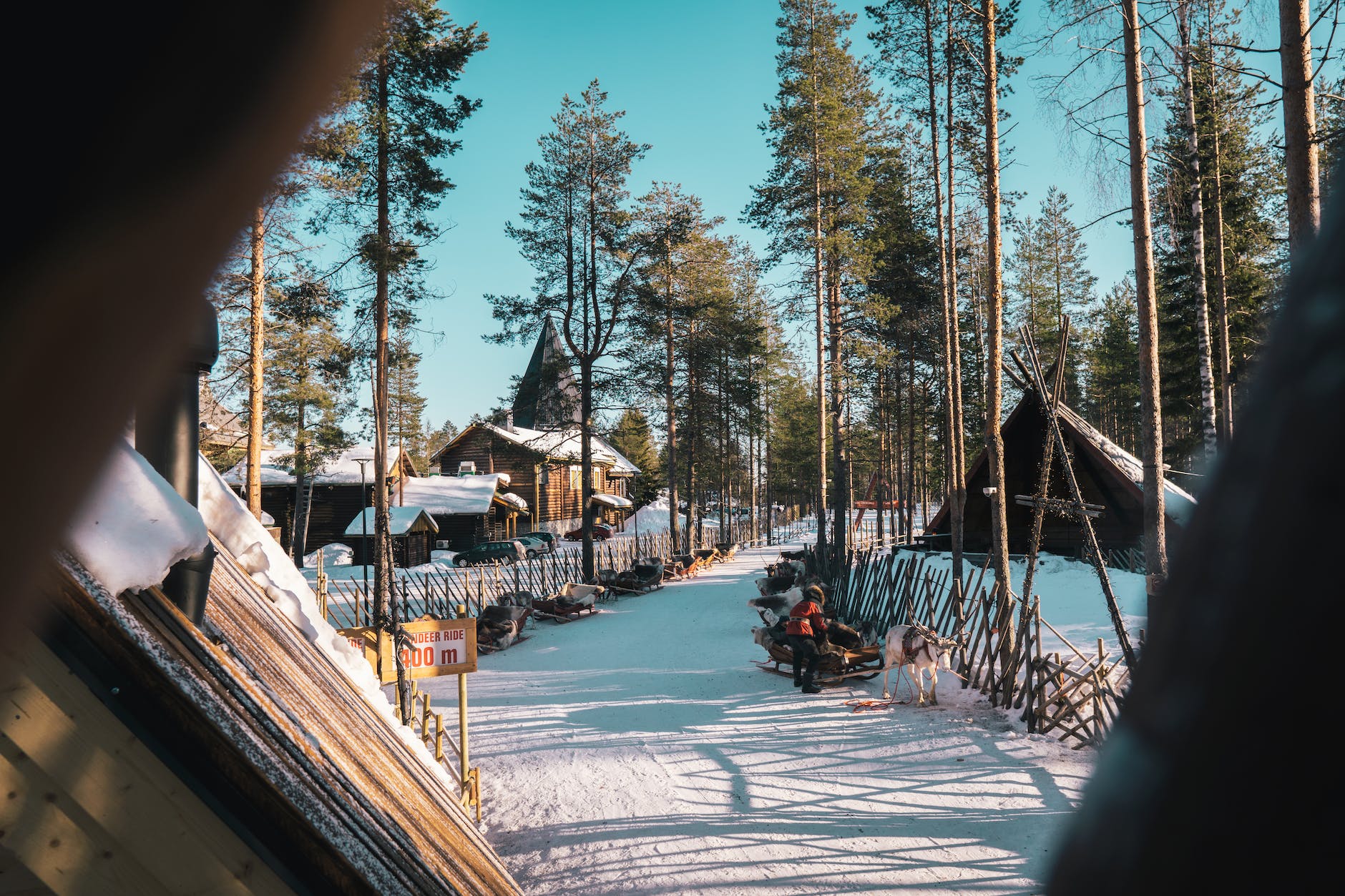
What Finland understood
With Finland’s recent entry into NATO, Finland can be described as a country seeking shelter for security reasons. Does this mean that previous tactics to ensure Finland’s security have not succeeded in sheltering the country from international security turbulence? Finland would not have succeeded to get its country into NATO if it had not created room for manoeuvre in the years leading up to its integration. It was through these manoeuvres that Finland was able to protect itself when its powerful neighbour became a threat again. As a former victim of the Soviet Union’s quest for security, Finland understood what Russia was capable of in terms of measures in its more recent security quest and what this meant for today’s international geopolitics. Hence Finland’s unprecedented decision to join NATO. In this paper we will look at how Finland deal with the security dilemma that it had with the Soviet-Union during the Cold War, and how it explains it’s decision to get into NATO. This paper is a reminder not to underestimate the security issues on a state’s agenda and an example of how a small country can act in the face of similar challenges.
How to deal with a Security Dilemma: A finnish Example
Introduction
How did Finland deal with the security dilemma that it had with the Soviet-Union, and how it explains it’s decision to get into NATO ? A possible answer is that Finland used the 1948 bilateral treaty with the Soviet Union and its securitisation discourse to create sufficient room for manoeuvre to initiate a multilateral institutional security platform (CSCE) including Northern, Western and Eastern countries, thus creating more room for manoeuvre by leading the movement. To do this, they used an adaptation of the constellation strategy. It could be described as ‘constellationisation’, a new term adapted from dr Hans Mouritzen’s constellation in The Geopolitics of Euro-Atlantic Integration. [1]It is the active use of the different constellations of a small country to create more room for manoeuvre by playing on role and status.
There is some theory written about the northern (neutral) states and their policy during the Cold War. Aryo Makko compared the behaviour of Sweden, a neutral state, and Norway, an aligned state, when it came to the Commission on Security and Cooperation in Europe (CSCE).[2] His describing of Swedish policy is similar to the term Finlandization coined by Ginsburg’s and Rubinstein in Soviet Foreign Policy towards Western Europe. Finlandization is the “behaviour of a country whose foreign policy and domestic policies are strongly conditioned by a conscious desire to mollify and maintain friendly relations with Moscow; at the expense if need be of close ties with formal allies and traditional friends or of its own sovereignty”.[3] In his book, Mouritzen, whose constellation systems will be used in this essay, also argues for a theory of ‘adaptive politics’, in which the politics of a weaker country chooses to make certain concessions to a more powerful neighbour in order to preserve a more important element of independence.[4] I argue in this essay that Finland did much more than that. So, in the pages that follow, with the written literature in mind, I will look at the margins for manoeuvre of Finland according to American sources. This, because those sources never were used in research before. Indeed, this research will make extensive use of Decimal Files 760E and 860E of the Internal Political and National Defense Affairs archive of the US archives. As one of the two superpowers, the US had an interest in keeping an eye on the neutral states in Europe. They greatly reported on, as they were trying to understand, the political intentions of the Finns during the Cold War. This is important for this paper as it has the same goal. It should be duly noted that these sources came from an anti-communist country and were therefore not neutral. This means that this article will draw its conclusion not from the sources of Finnish policies themselves, but from the American view of Finnish policies. But one might think that, since the American secret services had an interest in knowing the objectives of Finnish policy, they had no reason to colour the truth; this, to react accordingly to the actual situation on the ground.
To find an answer to the question posed, I will analyse the case study through the dominant position of the realist school of thought. This seemed to be the most appropriate choice for the period on which my case study focuses, namely the Cold War.
As my hypothesis implied, there are some theories that I will focus on during this analysis. The first of them is state security and the security dilemma/paradox, as developed by the Copenhagen School. As defined by De Graaf, security refers to the expected state of inviolability in the future.[5] The security paradox is defined as the pursuit of security by one state resulting in the obstruction of another state’s security.[6] As Finland was a neutral state in a bipolar world, it was paramount to maintain territorial security as a priority in their foreign policy. Yet the question arises: how did they deal with the security paradox between the West and the East, and between themselves and the Soviet Union?
The second concept, and the most important, is bandwagoning. Important to notice is that Securitization is essential for this second concept to hold true. From a neorealist perspective, bandwagoning is one of the two ways in which small states can exercise power, their behaviour being characterised by meeting the demands of the more powerful party.[7] The other way is by adopting a balancing behaviour, as they want to compensate for structural changes in the balance of power between the great powers; which is particularly relevant in a Cold War context.[8] Another version of the concept of bandwagoning is Mouritzen’s constellation. The constellation is what the small state belongs to. It is its basic set of relations with the strong powers in its salient environment; it may be a satellite of a larger power, it may be between two powers or in an adaptive acquiescence constellation.[9] So we might ask, where did Finland belong? When most of Europe had to choose a camp, how did Finland manage to stay neutral with the help of international connections?
The questions posed during this introduction will be answered within these chapters and will, in the conclusion of this paper, come together to form an answer to the research question: How did Finland deal with the security dilemma that it had with the Soviet-Union, and how it explains it’s decision to get into NATO ?
Finland during the after-war
Context: Security problems
Finland has had a tumultuous history with the Soviet Union: The Winter War and the Continuation War are obvious examples.[10] These wars were then still fresh in the minds of the Finns, who are, in 1948, primarily concerned about their security against such a powerful neighbour. After World War II, the victorious Soviet Union signed 18 mutual assistance treaties between 1943 and 1948 with Eastern European countries.[11] These treaties provided the USSR with interlocking legal commitments in an attempt to build a regional system.[12] Through the multitude of bilateral treaties signed, the USSR paved the way for closer military, political and economic relations in all Eastern European states.[13] This, to create a security belt for the USSR on its western borders. According to the US Department of State in 1948 there are different stages in the political incentives behind those different treaties, the latter stage was reinforcing political hegemony by integrating ex-Axis countries into the Soviet sphere.[14]
From this source, it is clear that the USSR was motivated by a discursive process of securitisation, claiming to fear a resurgent Germany, and by diplomatic reconstruction in the East, taking advantage of the post-war chaos to strengthen its political ties and hegemony in the region. One country stands out in the post-war political process of the USSR. Finland, which was in a unique position because of its sole treaty with the Soviet Union.[15]
Finland, sui generis
Finland used the bilateral treaty, which gave it a unique position in the Eastern sphere, to define a new foreign policy: non-aligned, neutral, realistic, seeking its own security. It reduced the security paradox and legitimacy to pursue this foreign policy line. This because it created a jurisdictional and political framework on which Finland could rely: it was less scared of the Soviet Union; and the Soviet Union could trust Finland again.
The Agreement of Friendship, Cooperation, and Mutual Assistance (AFCMA) signed on April 6 1948, under the auspices of a securitisation discourse, marked a turning point in relations between Finland and the USSR. The treaty, based on a Finnish draft under President Paasikivi, obliged Finland to act militarily only within its own borders and only in the event of an attack on the USSR via Finnish territory.[16] Soviet aid was to be given only by mutual agreement, which was unique in the political sphere of Eastern Europe.[17] Therefore the treaty underlined and renewed the traditional neutral and non-aligned Finnish foreign policy.[18] The Finnish approach through the treaty required a careful political play on the part of Finland: on the one hand it underlined Finland’s policy of neutrality, but on the other hand, by signing a treaty, it de facto brought the two countries closer together through diplomatic ties and “Bandwagonned” the country into the sphere of the USSR.[19] The Finns will make great use of this new constellation, as we will see later.
Finland’s special position vis-à-vis the USSR was also due to its geographical location, not to mention the areas covered by the AFMCA treaty. Finland was part of three constellations: the one with the Soviet Union because of the treaty; the one with the northern countries because of geographical factors; and the last one with Europe, and thus with the West, because of trade links and its neutral and non-aligned position. As part of the northern constellation of Europe, Finland could be used as a lever to create a Scandinavian Federation, as the US feared, and therefore proving the existence of this constellation.[20] Finland’s geographical position also strengthened economic ties between Finland and the USSR and between Finland and European countries, with the USSR using Finland to trade with NATO countries. [21] Finland is therefore economically linked to Europe and thus to the West in an important way. The two aspects of Finland’s geographical location, and the Finnish draft of the 1948 treaty, gave Finland room for manoeuvre in its project of institutional strategy in its integration with Northern Europe and the West, as we shall see.
So as we have seen, the Finns resolved the security paradox between themselves and the Soviet Union by signing a treaty with the Soviet Union. This not only guaranteed them direct security against any Soviet attempt to attack them with the treaty’s stipulation of mutual agreement for Soviet intervention in Finland, but also emphasised their military neutrality and international non-alignment. As we will see in the next chapter, they used their new position vis-à-vis the Soviet Union, between West and East, to assume a bridge-building role. This by using both an identification and an institutional strategy, and thus securing their newly acquired position by strengthening the new balance of power.
Finland in the Cold War, manoeuvring for margins
The Finns used their new base with the Soviet-Union to emphasize their neutrality, military non-alignment and quest for security in their other constellations: first by buying defensive weapons from both the West and the East.[22] It created a continuous foreign policy line thereby creating trust in their neutral position on both sides. Secondly by using their special relation with all constellations, being the sole country being into all three, to build bridges between them.
Within the logic of the Cold War international system, Finland prepared for “the worst” in a true Realist way. Between 1960 and 1962 the Finns were looking to buy military equipment.[23] It was clear that Finland needed to modernise its army by purchasing new equipment to comply with the treaty. Specifically, they looked at the West and the US to strengthen their position vis-à-vis the USSR, and to balance any purchase they made from the latter.[24] The Finns purchased American, British and Soviet military equipment between 1960 and 1963.[25] This thanks to a reinterpretation and agreement with all signatories of the 1947 peace treaty, which allowed Finland to acquire defensive guided missiles.[26] In the search for weapons and equipment, Finland made it clear that a government-to-government approach would violate its policy of neutrality and would therefore be impossible to achieve.[27] In doing so, they emphasised their international non-aligned status and defensive foreign policy, which makes them more reliable in their foreign policy intentions, acting on their words.
Finland tried, while buying military equipment, to establish closer diplomatic ties with its Nordic counterparts such as Sweden and Norway, with the blessing of the Soviet Union,[28]by playing on the northern constellation. An example of this behaviour is The Nordic Nuclear-Weapon-Free Zone proposal (NWFZ) in 1958. It was a Soviet proposal and duly promoted by Finland.[29] Kekkonen would make it one of his major projects from 1963 to 1978, primarily because of the recent Cuban crisis and the threat of an ongoing arms race between the US and the USSR.[30] In promoting this plan, Finland moved away from the Soviet-Union constellation into the Northern European constellation, using the Soviet Union’s political ambition in the Nordic countries. This manoeuvre was only possible because the USSR no longer saw Finland as a threat due to its previous manoeuvres (and treaties), for example in the area of arms and military purchases.
The NWFZ is an excellent example of the implemented institutional strategy by Finland into its foreign policy. After the 1960s, Finland tried to build bridges between the Soviet Union and the West, to establish institutionalised cooperation and interdependence.[31] One of its greatest success is the CSCE conference in Helsinki in 1975, were it played an important role in the formation and during the CSCE conference.[32] Originally a Soviet idea, it was not initially followed up due to the dubious intentions of the Soviet Union in initiating the conference, as the United States was not invited to participate. [33] It was only when the Finnish government put forward its own proposal (including the participation of North American members of NATO) that the idea of the conference was taken seriously.[34] As Europe was an area of constant tension between the two sides of the Cold War, a European security project was welcomed by many countries. The context of the Cold War détente, Finland’s timely proposal, its neutral position and diplomatic ties made the conference a success. Finland created a permanent forum with the CSCE in which it could advance the dialogue between East and West, promote cooperation and thus security. As a result, it alleviated its own security dilemma and doing its utmost to promote neutrality, all in accordance with its then well-known foreign policy line.[35] By organizing the conference, Finland became increasingly involved in European security, moving closer to the constellation of Europe, with the blessing both East and West. This because the policy of the East was to get closer to the West to guarantee and secure what they had. Those countries considered Finland’s behaviour rational and fully in line with the 1948 treaty and the traditional line of Finnish foreign policy.[36]
The organisation of the CSCE from Finland was a great diplomatic move. By moving closer to the northern states in the 1970s, by working beforehand to set up initiatives such as the NWFZ, and later by organising the CSCE conference with Sweden and Norway (as part of the Group of Ten[37]), they gained enormous leeway. They found themselves in a position where, in the three constellations in which they were part of, they were seen as an important member of the global security construct as bridge builders.[38] They used a multilateral institutional strategy by actively participating in the European security process and, at the same time, the identification strategy by taking the lead as the only country capable of leading this project: being the sole country within the special constellation between East, West and North. More impressive is that by organising the CSCE, Finland redefined the international framework of security, [39] and with that, also the one that bound it to the Soviet-Union. Finland transformed, in fifty years time, its bilateral relation with the Soviet Union into an institutional multilateral one.
Conclusion
The Finnish strategies for manoeuvres after the Second World War were quite remarkable. The Finns made firstly room for manoeuvre by solving the Cold War security paradox by adopting a policy of neutrality in the balance of power: they signed the AFMCA to protect their country from foreign threats, thus playing into the hands of the Soviet Union’s security quest discourse at the time. This not only guaranteed them direct security against any Soviet attempt to attack them with the treaty’s stipulation of a mutual agreement for Soviet intervention in Finland, but also underlined their military neutrality and international non-alignment.
Then, their second strategy to create room for manoeuvre was their policy, which could be described as ‘constellationising’, a new term adapted from Mouritzen’s constellation. It is the active use of the different constellations of a small country to create more room for manoeuvre by playing on role and status. Indeed, they used a multilateral institutional strategy by actively participating in the European security process. At the same time, they use the strategy of identification by positioning themselves, as the only country capable of leading this project, being in three crucial constellations as a bridge builder between East, West and North.
By identifying itself as a neutral country that only wants the security of Europe and international cooperation to that end, it has managed to remain neutral between the Soviet and American camps. This identity has been reinforced by actions such as the creation of the CSCE, as the country has positioned itself as a leader in the field of European security. Finland took the lead when other European countries, and to a certain extent the US and the Soviet-Union, had also the same goals. The two camps needed a trustworthy country to lead the conference so that hidden agendas could be largely be avoided. This paper has shown that Finland used a new theorized tactic and created a great number of margins for manoeuvre, and that small states can have enormous impact in Europe and in the world. This paper showed how small states can use their potential to have impact in the world and showed how Russian security that matters today mattered also in the past.

The Helsinki Final Act negotiators, the Foreign Ministers of the CSCE participating States, at the first Helsinki meeting in 1973.



Leave a Reply